

Navigating Structural Shifts and Regulatory Transformation
 The government, backed by a new popular mandate, has embarked on Economic Reform 2.0, a second generation of reforms aimed at accelerating growth and improving service delivery. Although the urgency of sweeping legislative, administrative, and procedural changes has long been debated, persistent political instability previously hindered these initiatives. Such reforms are now vital for structural transformation, technological integration, and high-quality infrastructure to minimise logistics costs, enhance regulatory efficiency, and foster a conducive investment climate by lowering the cost of capital.
The current administration enjoys a favourable atmosphere to advance these reforms without further delay. These measures will likely attract fresh investment across sectors, boosting production, creating jobs, and ultimately expanding the economic pie. Currently, nearly every sector including tourism, industry, energy, agriculture, real estate, and financial services, remains stagnant.
“Only a competent government and an efficient private sector can break this existing stagnation,” notes Avinash Bohra, Former President of the Chamber of Industries Morang.
The initial phase of reforms was shaped by liberal economic policies that laid the foundation for private sector growth. Since the 1990s, Nepal’s economic and social development has reached new heights, marking a significant departure from a state-owned economy toward a liberalised one.
The agenda for the second phase of reforms addresses the limitations and external consequences of earlier policies, tackles unfinished business from the 1990s, and responds to newly emerged economic issues. These actions are essential for achieving sustainable and inclusive growth, digitalisation, and global competitiveness.
 Economic resilience is now deemed essential given the escalating vulnerabilities stemming from climate shocks and unforeseen exogenous pressures. In this context, the new government has announced a systemic overhaul to accelerate reform initiatives. The administration’s 100-point programme, set for implementation within 100 days of assuming office on March 27, signals that these reforms are its highest priority.
While the government has yet to unveil a broad package, Finance Minister Dr. Swarnim Wagle has stated that the High-Level Economic Reform Advisory Commission Report of 2025 will serve as the guiding document. The Ministry of Finance has already formed committees to develop an action matrix for the time-bound implementation of this comprehensive report, alongside other critical documents like the 2018 Public Expenditure Review Commission Report.
Upon assuming office, Wagle emphasised the need to scrap 15 antiquated laws via parliamentary approval and announced the closure of the Department of Revenue Investigation (DRI) to bolster private sector confidence. “The private sector raised serious complaints regarding the DRI. We decided to abolish this agency as recommended by the High-Level Commission because we believe the state should not be predatory,” Wagle stated, reinforcing his commitment to fostering investment and entrepreneurship. “Our priorities remain ensuring good governance, expanding the middle class, creating employment, and developing quality infrastructure.”
The government has committed to creating an enabling environment to attract private investment, foreign direct investment, and diaspora investment.
“The upcoming budget will reorient our economic trajectory in line with the new mandate. Numerous rules, regulations, and discretionary powers will be constrained. We are moving forward with a roadmap for comprehensive reform, reflected in a budget that prioritises growth, jobs, investment, and entrepreneurship,” Wagle reiterated. “The budget will be transformative in every sense. Additionally, the protection of private enterprises is critical. We have formed a committee to amend relevant laws or use the budget to promote and protect private sector investments, including FDI and diaspora contributions.”
“Reform is not a standalone concept. It requires a holistic approach and ownership from all stakeholders. The government must first establish the right environment and clearly communicate the specific measures they intend to implement,” mentioned Shristi Gurung, promoter of the Siddhartha Cable Car Project in Butwal. “The private sector, prospective investors, and the general public must all benefit from these changes.”
Furthermore, experts suggest the government utilise the World Bank Group’s Business Ready report as a reference to identify necessary interventions. This report gauges the business enabling environment through indicators such as business entry, location (physical space and property rights), utility services, labour, financial services, international trade, taxation, dispute resolution, market competition, and insolvency. These are clustered under three pillars – regulatory frameworks, public services, and operational efficiency – and include cross-cutting themes like digital technology adoption, environmental sustainability, and gender inclusion.
In the wake of the Gen Z uprising on September 8-9, 2025, in Nepal, which protested corruption and malgovernance while exposing a weak, vulnerable system, administrative inefficiencies, and political coercion, the new government must act swiftly. It must jumpstart efforts to fix administrative failings, strengthen governance, tighten regulations to close existing loopholes, and implement immediate ‘stroke of the pen’ reforms.
Lost momentum
Nepal implemented landmark reforms following the political shifts of the 1990s. The government of that era executed reforms in a mission-driven manner, ending the licensing regime and opening the door to private sector investment. During this period, the state focused on prudent regulation, infrastructure development, and social progress by expanding health and education services to every corner of the country. This transformative shift in economic liberalisation and financial sector growth was fuelled by the restoration of multiparty democracy.
 New legislation was enacted to foster private sector expansion, including the Privatisation Act (1994), the Foreign Investment and Technology Transfer Act (1992), and the Industrial Enterprise Act (1992). The financial sector also evolved in alignment with these policies. Following the introduction of these laws, several multinational companies entered Nepal with capital and technology, including Dabur, Unilever, Colgate-Palmolive, Statkraft, and Ncell among others. Additionally, several joint-venture banks such as Nepal SBI and Himalayan Bank were established, alongside insurance providers like Life Insurance Corporation (Nepal) and MetLife.
As momentum grew, Nepal undertook significant legal reforms concerning income tax, labour, and electricity. Substantial development in the electricity sector was driven by the state-owned Nepal Electricity Authority (NEA) guaranteeing power purchases, which successfully lured private sector capital into hydropower development.
Initial reforms were driven by a global wave of liberalisation, guided by the principle of ‘the bigger the market, the better’. Back then, the rise of liberal political parties following the people’s movement pushed Nepal’s agenda from a state-owned economy toward a market-led one. Former Finance Minister Dr. Yuba Raj Khatiwada likened this liberalisation and privatisation to the opening of a dam. It propelled growth, yet limitations surfaced due to the lack of a proper framework for privatisation and insufficient attention to the agricultural sector.
Despite these challenges, Nepal’s key reforms to augment productivity including the foreign investment environment, banking sector reforms, capital market development, agricultural deregulation, financial sector privatisation, tax reforms, legal systems, and property rights, have been highly applauded. However, research and development (R&D) was given the least priority. Unfortunately, the momentum of these reforms lost ground due to political instability and armed conflict.
Today, procedural hurdles, delays, red tape, and administrative inefficiencies persist. An insular mindset among state actors, an overreaching government, cronyism, and regulatory capture predominantly discourage private sector investment. Reform initiatives are now crucial to eradicate these barriers and create a level playing field for all. In practice, a licensing regime still exists in Nepal, where the nexus among political leaders, bureaucrats, and certain private sector players has distorted fair business practices and left investment protection largely ignored.
Structural challenges in the economy
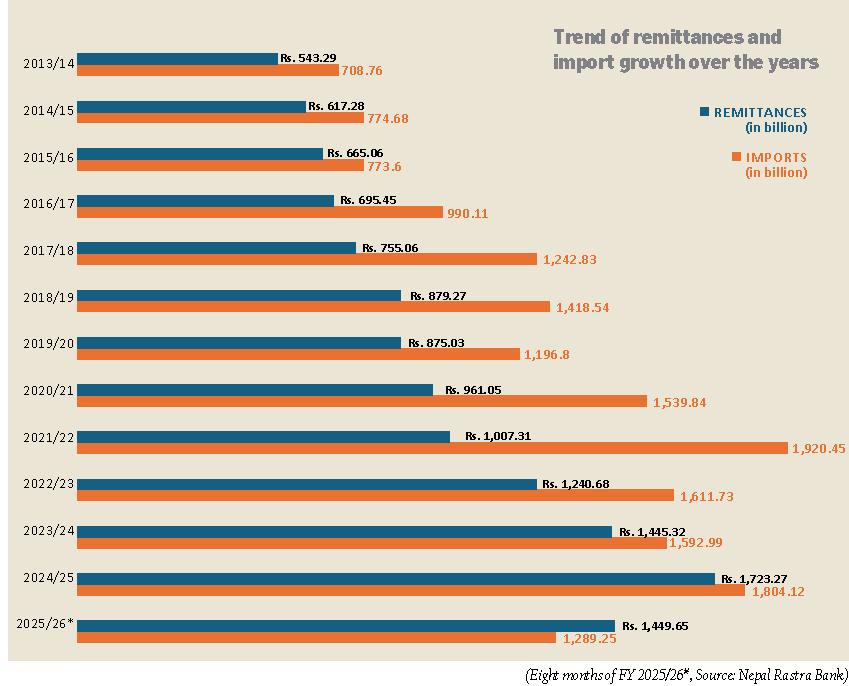
Nepal’s economy is primarily import-driven, with imports and consumption sustained by a steady influx of remittances from labour destinations abroad. This reliance is often described as a form of ‘Dutch disease’ for Nepal. It provides a convenient cushion for foreign exchange reserves, allowing the government to maintain stable macroeconomic parameters without addressing underlying structural issues.
The influx of remittances has fuelled imports and consumption, and this heavy dependence on foreign goods not only distorts the domestic production base but also exerts significant pressure on the current account balance. Nepal frequently faces the challenge of twin deficits – a budget deficit and a current account deficit – which necessitates reforms in domestic production, broad-based taxation, and competitiveness enhancement, among other areas.
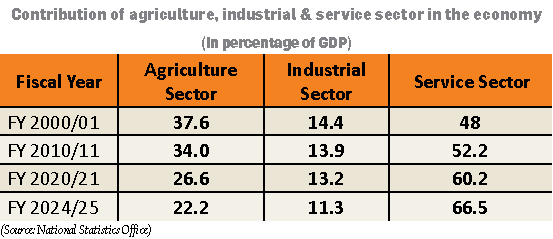
The service sector’s contribution to the economy has expanded over the years. Conversely, the other two major sectors, agriculture and industry, have remained stagnant. Agriculture and the industrial sector contribute 22.2% and 11.3%, respectively, to the country’s Gross Domestic Product (GDP). These figures have remained unchanged for years, exacerbating economic vulnerability through low productivity, sluggish growth, and frequent high inflation caused by a reliance on foreign goods and services.
While the contribution of agriculture is declining due to static growth over time, a large portion of the workforce remains involved in the sector. The primary challenge lies in transitioning this workforce from agriculture to industry and services while simultaneously mechanising farming. A smaller labour force paired with higher productivity is essential to making agriculture competitive.
Secondly, Nepal faces numerous hurdles regarding industrialisation. The country has experienced premature deindustrialisation, leaping from an agrarian economy to a service-oriented one without establishing a strong industrial base. Consequently, industrial production remains low, and unemployment has become a pressing challenge for the nation.
 The agricultural sector remains underdeveloped due to a lack of supporting facilities, such as irrigation, advanced seeds, fertilisers, mechanisation, extension services, and agro-market development, including cold storage. Additionally, a lack of commercialisation, the exclusion of foreign capital and technology from primary production, often under the guise of safeguarding farmers, and land fragmentation have hindered sectoral growth.
Nepal’s policymakers have frequently struggled with a paradox: whether to focus on light manufacturing and emerging services like IT or on labour-intensive heavy industries. While the private sector has begun identifying and acting on potential opportunities, integration into the global value chain is still missing. Nepal has lost opportunities amidst this dilemma and blurred focus. Meanwhile, unstable governments and policy uncertainty have prevented the country from choosing the right economic anchors.
Transforming regulators as facilitators
Regulatory barriers are frequently cited as the primary obstacle to private sector development. While regulatory agencies are meant to set the rules of the game with public interest at the centre, Nepal’s private sector has often experienced regulatory hurdles and capture rather than facilitation. Influential players, often cronies of ruling political leaders, have captured these agencies to manipulate the rules. Those outside this inner circle face systemic difficulties, reflecting a predatory state environment. Instead of safeguarding consumers, some regulatory agencies have colluded with businesses, seeking undue advantages from market participants.
“The new government must ensure prudent regulation and a level playing field for everyone,” says Nurrani Dhungel, founder of Mother’s Magic, a startup based in Hetauda, Makawanpur. “The ethics and integrity of employees within these regulatory agencies remain a major issue in the current context.”
Large business houses and conglomerates maintain a vested interest in the political appointments of leadership at agencies such as Nepal Rastra Bank, Securities Board of Nepal, Nepal Insurance Authority, Nepal Telecommunications Authority, Civil Aviation Authority of Nepal, and Nepal Electricity Regulatory Commission (NERC). Historically, these top-level appointments have often been mired in controversy. Consequently, regulatory governance has become one of the most pressing issues in the country.
“Regulatory agencies must act as effective facilitators for private sector development by setting unbiased and fair rules. The stability and growth of any sector depend on a regulatory environment that is essential for gaining public trust,” Dhungel adds.
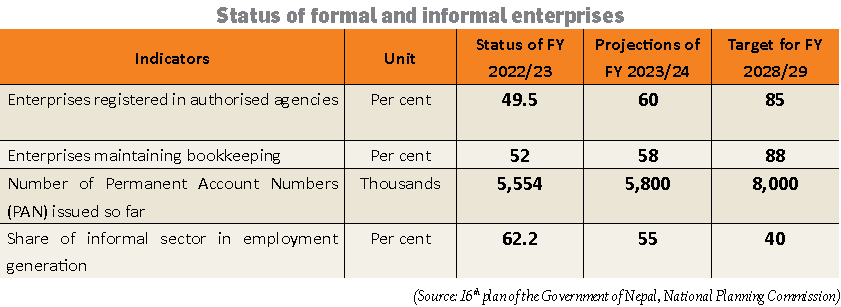
On the other hand, a pervasive mentality of creating obstacles for the private sector persists. Mohan Katwal, Vice President of the Federation of Nepal Cottage and Small Industries (FNCSI), noted that a large number of enterprises operate informally due to these hassles. Citing the example of iron and steel grill industries, which were barred from operating in core urban areas, he explained the dilemma: “Such industries often operate without registration, but when we attempt to register and formalise our businesses, authorities demand numerous compliances, such as relocating to the outskirts of town or conducting environmental assessments.” He added, “These rules often overlook practicality, setting standards that small enterprises simply cannot meet. Consequently, many businesses choose to remain informal.”
Ultimately, decisions made in political hubs that are detached from ground realities remain a major constraint for entrepreneurship development.
Entrepreneurs emphasise that the government should focus on optimising the country’s inherent potential, particularly within Nepal’s tourism sector. They remain optimistic about future prospects, especially as Prime Minister Balen Shah has prioritised unleashing tourism potential and positioning Nepal as one of the world’s most attractive destinations.
“Human resource skill development is a pertinent challenge in the hospitality sector. Primarily, workers take jobs to gather experience before migrating abroad. The hospitality sector in Nepal essentially serves as a launchpad or learning platform for them to scale up their careers elsewhere,” noted Laxman Baral, President of the Restaurant and Bar Association of Nepal (REBAN), Pokhara.
Private sector development and employment creation
Alongside regulatory reforms, the government’s efforts to further liberalise Nepal’s economy involve opening up services, particularly in professional fields like accounting, auditing, reconciliation, settlement, and legal services linked with IT. Without opening business process outsourcing, we can neither create domestic employment for our youth nor encourage them toward entrepreneurship. According to Nara Bahadur Thapa, an economist and Former Executive Director of Nepal Rastra Bank, if we want to provide jobs and earn foreign currency by engaging the millions of youths who have migrated abroad or remain unemployed at home, we must open these sectors.
“At present, consulting services remain restricted in Nepal. We should encourage the so-called Big Four – KPMG, Ernst & Young, PwC, and Deloitte – to open offices in Nepal, where youths with skills in accounting, commerce, and IT can find employment and enhance their capabilities.”
Rather than relying on exceptions, establishing a general rule will encourage major consulting firms to enter Nepal. By opening offices to perform back-office operations for other countries, they will employ our local youth.
“This will contribute to the modernisation of Nepal’s economy. A few decades ago, by introducing three joint venture banks, we triggered a revolution in the banking sector. A similar revolution must now be brought to the services sector,” he remarked.
Moreover, industrialists and entrepreneurs have been advocating for an ‘industry-first’ mindset within the government. Currently, the state appears more concentrated on revenue collection than on supporting industrial production.
“The government must shift away from its revenue-centric mindset. The paradox of prioritising taxes over industry has significant consequences for Nepal’s industrial development,” stated Devendra Hamal, Chairperson of Dinesh Soap & Household Industries Private Limited in Kailali, Sudurpashchim Province. “How can domestic industries remain competitive when the government levies higher taxes on intermediate goods than on finished products?”
In addition, incentives established by the Industrial Enterprises Act and the Special Economic Zone Act are frequently scrapped or revised by the annual Finance Act issued alongside the fiscal budget.
Most importantly, the corporatisation of privately run businesses should be prioritised. The government should announce necessary facilitation and incentives to motivate private limited companies to go public, which would simultaneously benefit the public shareholders who help raise capital. The Ministry of Finance (MoF), NRB, and SEBON are the most critical institutions for shaping the policies and regulatory environment needed to foster corporatisation.
In the past, the policy requiring banks and financial institutions to issue 30% of their shares to the public significantly contributed to the development of Nepal’s capital market. It is argued that had similar provisions been included in the Foreign Investment and Technology Transfer Act (FITTA) and the Industrial Enterprise Act, the capital market would be even stronger and more diversified today. Moving forward, the NRB could introduce mandatory rules requiring borrowers of large-scale loans to become public companies, thereby developing a corporate culture and optimising potential by expanding firm sizes.
Use of technology
Technological improvements, along with technology-related and structural policies, are the primary drivers of Total Factor Productivity (TFP). The government can advance growth by reforming these specific policy areas.
Historically, the acceleration of technological revolutions since the 1850s has fundamentally shifted production and employment. Rising labour wages benefited people globally as advancements in four key fronts transformed the world: energy (transitioning from steam to electric), transportation (trains, automobiles, and aviation), communication (telephones, computers, the internet, and mobile phones), and health and sanitation (the development of medical services and indoor running water).
Against this backdrop, Nepal must continuously and effectively improve its business environment. It is important to note that technological and structural policies remain under the direct control of the authorities. Despite this, previous governments failed to effectively implement initiatives like the Digital Nepal Framework 2019, and authorities have delayed decisions regarding the rollout of 5G. In 2017, TFP contributed a peak of 8.2% to a total GDP growth of 8.98%. Analysing the period between 2015 and 2016, the average contribution of TFP was 3.32%, which remains substantially higher than the contributions of capital (0.51%) and labour (0.38%).
From this perspective, Nepal’s growth over the past decade has been driven largely by Total Factor Productivity rather than a massive accumulation of capital or labour. Analysing the trend from 2016 to 2025 reveals that labour’s contribution has been particularly low, averaging just 0.04% between 2016 and 2020 before marginally improving to 0.7% during 2021-2025.
Labour’s role remains weak and unstable. While the average pattern of capital contribution is increasing, its role remains secondary. In this regard, TFP is dominant but volatile. In the last three years – 2023, 2024, and 2025 – TFP stood at 1.05%, 2.72%, and 3.59%, respectively. If the government aspires to high growth, reforms in technological and structural policies, where authorities can play a decisive role, are mandatory.
Nepal currently lags in both the use and development of technology. In the present context of a ‘techno-feudal’ world, technological development often benefits only a few tech giants rather than everyone, including those at the grassroots. Conversely, the technologies developed over the 150 years between 1850 and 2000 transformed the globe, benefiting every member of society. Given this context, next-generation economic reforms require not just building readiness for technology adaptation, but also investing in the acquisition of new technologies and supporting research and development.
“Technology is the linchpin in leveraging production and investment. The rapid development of new technologies has fundamentally changed the landscape of production, employment, and service delivery,” said Dr. Om Prakash Mishra, President of the NYEF Nepalgunj Chapter.
Quality infrastructure
Poor infrastructure and insufficient investment in physical assets have long constrained rapid economic development. Nepal has been unable to achieve sustained, double-digit growth for a five-to-ten-year period largely due to these inadequacies.
High logistics and trade costs have hindered economic competitiveness, discouraging private investment. Consequently, second-generation reforms must focus on developing sustainable and resilient quality infrastructure. Given the shrinking revenue base and increasing public debt, the government should adopt diverse models, including Public-Private Partnerships (PPP). The overarching goal of infrastructure development is to provide multiplier benefits to the economy by creating new investment avenues, generating employment, enhancing efficiency, and improving overall service delivery and public wellbeing.
Simultaneously, public expenditure reform is essential for scientific resource allocation and for improving the implementation capacity necessary to complete public projects on time and within budget. Past anomalies in public procurement led to time and cost overruns in nearly all infrastructure projects. Furthermore, good governance activists emphasise that the cost efficiency and quality control of private-sector projects, particularly in energy, require closer scrutiny to ensure the efficient utilisation of resources.
“Critical infrastructures, such as lifeline roads and trade facilities, play a vital role in supply chain management, production, and service delivery,” stated Biswo Karan Jain, an entrepreneur from Birgunj.
Even relatively small trade infrastructures, such as Integrated Check Posts (ICPs), have significantly reduced customs clearance times and expedited cross-border trade. These facilities have lowered trade costs, enhanced predictability, and streamlined the supply of essential goods and industrial raw materials.
Given the substantial infrastructure gap in Nepal, studies suggest an annual investment of 15% of the GDP is required. However, low capital expenditure, weak project implementation, and the inability to effectively utilise public-private partnerships have left a massive financing void. The new government has vowed that inertia in development and public service delivery will no longer be tolerated.
To facilitate major projects, the administration is prioritising the removal of hurdles related to land acquisition, forest clearance, and tree felling. High-quality infrastructure remains essential for achieving overall development targets and unleashing the economy’s optimal potential.
——————————–
 Regulatory reforms should facilitate the seamless initiation, operation and scaling of businesses while maintaining robust protections for consumers and the environment. For entrepreneurs in manufacturing and personal care, the most critical advancements involve streamlined licensing, expedited approvals, predictable tax frameworks and uniform product standards applied equitably to all market participants.
To establish a level playing field, the government should implement several practical measures. First, import duties and domestic taxes must be structured so that local producers are not disadvantaged by low-cost imports that bypass the compliance and logistics burdens borne domestically. Second, protocols for product testing, labelling and certification should be transparent, affordable and accessible within Nepal to prevent startups from facing prohibitive costs or delays in proving compliance. Third, enforcement must remain consistent for both local and imported goods to ensure quality and safety standards are universally upheld.
For burgeoning enterprises, access to capital, industrial land and technical expertise is equally vital. A fair ecosystem is one where success is determined by product quality, innovation and execution, not the ability to navigate regulatory complexity. By reducing administrative friction and rewarding compliance, policy can effectively drive local value addition, job creation and sustainable competitiveness. Such reforms will empower Nepal’s entrepreneurs to scale with confidence while safeguarding genuine local production.
Nurrani Dhungel
Founder, Mother’s Magic
——————————–
 Human resource skill development is a pertinent challenge in the hospitality sector. Primarily, workers take jobs to gather experience before migrating abroad. The hospitality sector in Nepal essentially serves as a launchpad or learning platform for them to scale up their careers elsewhere
Laxman Baral
President, Restaurant and Bar Association of Nepal (REBAN), Pokhara
——————————–
 The government must shift away from its revenue-centric mindset. The paradox of prioritising taxes over industry has significant consequences for Nepal’s industrial development. How can domestic industries remain competitive when the government levies higher taxes on intermediate goods than on finished products?
Devendra Hamal
Chairperson, Dinesh Soap & Household Industries Private Limited
——————————–
 Technology is the linchpin in leveraging production and investment. The rapid development of new technologies has fundamentally changed the landscape of production, employment, and service delivery.
Dr. Om Prakash Mishra
President, NYEF Nepalgunj Chapter
——————————–
 “The private sector raised serious complaints regarding the DRI. We decided to abolish this agency as recommended by the High-Level Commission because we believe the state should not be predatory. Our priorities remain ensuring good governance, expanding the middle class, creating employment, and developing quality infrastructure.”
Swarnim Wagle
Minister for Finance
——————————–
Critical infrastructures, such as lifeline roads and trade facilities, play a vital role in supply chain management, production, and service delivery. Even relatively small trade infrastructures, such as Integrated Check Posts (ICPs), have significantly reduced customs clearance times and expedited cross-border trade. These facilities have lowered trade costs, enhanced predictability, and streamlined the supply of essential goods and industrial raw materials.
Biswo Karan Jain
Entrepreneur based in Birgunj

