
How disruptive technologies are reshaping jobs and workforce planning

The nature of jobs has been changing with evolving disruptive technologies. Undoubtedly, technology has played a critical role in displacing workers or transitioning them from one job nature to another. Moving ahead from industrial automation and the digitalisation of clerical and manual tasks, robotics has transformed production processes, service delivery, and office work.
The development of the platform economy has been transitioning the workforce to grab new opportunities across different sectors. Organisations have been closely watching, navigating, and dealing with this changing nature of jobs. It has, in fact, brought both opportunities and challenges to organisations. New technologies have been providing necessary impetus to organisational efficiency and growth, but at the same time, there have been challenges for workforce planning and redesigning jobs in new settings. On the other hand, these technologies are changing rapidly.
Technology adaptation, skills, and the capacity to purchase technology give no excuse when one has to compete. For private sector organisations, the entire objective is revenue and growth. At large, when organisations remain stationary, the national economy is deprived of catching momentum.
It is believed that organisations always focus on efficiency, agility, and competency to move forward. Jobs demand competency for achieving desired performance. Organisations need an open mindset, agile skillsets, and the right toolkits to adapt to a changing environment.
Navigating workforce planning in the age of AI
In organisations, workforce planning is simply a systematic analysis of human resource needs to ensure the correct number of employees with the required skills are available when needed. Workforce planning is the most critical human resource management challenge in organisations, considering changing demographics, migration, and the new economy created through the use of disruptive technologies.
Much like how industrial automation displaced many jobs by altering their very nature, Artificial Intelligence (AI) could also bring substantive changes to standardised work, according to Udaya Raj Paudel, Founder and Principal of Quest International College.
“AI has surprised many of us. It has become more advanced in its second wave (generative) compared to its first (predictive). The third wave
(agentic or autonomous) AI systems reportedly break down complex goals, make independent decisions, use multiple tools, and execute multi-step workflows without human support.”
Thus, the nature of jobs will change rapidly, forcing organisations into proper workforce planning as many jobs become dispensable or automated by technology. Moreover, organisations might require prompt engineers alongside content creators, opines Subita Kapali, an HR professional.
“In the new settings, it seems organisations have to deal with basic cybersecurity hygiene, data governance and ethics, social media policies, and other related matters.”
Modern HRM relies on meaningful job design, employee experience, recognition, career progression, corporate titles, achievement, and purpose as essential tools for, motivating, and retaining talent.
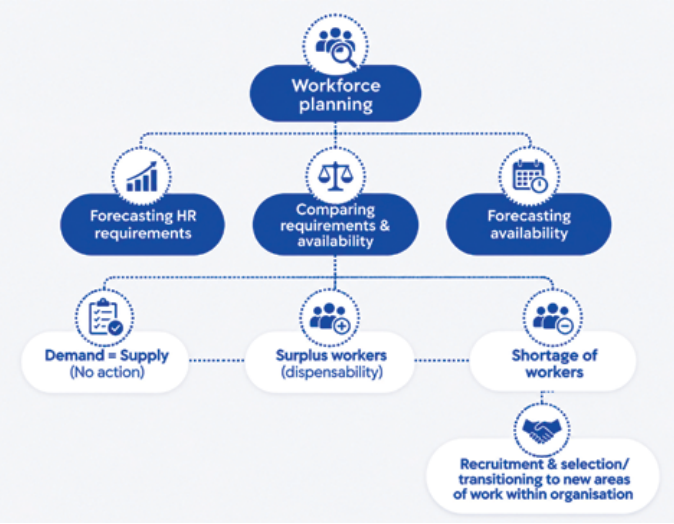
Optimising the workforce is always crucial for organisational growth. However, organisational leaders are still navigating the extent to which disruptive technologies are suitable for particular sectors, as well as their capacity to purchase and adopt them. “Displacement of jobs in the construction sector might take longer, but advanced technologies, such as geotechnologies, site characterisation, and subsurface mapping, are making the work much easier compared to the past,” remarked Deepak Shrestha, Vice President of Nepal Chamber of Commerce.
Moreover, organisational readiness, adaptability (on both the service provider and service seeker sides), trust, and the cost of technology affect its introduction. The process could take time and require a phased induction.
Citing Parkinson’s Law, Diwas Karki, Chief of Human Resources at Nabil Bank, opined that when a single job is assigned to two employees, the work expands to keep both busy rather than getting done twice as fast. Parkinson’s Law clearly illustrates that effective workforce planning and job redesigning are crucial for addressing overstaffing.
Against this backdrop, long-term skillset requirement forecasting and scientific planning have been given high emphasis.
Industry leaders have underlined that Nepal has been facing a polarisation of unemployment and underemployment. Government policy alone can determine which sectors will grow in the next 20- 30 years, allowing industry and academia to focus on relevant skill development so that organisations can hire the right people at the right time, according to Bhim Ghimire, National Vice President of the Confederation of Nepalese Industries.
“In some sectors, opportunities exist, however, we have not been able to find the right people in the domestic labour market when needed. There must be an integrated approach, and broader national policies must orient toward priority sectors.”
The availability of a workforce with the required skills gives organisations the confidence to explore and expand.
Redesigning jobs and rethinking modern HRM
The changing nature of work is also challenging traditional human resource management. Modern HRM increasingly emphasises meaningful job design, employee experience, recognition, career progression, corporate titles, achievement, and purpose as tools for attracting, motivating, and retaining talent. Meanwhile, workers accustomed to the autonomy and flexibility of gig work or consultancy may find conventional organisational structures, managerial hierarchies, and workplace discipline less attractive, or difficult to adapt to, which has posed challenges for organisations.
A recent example is Nepal’s media industry, where established corporate media houses face a shortage of journalists and content creators. Platforms like Meta, YouTube, and others have enabled content creators to work individually or in small teams. Consequently, many large media outlets have downsized.
This trend is occurring across many sectors. Organisations are moving away from maintaining end-to-end inventories for all functions, considering management costs, required workforce, and various other reasons. “We have started outsourcing many of our products and services as specialised firms enter the market with the strength to supply commodities and services of the required standards,” stated Nabin Khati, Group HR Head at Panchakanya Group.
Thus, a company’s use of technology and material supply strategy displaces or transitions the workforce into other domains. It is equally tough for workers to navigate these challenges and opportunities, while reskilling and upskilling to remain dynamic and easily transition to other sectors.
This raises an important question for Nepal: What will the future of jobs look like in an economy that simultaneously needs to create employment, export labour, and prepare its workforce for an increasingly technology-driven world?
Redesigning a job is not an easy task. It must undergo the rigorous process of job analysis. Job analysis is the research component of Human Resource Management. It serves as the overarching investigative process, yielding two primary documents: the job description (which details what the job entails) and the job specification (which details who is qualified to do it). Job specification is more concerned with the financial worth of the job. Every job consists of content, context, and human requirements. Content is associated with tasks, duties, behaviour, authority, output, performance, and standards. Similarly, context is more concerned with the organisational setting like equipment, physical and social work conditions, work schedules, and workplace environment/ hygiene, among others. Further, human requirements encompass knowledge, skills, abilities, experience, and personal attributes.
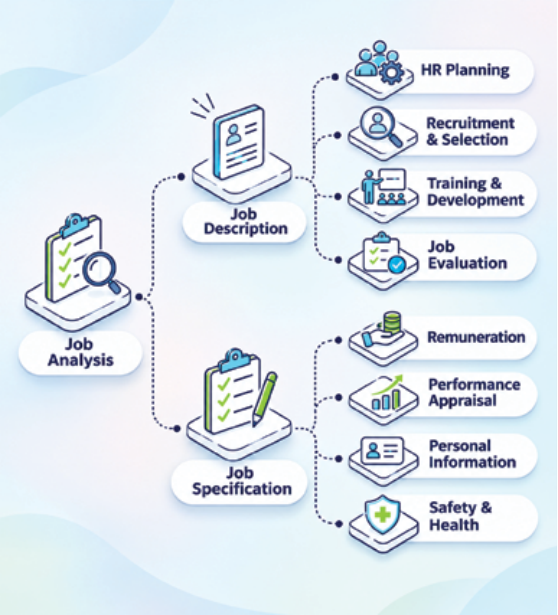
The job description (JD), which comprises Key Result Areas (KRAs), Objectives and Key Results (OKRs), and Key Performance Indicators (KPIs), is the output of job analysis. Job analysis focuses on evaluating existing jobs to define what will be done, breaking down the role to create foundational HR documents. Experts consider three Key Result Areas (KRAs) ideal for a single role, with an optimum of five duties per KRA. If more KRAs and duties are included, the role loses its focus.
When redesigning jobs, organisations must emphasise where employee motivation (intrinsic satisfaction) originates. Herzberg’s Two-Factor Theory classifies factors into motivators and hygiene factors regarding job satisfaction or dissatisfaction. Salaries, perks, working conditions, policies, supervision, and relationships are classified as hygiene factors. They are supportive but not the primary determinants of job satisfaction. True job satisfaction derives from achievement, position (title), responsibilities, personal interest, and advancement (growth), among other factors.
In this context, modern HRM increasingly relies on meaningful job design, employee experience, recognition, career progression, corporate titles, achievement, and purpose as essential tools for attracting, motivating, and retaining talent.
How technology redesigns rather than replaces jobs
Experts argue that technology redesigns modern jobs rather than simply replacing them, automating routine tasks while elevating roles that require human judgement, empathy, and problem-solving. Modern jobs are the creation of technologies, born from inventions in energy (from the steam engine to electricity), transport (railways, aviation, maritime, and space), communication technology (telephone, computer, internet, and new internet innovations), and other fields.
The landscape is changing, but it does not mean humans are losing jobs. They are aligning with new roles and exploring evolving trends.
Innovations over the years in healthcare, sanitation, and education, among others, have increased human longevity, eradicated poverty, eased human life, and motivated people toward research, design, and innovation alongside economic activities. Artificial intelligence is increasingly seen as a disruptive force, with significant implications for the future of jobs.
This leads people to question what types of jobs are dispensable or disposable in organisations across every sector, given that AI and cutting-edge technologies are impacting all industries, though to varying extents. This impact affects unskilled, skilled, highly skilled, and managerial positions alike. Around the world, individuals with a learning mindset are navigating new opportunities and acquiring dynamic skill sets.
When machines start performing tasks previously thought to be exclusive to humans, they do not just displace people from those roles, they also create new opportunities. Taking banking services as an example, access was limited to a few when operations were manual. Digitalisation, driven by computers and the internet, became imperative for expanding service footprints down to every municipality.
Currently, mobile banking has made access effortless for anyone familiar with a smartphone. Thus, manual and clerical jobs are automated, while new jobs are generated alongside the expansion of services. Banks and financial institutions (BFIs) are now able to serve large numbers of clients, maintain their records, and offer the easiest, most accessible services.
Older-generation employees who were unable to learn new skill sets opted for the voluntary retirement schemes (VRS) launched by government-owned banks in 2002.
Evolving roles and the division of human-AI work
There has been an ongoing debate about whether technology could replace jobs; simply put, it does not. However, the human resources displaced from dispensable jobs due to the introduction of technology should reskill, upskill, and transition to relevant domains within organisations or sectors of their interest. This has been happening for decades, according to Santosh Gyawali, a development sector professional with a wealth of experience. Initially, people worked in agriculture and livestock. Then, alongside industrialisation in Europe from the mid-18th century, the workforce in agriculture gradually transitioned to the industrial sector, and later to the service sectors from both agriculture and industry.
Technology is also challenging the conventional boundaries between human and machine capabilities. Activities such as web design, report writing, content production, translation, data processing, music composition, and other creative or knowledge-based tasks that once depended heavily on specialised human skills can increasingly be supported or performed by AI-enabled tools. The question is therefore no longer simply whether technology will replace jobs, but how the division of work between humans and technology will evolve.
“Human resources transition into new and evolving job roles. The landscape is changing, but it does not mean humans are losing jobs. They are aligning with new roles and exploring evolving trends,” according to Gyawali.
Jobs are not static or linear. They are constantly evolving in terms of roles, responsibilities, and performance expectations. New technologies are advancing faster than traditional, linear approaches can keep pace with. The rapid pace of technological change has also created uncertainty for many in navigating the future of jobs and careers.
The HRM Nepal Roundtable on future of jobs
The HRM Nepal has organised a roundtable among industry leaders, academia, HR professionals, and other relevant stakeholders to examine the future of work in Nepal across both formal/regulated and informal sectors.
The discussion explored how Nepal can prepare its workforce, organisations, and institutions for a labour market in which technology, skills, demographics, and worker preferences are changing simultaneously. The key areas of discussion centred on AI and the future of jobs, skills for the future, job design and employee motivation, human–AI collaboration, formal and informal employment, and policy and institutional readiness. The discussion also focused on how organisations, educational institutions, and policymakers must rethink job roles, competencies, and workforce development to remain relevant in an evolving employment landscape.
Welcoming the distinguished guests, Mohan Raj Ojha, founder of Growth Sellers Pvt. Ltd. and publisher of The HRM Nepal, underlined that disruptive technologies have changed the landscape of workforce planning and the nature of jobs, urging a vibrant discussion. Moving forward, panellists actively engaged in rich discussions.

Bhim Ghimire, National Vice President of the Confederation of Nepalese Industries (CNI), encouraged organisations not to view AI as a threat. He observed that even developed countries with advanced AI capabilities continue to require both skilled and unskilled labour, including talent from developing nations. The underlying challenge is the mismatch between labour supply and market demand. He emphasised the need to develop educational curricula that better align with industry requirements and called for greater collaboration with the government. He also stressed the importance of practical industry exposure and highlighted that policy adaptation must be a priority.

Similarly, Deepak Shrestha, Vice President of Nepal Chamber of Commerce, identified workforce planning as a significant challenge for organisations. He observed that the current market requires more than conventional HR and managerial expertise. Approximately 50% of the HR-related workforce requirements he encounters involve individuals with practical production and business knowledge. He stressed the importance of understanding business operations when planning and developing the workforce.
Shrestha expressed concern that the Ministry of Labour has traditionally focused more on unskilled labour migration, with comparatively less attention given to skilled professionals leaving the country. He emphasised the need for better workforce planning, particularly in sectors such as IT, engineering, and medicine. He further noted that these professions should be recognised not merely as employment categories, but as specialised careers requiring appropriate recognition, development opportunities, and professional respect. He also highlighted that HR as a professional function remains relatively underdeveloped in Nepal.

Another industry sector leader, Babu Kaji Karki, Executive Committee Member and Vice-Chair of the Employers’ Council of the Federation of Nepalese Chambers of Commerce and Industry (FNCCI), pointed out the paradox of high unemployment existing alongside a shortage of skilled labour in Nepal. Although job seekers are available, many lack the specific competencies required by employers. He also identified employee retention, a lack of self-motivation, and limited outcome-oriented thinking as major workforce challenges. While AI will undoubtedly transform the employment landscape, he believes its immediate impact in Nepal may be limited due to inadequate technological infrastructure and advancement compared to developed nations.
Karki further stated that discussions surrounding the future of jobs must extend beyond the organisational level and be addressed from a broader national perspective. He emphasised the need for the government to develop a clear five-year workforce and employment plan, noting the current lack of clarity in national HR planning. He also observed that organisations with the necessary resources, capacity, and willingness to change will be better positioned to adapt, while others may struggle. He stressed that the government must actively engage with industries, understand their requirements, and demonstrate the tangible value of policy interventions.

In his remarks, Shankhar Ghimire, Executive Director of Asian Pharmaceuticals Pvt. Ltd., discussed the role of AI in improving accuracy and reducing human error, particularly in sectors such as pharmaceutical manufacturing. However, he emphasised that AI would complement rather than completely replace human expertise. He shared that their approximately 80 pharmacists are required to undergo AI training, as technological competency is becoming essential for professional excellence. He stressed the growing need for HR professionals who possess both human resource management expertise and an understanding of AI.
Ghimire underscored the need to eliminate intermediaries and promote greater respect for work across all professions. He observed that many individuals view employment in Nepal as a short-term arrangement, with overseas employment remaining their ultimate objective. Citing the example of pharmacists who would rather take up jobs at gas stations in the United States than pursue pharmacy careers in Nepal, he highlighted the mismatch among professional qualifications, domestic opportunities, compensation, and career aspirations. He stressed the importance of creating an environment where skilled professionals are valued and can build sustainable careers within the country.

Likewise, Subita Kapali, a senior HR professional, highlighted how the workforce has continuously evolved alongside technological advancements. Drawing parallels between the transition from handwriting to typewriters and computers, she noted that jobs and HR practices have undergone similar transformations, moving from manual leave forms to integrated HRIS systems. She described AI as an enabler and amplifier rather than merely a replacement for existing processes. Organisations must identify opportunities to leverage AI and adapt to emerging technologies, as failure to evolve could render them obsolete. She emphasised that adaptability is essential for moving forward.
Regarding the redesigning of jobs, she observed that while the fundamental responsibilities associated with certain roles may remain unchanged, the competencies required to perform them have evolved significantly. She emphasised the importance of reskilling and upskilling existing employees. However, she noted that transformation must begin with a change in mindset, followed by the development of relevant skill sets and the provision of appropriate organisational tools. She also highlighted the emergence of entirely new job roles, such as social media content creators, and stressed the importance of competency mapping and developing a clear blueprint for workforce transformation.

Delivering striking remarks in the roundtable discussion, Diwash Karki, Chief of Human Resources at Nabil Bank, emphasised three key areas: technology, innovation, and implementation. He highlighted the existing gap in technological knowledge and noted that technological requirements vary significantly across industries. Drawing comparisons with countries such as China, where AI is increasingly being used in areas like cooking and customer service, he explained that technology adoption depends on the maturity of the country, industry, and customer base. Although Nepal has demonstrated increasing technology adoption and some progress in technology exports, he does not anticipate immediate, widespread human replacement. However, he believes that a shift in mindset over the next five to six years could accelerate adoption.
Delving into the redesigning of jobs, Karki highlighted the changing expectations of the modern workforce. He noted that today’s employees have different expectations regarding their jobs, workplace culture, and career development. However, many organisational policies and practices were developed by senior leadership 20-30 years ago and may no longer reflect the realities of today’s workforce. He emphasised the need to revisit existing policies and organisational approaches to better align them with contemporary employee expectations.

Suraj Shrestha, a senior HR strategist, emphasised that while the practices and tools of work have evolved, the fundamental nature of work remains largely unchanged. He highlighted the importance of workforce planning and clarity in organisational structures. Referring to Parkinson’s Law, he stressed that HR must be treated as a science, complete with measurable indicators and evidence-based practices. Organisations and professionals that fail to evolve risk being replaced. He anticipates that the period between 2026 and 2030 will represent a significant peak in AI adoption across industries globally, making foresight and preparedness essential.

Delivering her views as an HR professional, Ritu Chauhan, HR Head at Golchha Group, laid emphasis on the importance of developing a digital mindset and expanding the scope of digital transformation within organisations. She shared examples from Golchha Group, where efforts are underway to integrate AI into HR practices. These include using AI agents for initial candidate screening and implementing digital grievance mechanisms that protect employee identities. She emphasised that AI extends far beyond tools such as ChatGPT and can support broader organisational digitalisation and automation. However, she also identified data privacy breaches and information security as significant challenges that organisations must address.

Sharing his perspective as a computer engineer, Santosh Gyawali, a development sector professional, stated that while AI may displace certain jobs, it is unlikely to replace humans entirely. He emphasised that the speed at which the population can adapt to emerging technologies will be a defining factor in determining the future of employment. He also highlighted the digital divide between urban and rural Nepal, particularly in terms of internet connectivity and access to technological infrastructure.

Surendra Subedi, College Chief of Kathmandu Model College and Chairman of MIT, discussed the role of academia in preparing the future workforce. He described AI as a tool that can simplify day-to-day activities and agreed that it is more likely to displace than completely replace human workers. He stressed the need for greater industry-wide involvement in shaping academic curricula. While industries are evolving exponentially, educational curricula are not adapting at the same pace. This disconnect risks making academic institutions increasingly irrelevant to industry needs, ultimately affecting the quality and readiness of the workforce.
He further highlighted the growing challenges associated with labour migration and domestic employee retention. He observed that the movement of students abroad for higher education, coupled with the increasing number of individuals seeking permanent residency and opportunities overseas, is contributing to the loss of domestic talent. He also pointed to capital flight and the broader implications of these trends for Nepal’s workforce and economy.

Moreover, Nabin Khati, Group HR Head at Panchakanya Group, categorised employment into four broad segments: unskilled, semi-skilled, highly skilled, and managerial positions. He highlighted that the current CTEVT curriculum does not adequately address the requirements of industries seeking semi-skilled and unskilled workers. Sharing Panchakanya’s organisational priorities, he explained that the company plans to automate procurement processes and train its existing workforce accordingly. He emphasised automation, task minimisation, and workforce upskilling as key priorities.

Delivering a perspective from academia, Khem R. Lakai underlined the contradiction between Nepal’s production of a large number of hospitality graduates and the challenges faced by the domestic hospitality industry. He expressed concern about exploitative employment practices and inadequate compensation, which contribute to brain drain. He also questioned excessive documentation requirements in sectors such as banking, noting that such practices are not necessarily prevalent elsewhere. He advocated for competency- based education over traditional lecture-based learning and emphasised the dignity of labour. Regarding Gen Z, he observed that younger employees are more likely to remain loyal to organisations where they feel valued and continuously challenged. He concluded that customer experience is increasingly becoming the key differentiator in competitive industries, including banking, where products and services are often similar across institutions.
Further, Lakai emphasised that the future of education must shift from knowledge-based learning toward competency- based development. He argued that knowledge alone is no longer the most important measure of an individual’s capabilities and that practical experience should receive equal recognition alongside formal education. Referring to practices in other countries, he highlighted the need to create alternative pathways that allow individuals from different professional and educational backgrounds to pursue diverse careers. He further stressed the importance of promoting the dignity of labour and ensuring that career pathways are accessible and clearly defined.

Udaya Raj Paudel, Principal of Quest International College, discussed the need for academia and industries to adapt to the rapidly changing technological environment. He described traditional, theory-heavy education as increasingly inadequate and highlighted the transformative potential of AI, which he referred to as entering its third wave of transformation. He also noted that job design and employee motivation are changing, requiring organisations to embrace remote work and flexibility. He identified inadequate infrastructure within the education sector as a major barrier to preparing the future workforce.

Nabin Shrestha, Communication Strategist and Creative Head at Water Communication, drew comparisons between China’s emphasis on vocational training and India’s focus on higher education over the past three decades. He suggested that Nepal could learn from both approaches and their respective outcomes. He noted that human resources remain one of Nepal’s largest exports and argued that the government does not necessarily need to lead every aspect of change. Instead, adaptability in skills and technology must become a priority at the policy level. He also highlighted the growing influence of youth in shaping the country’s future, referencing both recent political developments in Brazil and Nepal’s Gen Z movement.

