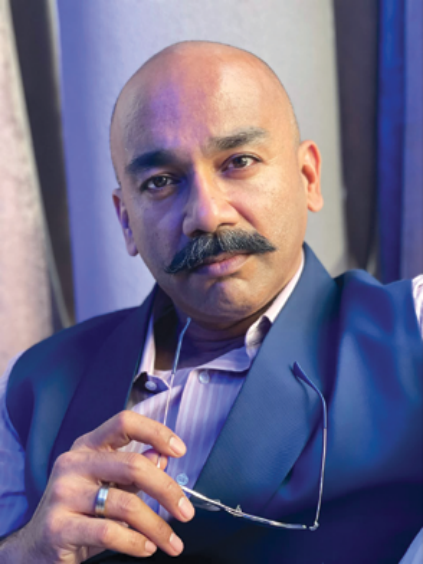
Vijay Vikram Singh is one of India’s recognisable narration voices, best known for narrating Bigg Boss since 2010 and lending his voice to popular television shows, including Kaun Banega Crorepati, Indian Idol and MasterChef India. After beginning his voice-over career in 2009, he expanded into acting, appearing in productions such as The Family Man and Special Ops 1.5. Having transitioned from the corporate world to the creative industry, he now also works in communication coaching, helping professionals develop clarity, confidence and executive presence. His journey offers a compelling perspective on the power of voice, storytelling, personal branding and professional reinvention. The HRM Nepal had tete-a-tete with Singh on the communication strategy, personal branding and emerging new trends in voice artisan. Excerpts:
Your voice has become recognisable to a large audience, particularly through Bigg Boss. How did you build a distinctive identity in a competitive voice-over industry?
I think the first thing we need to understand is that a distinctive identity is not necessarily something you create consciously. Very often, it is something that evolves through years of consistent work. When I entered the voice-over industry, I wasn’t thinking about building a personal brand. I was thinking about becoming good at my craft. I wanted to understand my instrument, which is my voice, and learn how to use it effectively.
Bigg Boss happened in 2010, and over the years, the association became stronger. But here’s something interesting. People often believe that a distinctive voice is about having a deep voice or a certain texture. I disagree. A distinctive voice is about the personality that comes through that voice.
There are thousands of people who have beautiful voices. What differentiates one from another is their ability to communicate an emotion, establish a connection and make the audience feel something.
I have always believed that a voice should not merely be heard. It should be experienced. My identity has been built through consistency, understanding the demands of the medium and, most importantly, never taking the audience for granted.
A personal brand is not built by repeatedly telling people who you are. It is built when people begin recognising you without your having to introduce yourself.
At what point did you realise that your voice could become more than a professional skill, a personal brand with commercial value?
Interestingly, the realisation came much later than the recognition. For a long time, I considered myself a professional who was paid to use his voice. I would go into a studio, perform my assignment and come back. That was my understanding of the profession.
Gradually, people started recognising me through my voice. They would hear me speak and immediately associate me with Bigg Boss. That’s when I realised something important. My voice had acquired an identity independent of my physical presence.
But the bigger realisation happened when I started moving into acting, motivational speaking and communication coaching. I realised that the credibility I had earned in one profession was opening doors in other professions.
However, there is a distinction I always make. Recognition gives you visibility. Credibility gives you commercial value. Someone might invite me because they recognise my voice, but they will invite me again only if I deliver value. That is the difference between being famous and building a sustainable personal brand.
What are the essential elements of a strong personal brand? How can professionals identify and communicate what differentiates them from others?
I would identify five important elements: competence, authenticity, consistency, credibility and differentiation.
But before we discuss these elements, I think we need to ask ourselves a fundamental question.
What do people remember about you after you have left the room? That, to me, is the beginning of personal branding.
Many professionals make the mistake of confusing qualifications with differentiation. Your qualifications establish your eligibility. They don’t necessarily establish your uniqueness.
For example, there are thousands of communication coaches. So why should someone come to me? My differentiation comes from the fact that I have spent years practising communication professionally, as a narrator, an actor and a performer. I don’t merely teach the theoretical aspects of communication. I help people understand the physical process of expression through voice, breath, body and emotion.
I often tell participants in my workshops that having knowledge and being able to express that knowledge are two completely different abilities. Similarly, to identify your differentiation, look at the intersection of three things: what you are exceptionally good at, what people genuinely value about you and what you can deliver consistently.
Your personal brand exists at the intersection of your competence, your character and the experience people have when they interact with you.
How important are consistency, authenticity and credibility in building a brand that audiences recognise and trust?
I think these three are inseparable. Consistency creates familiarity. Authenticity creates connection. Credibility creates trust.
And trust is perhaps the most valuable currency any brand can possess. Let me give you an example from my own profession.
When people hear my voice on Bigg Boss, they expect a certain quality, energy and character. That expectation has been built over years of consistent delivery. But imagine if I started projecting a completely different personality in every professional interaction. People would find it difficult to understand who I really am.
At the same time, consistency should never be confused with repetition. You can evolve, experiment and grow while remaining true to your core values.
Authenticity is equally important. Today, particularly on social media, people sometimes become so preoccupied with creating an image that they forget to develop the person behind that image. I believe credibility is earned when your actions repeatedly validate your words.
Consistency makes people recognise you. Authenticity makes them relate to you. Credibility makes them believe in you. And when all three come together, you have the foundation of a powerful brand.
Your professional identity extends beyond narration into acting and other forms of communication. How do you expand a personal brand into new areas without diluting its core identity?
I think the secret lies in understanding your core identity rather than defining yourself by your designation. If I define myself only as the narrator of Bigg Boss, I automatically limit my professional possibilities.
But if I look deeper, I realise that my core competence is communication and expression.
Narration is one expression of that competence. Acting is another. Hosting is another. Communication coaching is yet another. The mediums change, but the underlying skill remains the same.
When I act, I use my voice, body and emotions to communicate a character. When I conduct a workshop at an IIM or with corporate leaders, I use those same instruments to help people communicate more effectively.
So, I am not moving away from my identity. I am expanding its application. However, I also believe that credibility in one profession does not automatically guarantee competence in another. You have to earn your place in every new domain.
The strongest personal brands are not restricted to one profession. They are anchored in one clear promise. For me, that promise is the power of meaningful expression.
Can storytelling help leaders communicate strategy, build a shared organisational purpose and bring employees along during periods of change? How can they use it without sounding rehearsed or manipulative?
Absolutely. In fact, I believe storytelling is one of the most underutilised leadership skills. Organisations communicate through numbers, presentations, targets and strategies. But human beings connect through emotions, experiences and stories.
A leader might say, “We need to improve customer satisfaction by 20%.” That is an objective. But if the leader shares the experience of a customer whose life was genuinely improved by the organisation’s work, suddenly the objective acquires meaning.
The numbers tell employees what needs to be achieved. The story helps them understand why it matters. During periods of change, storytelling becomes even more important because change creates uncertainty. People want to understand what is happening, why it is happening and where they fit into the larger picture.
But there is a danger here. Storytelling should never become a substitute for honesty. If a leader uses a beautifully crafted story to disguise uncomfortable facts, people will eventually see through it.
In my workshops, I encourage leaders to draw stories from their actual experiences. Talk about your failures, your doubts, your learnings and the moments that changed your perspective.
A powerful story does not necessarily need extraordinary events. It needs genuine intent and honest emotion. My advice to leaders is simple. Don’t try to sound like a storyteller. Try to become a person who has something meaningful to share.
How much does a brand depend on the quality of the product or service, and how much on the way it is presented and communicated?
I believe these are complementary, not competing, elements.
A great product with poor communication may never receive the attention it deserves. On the other hand, brilliant communication might sell an average product once, but it cannot guarantee long-term loyalty.
Let me relate this to my experience as a communication coach. I meet extraordinarily intelligent professionals who possess tremendous knowledge and expertise. But when they stand in front of an audience, they struggle to express themselves.
Their competence is unquestionable. Their communication is not doing justice to that competence. I tell them that your knowledge is your product, but your ability to express it determines how effectively that product reaches the audience.
Think of a brilliant entrepreneur pitching an innovative idea to investors. If the entrepreneur cannot communicate the problem, the solution and the opportunity convincingly, the idea may never receive the support it deserves.
At the same time, no amount of presentation can compensate indefinitely for a fundamentally weak product. Quality creates value. Communication makes that value visible. Consistent delivery converts that value into trust.
The strongest brands understand the importance of all three.
Many professionals use social media to build their personal brands. What distinguishes meaningful brand-building from simply accumulating followers and online visibility?
I think social media has created an interesting confusion between visibility and influence.
Having a million followers doesn’t necessarily mean you have the trust of a million people.
Visibility tells you how many people have seen you. Influence tells you how many people are willing to listen to you, believe you or act upon what you say.
I use social media to share experiences, lessons and perspectives from my professional and personal journey. When I speak about resilience, failure, communication or personal growth, I try to draw from experiences I have actually lived.
My journey through the corporate world, my transition into the entertainment industry, my experiences with failure and my years of performing have given me stories that I believe can help others.
For me, the most meaningful response to a post is not necessarily the number of likes. It is when someone tells me that something I shared helped them look at their life differently or encouraged them to take action.
I also believe that professionals should resist the temptation to comment on everything simply to remain visible.Sometimes, saying less but saying something meaningful is far more powerful.
Followers are an audience. Trust creates a community. And genuine influence begins when your audience finds value in your presence, not merely entertainment in your content.
How should a personal brand evolve as a professional gains experience, enters new markets or moves into different roles?
I believe a personal brand must evolve because human beings evolve. The person I was when I started my career in the corporate world is very different from the person I am today.
My experiences have changed me. My failures have taught me. My professional journey has given me new perspectives. If my personal brand remained exactly what it was 15 years ago, it would not represent the person I have become.
But evolution should not mean abandoning your identity every time a new opportunity appears.
For example, today I work with entrepreneurs, senior corporate leaders, management students and actors. Each audience has different expectations and requirements.
My communication has to adapt to their context. But my fundamental philosophy remains unchanged: communication is not merely about speaking. It is about expressing yourself in a manner that creates understanding and connection.
I would also say that as professionals grow, their brand should gradually move beyond what they do towards the value they create.
Early in your career, people may recognise you for your technical competence. Later, they may value your judgement, experience, perspective and ability to influence others.
Your brand should evolve from being known for a skill to being respected for the value that skill creates. That, to me, is professional maturity.
With AI-generated voices and synthetic media becoming increasingly sophisticated, how can human professionals preserve authenticity and differentiate their brands?
This is a fascinating question, particularly for someone like me whose professional identity has been built around his voice. AI can already reproduce vocal textures, generate speech and imitate certain characteristics of human expression with remarkable sophistication. And I believe these capabilities will continue to improve.
But I think we need to distinguish between reproducing a voice and reproducing the complete human experience behind that voice.
When I perform a scene as an actor, my delivery is influenced by my understanding of the character, my emotional memory, my interpretation of the situation and my interaction with fellow performers.
When I conduct a workshop, I am constantly reading the room. I observe people’s reactions, change my approach, improvise and respond to their emotional and intellectual needs.
AI may become increasingly capable of simulating many aspects of these behaviours. So, I would not argue that technology can never replicate emotional expression.
Instead, I would ask a more important question. What makes a human professional valuable beyond the technical output they produce?
I believe the answer lies in lived experience, judgement, relationships, accountability and the ability to create genuine human connections.
AI will also force professionals to rethink their value propositions. If your entire differentiation depends on having a certain vocal texture, technology may challenge that advantage.
But if your identity is built around interpretation, creativity, trust, adaptability and meaningful expression, you have a much stronger foundation.
I see AI as a tool that can expand human capabilities, but I also believe authenticity will become increasingly valuable in a world where almost everything can be artificially generated.
AI can imitate the sound of my voice. But my personal brand must stand for something much larger than the sound of my voice. It must stand for the experiences, values, judgement and trust that people associate with me.
And that is where I believe the future of human differentiation lies.