How do we stabilise economies when climate change shatters productive capacity before demand even shifts?
1. THE DUAL CRISES: MACROECONOMIC STABILITY AND CLIMATE DISRUPTION
The Sveriges Riksbank Prize in Economic Sciences in Memory of Alfred Nobel for 2026 was awarded to Robert E. Hall (Stanford University) and Michael Woodford (Columbia University) for pioneering the microeconomic foundations of macroeconomic stabilisation and central bank policy design. Their seminal contributions formulating how nominal and real rigidities interact with monetary policy, expectation formation, and business cycle fluctuations have provided central banks and national treasuries worldwide with robust frameworks to navigate economic shocks.
However, as developing nations in the Global South, particularly mountainous, landlocked economies like Nepal, confront an escalating frequency of climate-induced disasters ranging from catastrophic glacial lake outburst floods (GLOFs) and monsoon flash floods to massive landslides and ice-rock avalanches, the traditional boundaries of macroeconomic stabilisation are being fundamentally challenged. While Hall and Woodford’s frameworks were primarily engineered to smooth conventional demand and supply shocks, the contemporary climate crisis introduces structural, supply-side, and asset-destroying shocks that originate outside standard market matrices.
For climate-vulnerable economies, climate change is not merely an environmental externality; it is a profound macroeconomic and fiscal destabiliser. When recurring disasters wipe out physical infrastructure, destroy agricultural value chains, and displace rural communities, they trigger severe balance- of-payment pressures, inflationary spikes, fiscal deficits, and contractionary spirals. Synthesising the 2026 Nobel laureates’ insights on stabilisation policy with the realities of the climate economy offers a vital analytical pathway. This opinion reveals how developing nations can harness institutional economics, Elinor Ostrom’s Social-Ecological Systems (SES) framework, and stabilisation macroeconomics to transform climate vulnerability into climate resilience.
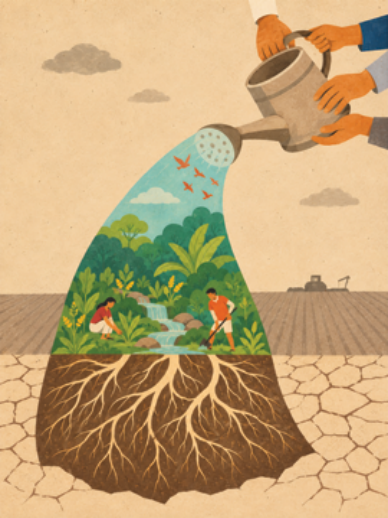
The 2026 Nobel Contribution: From Stabilisation to Shock Resilience
Robert Hall and Michael Woodford revolutionised modern macroeconomics by bridging microeconomic behaviour such as household consumption smoothing, wage-price stickiness, and firm-level price-setting with aggregate monetary and fiscal stabilisation tools. Woodford’s pioneering work on New Keynesian models emphasising the role of expectations and optimal monetary policy demonstrated that central bank credibility and forward guidance can anchor economic stability even amidst severe structural volatility. In advanced economies, macroeconomic stabilisation typically addresses demand-side fluctuations or nominal price shocks. In contrast, developing nations face asymmetric real shocks driven by climatic volatility. When a major monsoon, glaciers or ice-rock avalanche obliterates a hydropower plant, washes out national highways, livelihoods systems, personal properties, enterprises or inundates agrarian plains:
• Aggregate Supply Contracts Abruptly: the productive capacity of the economy shrinks instantly, triggering localised livelihoods and national inflationary pressures.
• Fiscal Space Collapses: governments are forced to reallocate capital expenditures away from long-term productive investments toward immediate emergency response, relief, and rehabilitation.
• Credit Markets Freeze: commercial banks facing heightened non- performing assets (NPAs) in climate-exposed sectors (agriculture, enterprises, rural infrastructure, hydropower) curtail lending, deepening the economic trough.
Applying the 2026 Nobel Prize in Economic Science insights to this dynamic requires extending New Keynesian stabilisation models to account for climate-induced supply shocks. Central banks and fiscal authorities in developing nations cannot rely solely on conventional interest rate adjustments to manage inflation driven by agricultural crop failures or supply chain blockages caused by landslides. Instead, stabilisation must incorporate structural credit policies, green macro-prudential regulations, financing for resilient infrastructure, and adaptive fiscal frameworks that protect productive capital from climate destruction.
2. THE CLIMATE ECONOMY IN FRAGILE MOUNTAIN ECONOMY: THE CASE OF NEPAL
Nepal epitomises the acute intersection of fragile topography, high climate vulnerability, and economic transition. Situated along the Himalayan arc, Nepal experiences global heating at rates significantly higher than the global average, driving accelerated glacial melt, the formation of potentially lethal glacial lakes, and erratic monsoon precipitation patterns. The Anatomy of Climate- Induced Disasters like:
• Glacial Lake Outburst Floods (GLOFs) and Ice-Rock Avalanches: as high-altitude permafrost thaws and glaciers recede, unstable moraine dams and hanging glaciers trigger catastrophic downstream floods. These events obliterate micro-hydropower projects, irrigation canals, eco-tourism lodges, and human settlements within minutes.
• Monsoon and Landslides: intensified monsoon dynamics produce hyper-localised cloudbursts, unleashing massive debris flows and landslides that sever national lifelines (such as the Araniko, Rasuwa Road Network and Prithvi highways, etc.), isolating entire districts and crippling national trade.
CLIMATE CHANGE IS NOT MERELY AN ENVIRONMENTAL EXTERNALITY; IT IS A PROFOUND MACROECONOMIC AND FISCAL DESTABILISER.
• Agro-Ecological Disruptions: rural livelihoods across river basins, which remain heavily dependent on subsistence and semi-commercial agriculture, suffer severe productivity shocks due to prolonged dry spells punctuated by torrential downpours that erode fertile topsoil.
Macroeconomic Transmission Channels
The macroeconomic transmission of these climatic events operates through multiple destructive channels:
• Capital Stock Destruction: physical infrastructure; enterprises, the backbone of economic output is repeatedly degraded, lowering the economy’s potential growth rate.
• Fiscal Deficits and Public Debt: post-disaster reconstruction forces developing governments into debt distress, crowding out vital expenditures on education, health, and technological innovation.
• The “Resource Curse” of Biodiversity and Natural Capital: as explored through institutional governance lenses, local communities inhabiting resource-rich ecological zones often face stringent state conservation controls, creating a paradox where ecological wealth coexists with acute economic vulnerability and restricted resource access.
3. BRIDGING ECONOMIC STABILISATION, INSTITUTIONAL ANALYSIS (IAD), AND THE RESOURCE CURSE
To construct an impactful economic policy strategy argument, I must integrate the
2026 Nobel Prize in Economic Science focus on macroeconomic stabilisation with Elinor Ostrom’s Institutional Analysis and Development (IAD) framework, the Social-Ecological Systems (SES) framework, and Resource Curse theory. In classic economic literature, the resource curse describes how nations rich in point-source natural resources (like oil and minerals) experience lower economic growth, authoritarian governance, and institutional decay. In biodiversity-rich, climate- vulnerable developing nations, this manifests as a micro-level institutional resource curse:
• Local populations sitting atop immense natural capital (forests, water resources, alpine pastures) are legally restricted by centralised conservation mandates (e.g., rigid protected area buffer zone regulations).
• While these ecosystems generate global and national ecological rents (carbon sequestration, biodiversity conservation, hydropower generation), local communities bear the disproportionate costs of human-wildlife conflict, land-use restrictions, and climate disasters.
• Centralised bureaucratic bottlenecks such as delayed timber harvesting approvals, rigid administrative permits, and uniform benefit-sharing rules prevent local institutions from engaging in proactive climate adaptation and resilient resource management.
ABUNDANT NATURAL CAPITAL DOES NOT AUTOMATICALLY TRANSLATE INTO REGIONAL PROSPERITY.
Reconciling Hall-Woodford Stabilisation with Ostrom’s Polycentric Governance
How do we stabilise an economy facing recurring climate shocks? The 2026 Nobel Prize in Economic Science emphasises rule-based stabilisation and institutional credibility. By pairing this with Ostrom’s polycentric governance principles, we derive a powerful synthesis:
• Macro-Level Stabilisation (Hall & Woodford): National central banks and ministries of finance must design forward-looking fiscal buffers and green credit guarantee schemes to absorb macroeconomic volatility caused by climate shocks.
• Micro-Level Institutional Autonomy (Ostrom): Top- down fiscal policies fail if local resource users lack the institutional autonomy to manage common-pool resources (CPRs). Empowering community-based organisations such as the Kangchenjunga Conservation Area (KCA) allows for decentralised management, localised bio- engineering, monitoring of glacier lakes, etc. for landslide prevention, and adaptive livelihood diversification.
4. ALIGNMENT WITH NEPAL’S 16TH PERIODIC PLAN AND NATIONAL BUDGET
To operationalise these theoretical insights, macroeconomic stabilisation and institutional reform must interface directly with national development planning and fiscal architecture.
Nepal’s 16th Periodic Plan (BS 2081/82 – 2085/86) The 16th Periodic Plan is structurally anchored around three core pillars: Good Governance, Social Justice, and Prosperity. It explicitly emphasises transitioning toward a green economy, climate change adaptation, regional balance, and productive employment while navigating Nepal’s historical graduation from Least Developed Country (LDC) status.
Strategic Transformation Sectors and the Resource Curse Paradox: The 16th Plan prioritises production, competitiveness, and infrastructure development (such as scaling hydropower and regional connectivity). However, the integration of Resource Curse theory and Ostrom’s institutional lens exposes a critical blind spot in standard planning: abundant natural capital does not automatically translate into regional prosperity.
While the 16th Plan targets rapid infrastructure and hydroelectric expansion, mountainous districts rich in natural resources often experience localised socio- economic deprivation due to rigid centralised conservation rules and bureaucratic red tape. Aligning the plan requires decoupling ecological conservation from micro-economic hardship by modernising buffer zone regulations to allow adaptive, community-led resource utilisation around protected areas like Kangchenjunga Conservation Area, Bardia and Chitwan National Parks, etc.
Alignment with the National Budget
The national budget operationalises fiscal policy, public expenditure, and climate- responsive financing through climate-budget coding and dedicated disaster risk reduction (DRR) allocations.
• Expanding the Hall-Woodford Framework to Climate Shocks: traditional national budgets rely heavily on reactive post-disaster relief funds once a flood or avalanche strikes. Aligning with modern macroeconomic stabilisation requires building rule-based, forward-looking fiscal buffers such as expanded contingency capital within Medium-Term Expenditure Frameworks (MTEFs) to instantly absorb output contractions when transport lifelines or hydropower facilities are washed out.
• Green Macro-Prudential Regulations: Central Bank monetary policy must direct commercial credit toward climate-resilient financing to infrastructure, agricultural value chains and localised renewable energy, shielding the broader banking sector from non- performing asset surges caused by localised climate disasters.
• Addressing Distributional Inequities and Pro-Poor Fiscal Transfers: uniform allocation rules in disaster relief and resource distribution fail vulnerable populations, disproportionately benefiting wealthier households who already possess private alternatives (such as LPG, biogas, solar, livestock, or private land timber stocks). The national budget must enforce progressive, targeted budgetary allocations ensuring that marginalised indigenous communities and vulnerable occupational castes receive direct subsidies, targeted energy transitions, and safety nets that offset state-imposed environmental restrictions.
5. STRATEGIC POLICY FOR NEPAL
To successfully synthesise the 2026 Nobel Economics Science, Ostrom’s institutional principles, and Resource Curse theory within Nepal’s 16th Plan and National Budget, policymakers should execute the following actionable strategies:
• Institutionalise Climate- Adjusted Macroeconomic Modelling: equip national planning bodies like National Planning Commission (NPC), Nepal Rastra Bank (NRB) and National Disaster Risk Reduction Management Authority (NDRRMA) with forecasting models that account for supply-side shocks driven by glacial melting, extreme monsoons, and infrastructure destruction.
• Decouple Conservation from Economic Deprivation: revise the Buffer Zone Management Regulations to streamline timber and forest product harvesting permits, converting protected area buffer zones from restrictive state-controlled reserves into productive, community-managed socio- ecological assets.
• Reform Climate Budget Tagging for Pro-Poor Equity: ensure that provincial and federal climate-coded budgets move beyond neutral or blanket environmental spending to explicitly fund targeted, equity- driven adaptation programmes for climate-displaced and resource-dependent households.
• Foster Polycentric Disaster Risk Governance: integrate local municipal governments, community forestry user groups, and scientific research networks into a unified, multi- tiered disaster preparedness architecture to mitigate high-altitude climate risks (like GLOFs and ice-rock avalanches) before they trigger macroeconomic distress.
HOWEVER, AS THE 21ST CENTURY IS INCREASINGLY DEFINED BY THE COMPOUNDING SHOCKS OF THE CLIMATE CRISIS, ECONOMIC THEORY MUST EXPAND ITS HORIZONS.
6. TOWARDS A MACROECONOMICS OF RESILIENCE
The 2026 Nobel Memorial Prize in Economic Sciences reminds us of the profound importance of rigorous institutional design and stabilisation frameworks in navigating economic turbulence. However, as the 21st century is increasingly defined by the compounding shocks of the climate crisis, economic theory must expand its horizons.
For climate-vulnerable developing nations facing the devastating triad of floods, landslides, and glacial melting, macroeconomic stability cannot be achieved through demand management alone. It requires an integrated intellectual synthesis: combining the New Keynesian rigour of Hall and Woodford with the institutional depth of Ostrom’s SES framework and the critical corrective of Resource Curse theory. By transforming centralised, extractive conservation models into polycentric, resilient, and equitable economic systems, developing nations can bridge the gap between ecological abundance and macroeconomic stability, ensuring sustainable prosperity in an era of climate disruption.