
FOR OVER HALF A CENTURY, the dominant purpose of business has been captured in a single idea: profit maximisation. Growth in revenue, expansion of market share, and rising shareholder value became the default measures of success, and management theory evolved largely in service of these goals. Yet, the consequences of this narrow focus are now impossible to ignore: widening inequality, depleted natural resources, climate disruption, and communities left behind by globalisation. Doughnut Economics, a framework developed by economist Kate Raworth, offers management a fundamentally different compass. Instead of asking how much a business can extract, it asks a better question: how can business help humanity thrive within a ‘safe and just space’, one that meets the social needs of all people while respecting the ecological limits of the planet?
The doughnut framework
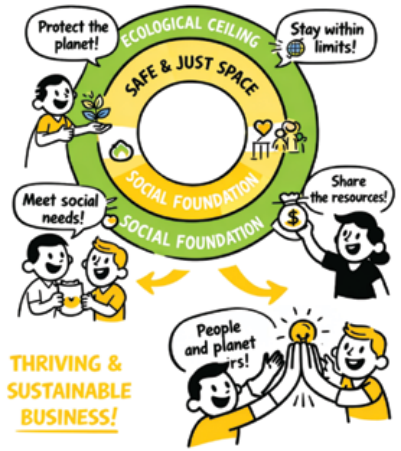
The model is visualised as a doughnut. The inner ring represents the social foundation – the essentials of human well-being such as food, housing, health, education, and political voice. The outer ring represents the ecological ceiling – planetary boundaries including climate stability, biodiversity, freshwater, and clean air. Between these two rings lies the safe and just space for humanity, where both people and planet can flourish. Fall below the inner ring and people live in deprivation; breach the outer ring and we destabilise the Earth systems on which all economies depend. For managers, the doughnut becomes both a diagnostic tool and a design brief: it reveals where business activities create shortfalls or overshoots, and it defines the space within which enterprise should operate.
Applying doughnut economics in management Redefining business goals. The first managerial shift is purpose. Rather than treating profit as the sole objective, businesses aim to thrive within the doughnut, generating value while meeting social needs and respecting planetary boundaries. This means considering a broader set of values in every major decision: social impact and environmental sustainability alongside financial return. Profit remains necessary, but it becomes a means to an end rather than the end itself.
Rethinking business design. Doughnut thinking goes beyond corporate social responsibility add-ons; it asks leaders to examine the deep design of their organisations’ products, supply chains, employment practices, ownership structures, and governance and transform them. In practice, this means pursuing regenerative practices such as eliminating waste, sourcing materials responsibly, restoring ecosystems, and designing circular products, alongside distributive practices such as ensuring fair wages, equitable ownership, and sharing value with workers and communities.
Fostering collaboration and innovation. No single company can redraw the doughnut alone. The framework explicitly calls for collaboration across businesses, governments, civil society, and communities to solve complex challenges. Managers are encouraged to build environments of open communication, creativity, and experimentation treating sustainability not as a compliance burden but as a frontier for innovation.
Promoting holistic leadership. Doughnut Economics demands a new leadership mindset: one that sees the interconnectedness of economic, social, and environmental systems. Leaders prioritise long-term resilience over short- term gains, remain transparent about trade-offs, and hold themselves accountable for their organisation’s footprint across both rings of the doughnut.
Measuring success beyond GDP. Finally, the framework challenges the metrics that drive management. Traditional indicators such as revenue growth or GDP contribution must be complemented by measures of social well-being and ecological health, carbon footprint reduction, waste management, worker welfare, and community engagement. What gets measured gets managed; the doughnut simply insists we measure what actually matters. In a historic restructuring, the outdoor apparel company Patagonia transferred its entire ownership to a unique trust and a non-profit organisation designed to combat the global environmental crisis. Under this new legal framework, all of the company’s non-reinvested profits are automatically funnelled directly into environmental initiatives and land conservation efforts. Founder Yvon Chouinard and his family gave up 100% of their ownership in the company, which was valued at approximately $3 billion at the time of the transfer. By making Earth its only shareholder, the brand has legally committed its corporate wealth to fighting climate change rather than enriching private investors.
For Nepal, a nation whose economy rests on agriculture, tourism, and hydropower while its communities remain highly vulnerable to climate change, Doughnut Economics offers a particularly urgent blueprint. By embracing regenerative tourism, equitable hydropower benefit-sharing, and circular agribusiness, Nepal can pursue development that lifts its people above the social foundation through jobs, education, and health without breaching the ecological ceiling its fragile Himalayas cannot afford. In a country where the well- being of the mountains, the forests, and the people are one and the same, the doughnut is not a foreign concept but a homecoming, and it is time for Nepali business and policy to thrive within it.

