

The last couple of years have seen the Rastriya Banijya Bank Limited (RBBL) rising among the ranks of top commercial banks in Nepal. In the past decade, RBBL, which is wholly owned by the government, posted high income and profit growth in a show of remarkable turnaround from the 1990s and 2000s when the bank was surrounded by various problems that had badly affected its profitability. With a focus on business growth, the bank is also engaged in branch network expansion and employee recruitment at present.
the HRM caught up with RBBL CEO Kiran Kumar Shrestha whose tenure is ending in the next few months after serving for eight years. With the HRM, he talked about the bank’s current focus and priorities, expansion drive, and the challenges of the banking sector, among other topics. Excerpts:
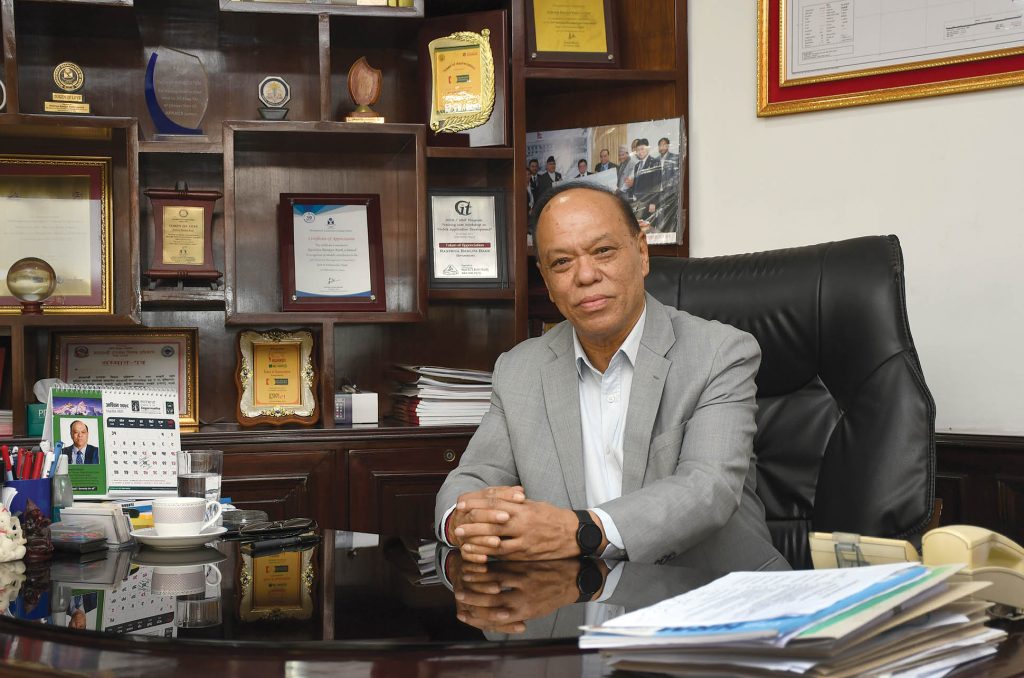 Q. RBBL posted a net profit of Rs 4.91 billion in the last fiscal year and earned the third spot as a top earner among commercial banks. How did the bank manage to continue this success despite the adverse macroeconomic scenario of the country?
A. The profit target was set at Rs 4.98 billion, and we are pleased that our actual profit met this expectation. Also, we achieved a credit extension of Rs 245 billion that was aimed at Rs 260 billion. To achieve the profit target, we took measures to reduce operational costs and also trimmed our HR expenses. Also, we adhered to the Nepal Rastra Bank’s recommended spread rate of 4 percent.
Just looking at the profit numbers would not be fair. We have to look at the return on equity (ROE). Our ROE falls within the range of 11-12 percent which makes the profit of Rs 4.91 billion a reasonable outcome.
Q. Liquidity in the financial system has improved significantly compared to a year ago. But even then, bankers say they are faced with stiff challenges as credit demand has not increased. Why has the demand for loans remained subdued?
A. In the fiscal year 2021/22, when there was a surge in loan demand, banks found themselves facing a shortage of loanable funds. However, the situation improved as remittances increased, leading to a surplus in the Balance of Payments (BoP), a decrease in imports, and an increase in forex reserves. Despite these positive developments in the banking system, deposit growth was not as anticipated. In response to the stiff competition to attract deposits, many banks began raising their interest rates. Eventually, the Nepal Bankers’ Association facilitated a ‘gentlemen’s agreement’ to stabilize interest rates, promoting a more balanced and predictable financial environment.
Despite the efforts to stabilize interest rates through the ‘gentlemen’s agreement’, the base rates of banks continued to rise. This upward pressure on interest rates affected both existing clients and new clients, who experienced increases in the cost of borrowing.
Despite these challenges, RBBL’s Credit-Deposit (CD) ratio remains comfortably situated at around 84-85. We have ample loanable funds at our disposal, but the current economic conditions have limited our capacity to extend loans. However, there is reason for optimism as we have observed a notable increase in loan demand in the current fiscal year.
Q. Importers have shown low enthusiasm to open letters of credit (LCs) to import various goods even as the festive season draws closer. How do you hope the festive season will fare in terms of increasing market demand?
A. The opening of LCs for importing various goods has indeed been on a low scale. This trend is primarily a reflection of the subdued market demand and reduced economic activities. It is obvious for businesses to open LCs sparingly at a time when demand slumps. However, we are cautiously optimistic about the upcoming festive season. The central bank has implemented policies aimed at facilitating easier access to home loans, automobile loans, and margin loans.
Also, there are expectations that the real estate market will revive as land plotting issues have been addressed. We also anticipate a boost in the demand for construction materials such as cement and steel. In recent events such as the NADA Auto Show, consumers have shown increased interest which indicates signs of automobile market revival. We are hopeful that economic activities will gain momentum during this festive season.
Q. RBBL is seen focusing on branch network expansion and employee recruitment at a time when other commercial banks have slowed their expansion. What is RBBL targeting from the expansion drive?
A. When I assumed the role of CEO seven years ago, RBBL operated with 161 branches. Today, we have significantly expanded our network to 284 branches, and by the end of the month of Kartik (September-October) this year, we will reach a total of 295 branches. We are a government-owned institution, and our mission is to extend our financial reach to serve a broader population. Initially, our presence was concentrated within the Kathmandu Valley, but we recognized a substantial gap in our coverage.
In line with the policy set by NRB, we have also revived branches that were shut down during the armed conflict in the country. Moreover, the overwhelming response and inquiries from the general public regarding the need for RBBL in their respective areas is the trust and confidence people have placed in our institution. We are dedicated to meeting this demand and continuing to serve our customers and the nation.
We currently employ a total of 2,600 individuals out of which 2,000 were recruited during my tenure as the CEO. This substantial recruitment drive was necessitated by the fact that 1,850 employees retired from the service during the same period. To maintain a capable and efficient workforce and ensure the smooth operation of the bank, we had to fill the resulting gap by bringing in new talent through these recruitment efforts.
In a single recruitment cycle last year, we hired an impressive 836 employees, selected from a vast pool of 135,000 applicants. In our ongoing recruitment efforts, we are currently in the process of hiring 445 more employees, following the hiring of 666 employees previously.
As a result of these hiring initiatives, the composition of our bank has become younger, with the average age of our staff now at 35 years. Our deputy CEO is just 45 years of age.
Q. After bankers ended the ‘gentlemen’s agreement’ on interest rates, banks have seen competing to get deposits as well as loans. How can this unhealthy competition be checked? Or, getting to the ‘gentlemen’s agreement’ again is the only way out in this regard?
A. The previous agreement to stabilize interest rates unfortunately could not be effectively implemented as intended. It seems there was a misunderstanding in the market and banks failed to effectively communicate its purpose and benefits to the public. This misunderstanding resulted in a surge of unhealthy competition in the market.
Institutional deposits, particularly from companies seeking the highest interest rates, exacerbated this issue, leading to a continual rise in interest rates. To address this situation and curb the unhealthy competition, the bankers’ association decided to establish a gentlemen’s agreement. However, the market perceived this agreement as an attempt to establish cartelling in the financial market rather than recognizing its goal of stabilizing interest rates and ending the damaging competition.
The decision to remove the agreement was influenced by the considerable pressure exerted by the market. However, it was surprising to witness that after the agreement was removed, some banks chose to increase their interest rates. This unexpected development was a shock, especially considering that institutional deposits at our bank were not being renewed. In response to these market dynamics, we were compelled to increase our interest rate by 0.25 percent. Unfortunately, this decision prompted criticism, with some asserting that even a government bank like ours had raised interest rates. Given the fluctuating circumstances and market reactions, we had to reassess our strategy. In the third month, we decided to decrease the interest rates in an attempt to restore balance and adapt to the evolving landscape of interest rate dynamics.
Q. What kind of policy easing do you seek from the central bank to bring down interest rates and increase demand in the market?
A. During the Covid-19 pandemic in 2020 and 2021, the central bank implemented various relaxation measures. In comparison to other nations, these actions were seen as a significant relief effort. There were even discussions about whether such substantial relief measures should have been the government’s responsibility. However, as the pandemic began to subside, it became apparent that the policies related to Covid-19 relief had become imbalanced.
Government policies are needed to regulate institutional deposits effectively. Policy changes should encourage institutions to make strategic decisions, such as investing in some sectors or depositing funds appropriately within the same bank. These policies can have a positive impact on the entire banking sector.
The central bank has to set guidelines for determining the premium rate. For instance, when the base rate is at 10.5 percent, and a 5 percent premium is added, it results in a total interest rate of 15.5 percent. While this approach might impact profitability, it needs revision by the central bank.
The difference between interest rates on normal savings and special savings is 3 percent, and 5 percent difference between savings accounts and fixed deposits. It has increased funding costs. In addition to the central bank’s role in managing monetary policy, it is important for the government to use fiscal policy, such as the annual budget, to support economic stability.
Q. Why has the rate of return decreased in the banking sector lately?
A. The cost of funds has risen, also there is pressure on the base rate. Operational expenses have increased, including staff salaries, due to the growth in the number of bank branches and the need for investments. These factors collectively have resulted in a decrease in bank’s the rate of return.
Q. The government has planned to merge the three state-owned commercial banks as the Ministry of Finance has already formed a task force to study the possibility of such a union. How do you see the prospect of a merger between the three banks?
A. In the past, when there were 31 commercial banks, RBBL ranked among the top three. However, with the reduction in the number of banks, RBBL has dropped to eighth in many indicators. If further mergers do take place, there’s a risk for RBBL to fall out of the top 10 spot. This could potentially lead to a smaller business size and diminished capacity for the bank.
Currently, RBBL has a paid-up capital of Rs 16.5 billion, while other banks in Nepal have paid-up capital ranging from Rs 35-40 billion. A higher paid-up capital allows banks to have a greater capacity for investments and expansion. Therefore, RBBL has to be strategic to enhance competitiveness and position in the market.
In Nepal, 19 banks are still publicly owned, with RBBL being the only one wholly owned by the government. There’s a prevailing perception that having at least one fully government-owned bank is necessary. Efforts were made to explore a merger between RBBL and Nepal Bank Limited. A committee was formed, consisting of central bank officials, bank CEOs, and representatives from the finance ministry, to oversee this initiative.
Initial progress was made in this direction. However, after a change in government, the process got stalled.
Q. How do you see the impacts of mergers in the Nepali banking sector?
A. The most significant challenge associated with the consolidation dive lies in managing the cultural differences and working styles of the banks involved post-merger. The human resource factor is particularly challenging to navigate and can potentially hinder the expected outcomes of the merger.
However, there are several positive aspects to mergers and consolidation, including an increase in capital, deposits, and various other key indicators. It may take at least a year to fully observe and assess the effects of the merger and consolidation on the overall performance and operations of the newly combined entity.
Q. How should banks adapt to the changing business trends and the presence of alternative financing options, and what are the key challenges they face in this evolving landscape?
Banks now need to shift their focus to project-based financing. Although the working capital guidelines says that separate collateral is not required for lending, many banks are not yet prepared for this approach. However, the experience of investing in hydroelectric projects has highlighted the challenge of lacking proper collateral, such as valued land.
In the case of hydropower projects, after the electricity generated by the plants is connected to the national grid, payments are made by the Nepal Electricity Authority. This has instilled confidence in banks regarding project financing for hydroelectric ventures. For instance, the upcoming 1,010 MW Upper Arun Hydropower Project, with an investment of over Rs 100 billion. Banks are investing Rs 56 billion in this project.
Q. What is RBBL’s plan for digital banking, especially considering the industry-wide shift towards digital banking and the growing adoption of digital services by consumers?
A. Digital banking is an essential part of our banking operations. We have achieved significant progress in this area, considering that we transitioned from a manual paper-based system that had been in place for 45-50 years. Our recent computerization has enabled us to embrace technology, especially given that our staff now has an average age of 35 years, making us well-equipped to adopt various technological advancements.
Currently, we have a customer base of 3.8 million and 50 percent of them are using digital banking services. While this is a positive adoption rate, we recognize that there is room for improvement, especially when compared to some other banks. To further enhance our digital capabilities, we are currently in the procurement process to digitize our systems even further. We have introduced products such as cardless transactions and digital banking solutions. We will continue to work on expanding and refining our digital infrastructure to meet the evolving needs of our customers and ensure a seamless banking experience.

