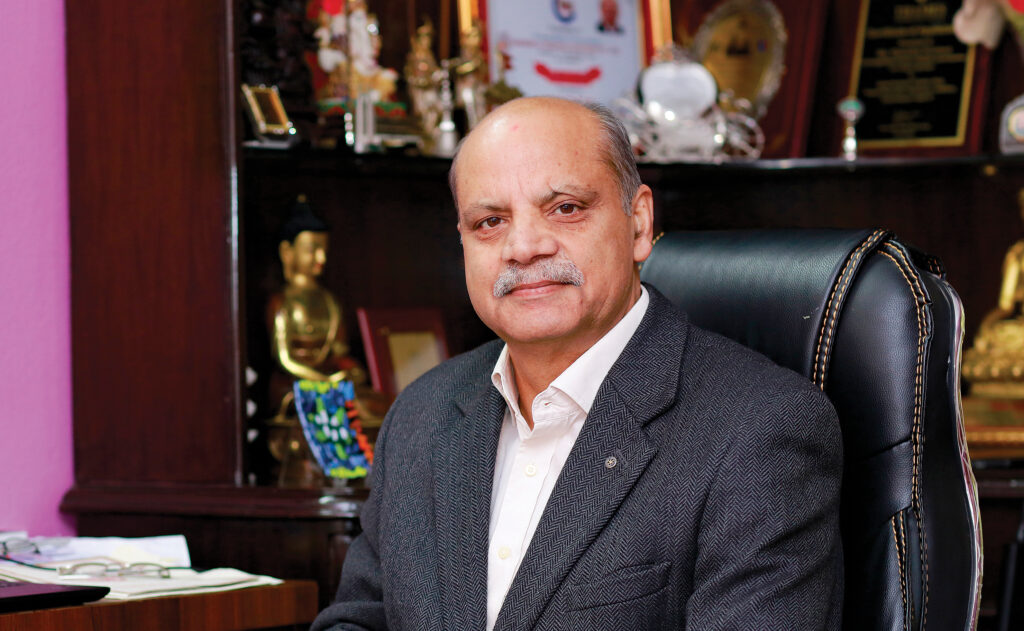
Siromani Dhungana is the Director of the Association of Community Radio Broadcasters (ACORAB) Nepal, which is a nationwide network of 386 community radio stations, operated by community-based and nonprofit organisations. As the Executive Head of the organisation, he oversees organisational management, drives business development and multi-donor partnerships, and leads initiatives that strengthen community media across Nepal.
Dhungana is a seasoned leader in the development sector with extensive experience managing complex portfolios across grassroots organisations, national and international NGOs, UN agencies, and academic institutions. He brings a result-oriented leadership that aligns organisational strategy with meaningful community impact. The HRM spoke to Dhungana on a range of issues. Excerpts.
 Q. How is ACORAB rethinking its resource-mobilisation model to ensure sustainable and community-driven resource mobilisation?
A. The landscape of development funding has shifted significantly in recent years, with traditional aid streams becoming less predictable and competition for resources intensifying. ACORAB has strategically reimagined its resource-mobilisation model to build financial sustainability that channels resources directly toward communities and their priorities.
Transparency and accountability remain ACORAB’s highest priorities. We ensure that resources are utilised efficiently, ethically, and in ways that directly respond to local needs. As an umbrella organisation of over 380 independent community-based and nonprofit organisations, we aim to ensure that funding flows to where it can make the greatest difference.
We have accelerated diversification of resources across sectors, engaging institutional donors, private partners, and community stakeholders to reduce dependency on any single funding source and foster a resilient financial footing. This aligns with how leading international development organisations emphasise broad, multi-partner engagement to withstand changing aid dynamics and deliver consistent community impact.
At the same time, the best value for money is not just a formal commitment on paper, but a principle translated into practice within ACORAB’s planning and implementation processes. We have strengthened financial planning, monitoring, and reporting systems so that every grant and partnership delivers measurable benefits for community radio networks and the people they serve.
We have also encouraged community radio stations within our network to explore innovative, locally appropriate business models that generate supplementary income while reinforcing their service missions. ACORAB has adopted a radio-digital convergence strategy that encourages and provides tools and resources to community radio stations to leverage the opportunities provided by digital technologies and AI, while serving the core purpose of community radio broadcasting.
Q. As director of ACORAB, you have been actively involved in resource mobilisation and business development with multiple development partners and donors. How do you perceive donor support? How do you respond to some of the negative concerns raised by a few stakeholders?
A. Development partners’ and donors’ support has been crucial in supporting organisations like ACORAB to reach communities effectively and implement impactful programmes. It’s important not to make sweeping generalisations or overlook the remarkable work they do for communities, even though, like any sector, there may be some exceptions.
ACORAB greatly values the support provided by development partners, whose contributions are essential for strengthening the community media sector and in promoting community voices. At ACORAB, we aim to maximise the benefits of partnerships with development agencies and donors through shared accountability and transparency, without compromising the needs of target communities. At the same time, the government should play a constructive role in facilitating strong, formal partnerships between development partners and organisations like ACORAB to serve the need of communities.
Q. As the umbrella organisation for over 380 community‑based organisations and radio stations, what management strategies do you employ to ensure operational efficiency, high social impact, and maximum public value across such a diverse network?
A. Managing community organisations is inherently complex. Community-based institutions must uphold fundamental values that are central to public service and social impact. At the same time, a vibrant and effective organisation requires adequate resources. My approach has been to maintain a delicate balance between these priorities, ensuring that operational efficiency and resource utilisation support the mission without compromising core values.
To achieve this, we adopt clear organisational policies and due processes to ensure that personal biases do not influence decisions, disrupt workplace culture, or hinder efforts to build diverse and inclusive teams. We make decisions that are objective, rational, and evidence‑based.
Many of our staff have been with us since the organisation was first established, dedicating their entire careers to this mission. This reflects the impact of our work. We make merit-based decisions and have a capable team that delivers results.
We regularly review our programmes and reflect on our approaches to ensure they remain relevant and effective. Rather than allowing rigid hierarchies to shape the working environment, we promote professionalism, equal opportunities, and respect for everyone’s perspectives in the decision-making process.
Sustainability is at the core of our work. We do not implement programmes merely for the sake of activity. We ask ourselves whether they are genuinely needed and how communities can continue to take ownership long after the programme cycle ends.
Q. Given the economic slowdown and sector-wide financial constraints, how do you identify the most critical skills for your team and retain top talent despite limited financial incentives?
A. Human resource management has become increasingly challenging across all sectors, and the media sector is no exception. Given ACORAB’s scale and scope, we demand talent that is innovative, adaptable, and capable of navigating the evolving complexities of community media. We have a dedicated central staff secretariat and dedicated teams in technical operations and administration.
While we have professionals with decades of experience in the community media sector, we also have a young and dynamic team that never hesitates to experiment with new approaches. We prioritise creating an enabling work environment that encourages shared learning and offers equal opportunities for professional growth.
I must be honest. Retaining talent is a challenge for organisations like ours that operate with limited financial resources. However, our scope is wide: we have a nationwide network and a mission centred on empowering community media. This sense of purpose is what inspires our staff to see their work here not just as a job, but as an opportunity.
Q. What internal systems such as performance management, feedback mechanisms, or decision-making processes have you institutionalised to balance accountability with a supportive and enabling office culture?
A. In its 25-year history, ACORAB has developed a robust set of policies and procedures to institutionalise accountability and to create a supportive work environment. These include Anti-Fraud and Corruption Policy, Financial and Administrative Regulations, and Human Resource Policy, among others. Each policy clearly safeguards employees while defining clear responsibilities and expectations.
At the same time, we recognise that a vibrant organisation requires continuous reform and adaptation. Policies are treated as living documents, reviewed and updated as needed to ensure that accountability mechanisms remain effective while maintaining an enabling office culture. In my opinion, policies must foster forward-looking, solution-oriented approaches and prepare for emerging challenges, not become setbacks.
Thus, I have prioritised the effective implementation of existing policies, while continuously supporting the Central Executive Board of the organisation to review, update, and develop policies to address emerging organisational needs and ensure sustained operational excellence.
Q. Looking ahead, what financial, technological, and human capabilities will be most important for community radio networks to stay relevant and resilient in Nepal’s fast-changing media and political landscape?
A. Community radios play an essential role in empowering communities and reaching underserved populations, but they continue to struggle to move beyond traditional FM broadcasting and fully embrace emerging digital opportunities as well. Limited resources and gaps in digital skills and competencies remain significant challenges.
I personally feel that radios must adapt to rapidly changing media landscape, technological advancements, digital disruption including emergence of Artificial Intelligence (AI), the growth in digital platforms, and changing media consumption patterns of audiences. In the emerging media landscape, radios require innovative approaches to remain relevant, effective and resilient.
ACORAB has adopted a radio-digital convergence strategy and is committed to supporting community radios as they digitise, upgrade their technological capacity, and diversify their revenue streams. Innovation, creativity and adaptation are must for any media to remain relevant.