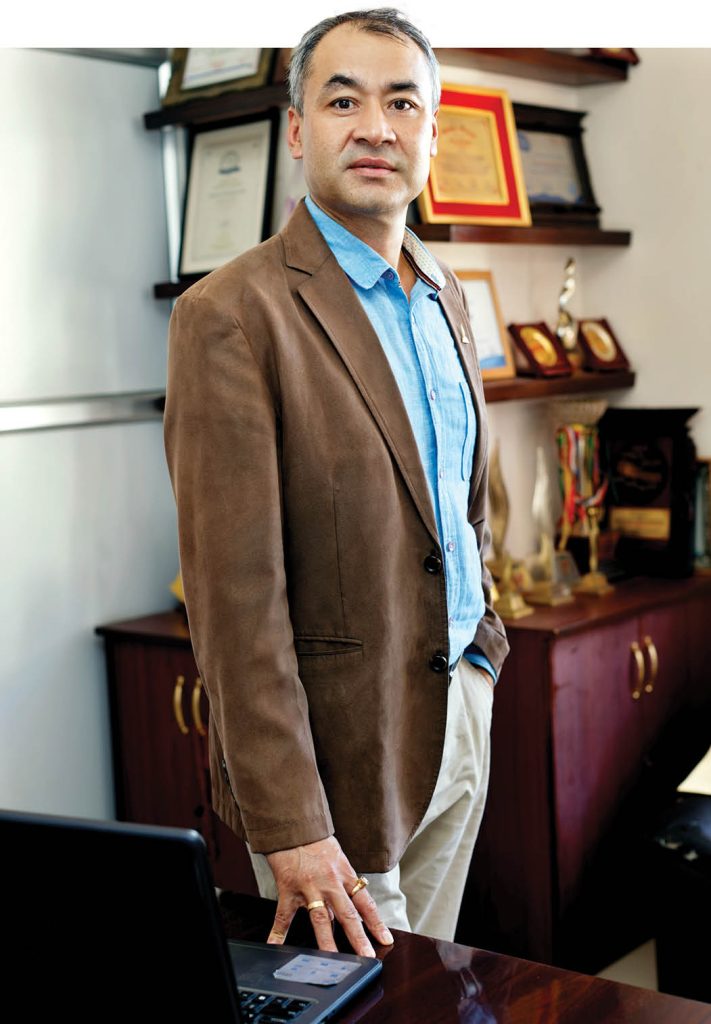
The Nepali advertising and marketing industry is going through a big transformation as consumer habits are changing rapidly with technology becoming an integral part of the lives of people. Santosh Shrestha, Managing Director of Mars Advertising and Research Pvt Ltd, thinks that the Nepali advertising industry is currently in a transitional phase. Shrestha has been active in the advertising and marketing sector for the last 25 years. In a conversation with the HRM, he talked about the current state of the Nepali advertising industry, the changes occurring in the sector, and the future of print media, among other topics. Excerpts:
 Q: How do you observe the current state of the Nepali advertising and marketing industry?
A: Advertising and marketing is a dynamic sector. It always evolves with the technology, trends, and most importantly consumer behavior. From communication to technology used to create advertisements and marketing approaches, everything has witnessed a paradigm shift in the last few decades. Things have progressed by leaps and bounds. Currently, advertising and marketing are undergoing a transitional phase as we gradually but consistently venture into the digital ecosystem.
Q: How has the economic downturn affected the advertising sector?
A: Just like with everything that undergoes a change, there are certain highs and lows we have to face. This is what is happening now. The Covid-19 pandemic created an adverse situation for the advertising sector. Because of this, the transition has not been so smooth. The economic recession has put a serious dent in almost every sector except the educational consultancy and abroad employment recruitment business. But the potential for bouncing back is always there.
Q: How are advertisers and marketers dealing with the challenges?
A: What do you do when you are sailing in shallow waters with heavy cargo? The first tactic is to lighten the weight so that you do not hit rock bottom. So that’s the first approach is cost-cutting and downsizing. Every organization is working towards lowering their operational costs, scaling down their marketing budgets, and functioning with the bare minimum. This is a time to make careful choices, hard decisions, and take calculated risks. Everyone is in survival mode and the main concern is to safely make it through the shallow waters.
Q: Has the festive season brought some respite to the advertising and marketing sector? How do you see the prospect of recovery?
A: Festive seasons mainly fall between September to April. During this window, we have back-to-back festivals such as Dashain, Tihar, Holi, and both the English and Nepali New Years. This is when the market is comparatively buoyant and consumers make big purchases. Though the scale and numbers of market schemes and offers have slightly gone down compared to a few years back, it is still happening.
Q: How do you think marketers and advertisers need to take a different approach to marketing and advertising in times like these?
A: First and foremost, we need to have a positive outlook. And secondly, we have to start doing things differently instead of focusing on doing different things. Nowadays clients tend to be more favorable towards digital media when it comes to brand promotions, but that does not mean we have to shun the traditional media. We need to maintain a presence in the digital sphere because its reach, scope, and database are much more dynamic than the traditional media, and also due to its cost-effectiveness. But the traditional media still has a lot of credibility. There is a whole lot of untapped potential in TV channels, newspapers, magazines, radio stations, and hoarding boards. We just have to think differently and do things in different ways, while working on these platforms.
Q: Many advertisers and marketers have resorted to digital and social media in recent years. What new trends have ushered in the advertising market with the proliferation of digital platforms?
A: Digital communication has taken traditional advertising by storm. Social media, web search, videos, content, reputation management, and influencers have changed the entire ball game. The recent real intervention of artificial intelligence (AI) like in chatbots, generative pre-trained transformers like ChatGPT, and immersive technology like augmented reality (AR) and virtual reality (VR) has shown some new high ways for digital communication. Short video has been trending which has given immense popularity to reels and stories. Content marketing has been becoming challenging as digital media is swamped by brands and whatnot. I think the world has embraced technology as an integral part of marketing, and I would like to say “Mark-Tech” is the new frontier and we have to be ready for what coming.
Q: How do you view the effectiveness of social media to reach out to a large audience compared to traditional mediums?
A: Social media has the potential to reach a larger audience. The targeted advertisements to the niche segment or the large, either my age or interest, cost-effectiveness, convenience, the potential to interact, to get viral and most importantly to measure the result as per the goal set are some of the keys that prove the effectiveness of social media platforms. The power that social media has given is largely on two fronts the real-time interaction and measurement of behavior through analytics. It means, that in the traditional media, there was no way one could have real communication and the measurement was possible but not as easy as in social media. User has the power to create their version of content what we know as user-generated content (UGC), which is the next big thing in the world of social media. But having said that, each media vehicle has its own importance which shall not be undermined.
Q: Influencer marketing has been seemingly growing as a big segment in the last few years. How do you observe the growth of influencer marketing?
A: Influencer marketing has quickly transitioned from a specialty concept to a commonplace marketing tool. The potential of partnering with influencers to reach their target audience is now being recognized by more brands across many industries. Influencers from a variety of niches and areas, including beauty, fashion, fitness, travel, technology, gaming, finance, and others, now make up the influencer landscape. Due to this diversity, marketers are now able to identify influencers who are very compatible with their goods or services. Growing in popularity was the emergence of micro-influencers, who have more modest yet actively engaged fan bases. I think in the near future, celebrities will have a tough fight with influencers and influencers will be the next celebrity.
Q: How do you see the future of print media in the digital age?
A: Wiener Zeitung, one of the world’s oldest newspapers, published its final daily print just a few months back, after three centuries of operation. However, the Austrian newspaper will continue to operate digitally ensuring its legacy. We can take some valuable cues from this. This scenario will surely happen in Nepal too. But it will take time. Unlike digital agencies, print industries work on a huge capital investment. Which is one of the reasons why they are more credible. And this is why print media will not go out without a fight. Right now, just like every other industry they are in survival mode. But all this will phase out, things will get better. Print media still has a long way to go, its life is dependent on its content’s quality.
Q: It has nearly been three years since the Clean Feed policy was implemented. Have the objectives of the policy been achieved?
A: AAN lobbied for the implementation of the Clean Feed policy for almost 20 years. So, it is still early to question the achievements of the policy implementation. A lot of things have changed but a lot more change is still to see the light of day. The business of traditional media like television has gone down since the Covid-19 pandemic. And the switch to digital media was very fast. It will take time for things to fall into place. Only then can we get back to making things happen on this front. Once things normalize, more will be done to achieve the targets of the policy.
Q: Has the Clean Feed policy spurred the growth of innovation and creativity in the production of TV commercials, as hoped during the implementation of the policy?
A: Unless we take a firm stand, there will always be loopholes. Dubbed foreign commercials are still playing all across national and international TV channels. This has to stop. We have to follow ethical practices. In order to make money and survive, many TV channels are neglecting this aspect. Many MNCs are following the Clean Feed regulations and have started creating localized commercials using local manpower and local themes. This is a good sign that might influence others to follow suit. So as of now, the impact has not been as expected. But as I said earlier, everything things take to take effect and yield results in Nepal.