#Jargon

Inversion thinking is a powerful mental model and problem-solving technique, which entails approaching a situation by first figuring out how to guarantee failure or accomplish the opposite of your intended result. It promotes thinking backwards from what you want to avoid in order to reveal hidden risks and necessary preventative measures, as opposed to moving linearly toward a goal. Those in favour of this approach, such as investor late Charlie Munger (Warren Buffet’s friend, vice chairman of Berkshire Hathaway), turn possible blind spots into a strategic road map for success. Its fundamental usefulness is found in its paradoxical simplicity: you can more accurately map out a path to success by closely examining the routes to failure.
Core Concept : The fundamental idea behind inversion thinking is that emphasising solely on a constructive objective frequently results in the neglect of important challenges. While failure is often concrete and instructive, success can be abstract and complex. Consequently, inversion thinking reverses the situation. It requires you to first ask “What would guarantee I never achieve X?” or “What would cause the exact opposite of X?” rather than “How do I achieve X?” This change in viewpoint compels one to face painful realities and hidden weaknesses.
How It Works : The process is a structured form of critical thinking:
Define the Desired Outcome: Clearly state your goal by defining the desired outcome (e.g., “launch a successful product,” “build a strong investment portfolio,” “improve team morale”).
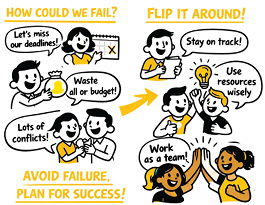
Invert the Problem: Carefully formulate the question in reverse. This turns into the question, “How could we ensure this product fails spectacularly?” for the aforementioned examples. “What could destroy my portfolio?” “What behaviours would undermine team spirit?”
Analyse the Pathways to Failure: List every potential response to the reversed query. This is an open and honest examination of possible mistakes, ranging from glaring mistakes to slow, subtle deteriorations.
Develop Preventative and Corrective Strategies: As a checklist of threats to methodically eliminate, use the list produced in step three. The intentional avoidance and mitigation of these recognised failure modes become your strategy for success.
Examples
Investing: An investor who only asks, “Which stock will grow?” often ends up chasing hype. Inverting the question to “How could I permanently lose capital?” shifts attention to real risks – margin calls, lack of diversification, blindly following trends, or investing in businesses they don’t understand. This mindset naturally leads to a strategy built around margin of safety, balanced portfolios, and disciplined research.
Project Management: A project manager focused solely on “How do we deliver on time?” may create an overly optimistic schedule. Asking instead, “What could cause major delays?” surfaces critical risks such as unclear requirements, single points of failure, weak communication, or scope creep. Addressing these issues early results in a more realistic and resilient project plan.
Personal Development: Someone chasing happiness by asking, “What will make me happy?” may focus on short‑term pleasures. Inverting the question to “What guarantees misery?” highlights patterns like chronic resentment, neglecting physical health, financial irresponsibility, and toxic relationships. Avoiding these pitfalls becomes a strong foundation for long‑term well‑being.
Benefits
Improved Decision-Making: It introduces a necessary layer of caution and foresight, grounding optimism in pragmatic risk assessment.
Enhanced Problem-Solving: By identifying the root causes of potential failure early, you solve problems preemptively rather than reactively.
Proactive Risk Reduction: It transforms risk management from an abstract concept into a concrete list of actionable items to address.
Increased Creative Insight: Thinking backwards breaks conventional thought patterns, often revealing non-obvious dependencies and innovative solutions that a straightforward approach would miss.
In essence, inversion thinking is not about pessimism; it is about intellectual rigour. It uses the clarity of understanding what you don’t want to construct a more robust and defensible path toward what you do. By making failure explicit, it allows you to systematically disarm it, thereby clearing the way for success.