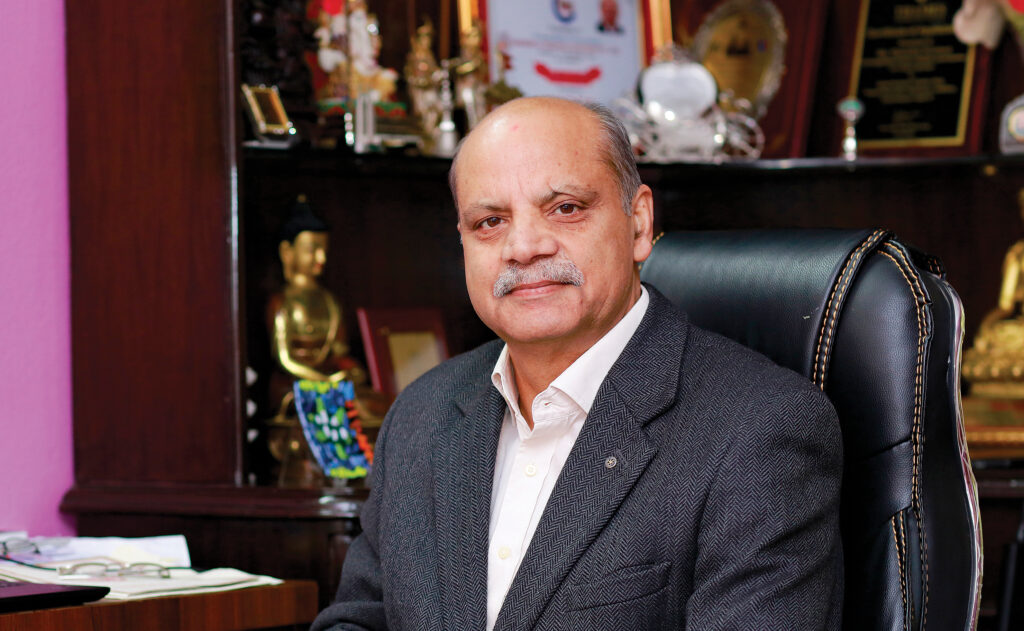
Rupesh Joshi is the Director of the Marketing, Sales and Ground Handling Department at Buddha Air, bringing extensive experience in aviation sales and marketing. He joined Buddha Air in 1998 after earning his MBA from the Symbiosis Institute of Business Management in Pune, India. Joshi has conceptualised and successfully implemented numerous marketing strategies that have strengthened the company’s market position.
As a market leader holding over 60% of the domestic market share, Buddha Air is also exploring regional prospects by connecting major cities across India and Nepal. The HRM Nepal caught up with Joshi to discuss his sales and marketing strategies and their execution. Excerpts from the interview are presented below.
 Q: How would you like to explain the strength of Buddha Air’s brand image?
A: Buddha Air has been in operation for the last 29 years. When Buddha Air started operations, most of the airlines were focused on sales, however, Buddha Air equally prioritised both brand and sales. As an airline company, we were determined towards creating a brand value. Though there are no specific standard ratings, Buddha Air is considered one of the top homegrown brands in Nepal.
Q: Buddha Air’s logo consists of a pair of flying pigeons, which are taken as symbols of peace. How was it conceptualised initially?
A: Initially, Buddha Air was established to operate helicopters. In the meantime, the government restricted MI17 helicopters for commercial operation, so fixed-wing aircraft (Beechcraft) were brought in for operations. The person who initially founded Buddha Air left after the plan to operate helicopters failed due to national policy. Although I was not associated with the company at that time, as I have heard from seniors and read in the book authored by Chairman Birendra Bahadur Basnet, the logo was finalised as a ‘symbol of peace’, for which Buddha is regarded globally.
Q: Buddha Air upholds certain values like passenger safety, operating by the book and viewing the company as a family. As the Director of Sales and Marketing, what are the key mantras behind Buddha Air’s success in becoming a dominant market leader?
A: Safety is the prime concern of Buddha Air. Without safety, an airline cannot exist. Over time, as Buddha Air added more aircraft to its fleet, we became a more trusted and reliable airline. Furthermore, after introducing more ATR-72 aircraft to the fleet, we tried to make fares as affordable as possible. We have also placed a strong emphasis on customer service. Thus, safety, reliability, affordability, and customer care have strengthened our brand image. Today, Buddha Air has become synonymous with these four components.
Q: What are the major turning points for Buddha Air?
A: Buddha Air has had two major turning points. Buddha Air’s establishment itself and the decision to operate fixed-wing aircraft mark the first turning point. In the beginning, Buddha Air purchased new aircraft. We were fortunate in a way, as two major operators, Everest Air and Nepal Airlines (domestic segment), halted their operations, allowing us to capture a portion of the market share.
Secondly, in 2009/10, the Buddha Air team envisioned that Nepal’s market share would grow significantly and decided to purchase larger aircraft (ATR-72). Over time, we were proven right, as the market grew just as we had anticipated. We then added more aircraft to our fleet, marking our second major turning point. We have since phased out the Beechcraft, and we currently operate 16 aircraft, comprising ATR-42s and ATR-72s.
Q: Why is Buddha Air confined to trunk routes only?
A: There are three major markets for aircraft operations in Nepal: STOL (Short Takeoff and Landing), rotorcraft (helicopters), and trunk routes. We cover every destination in the trunk route segment, including Surkhet and Tumlingtar. We have allocated flights to the maximum extent we can optimise given the number of aircraft we operate.
Q: Buddha Air has reportedly transformed the mountain flight segment. How was that possible?
A: We operate mountain flights and have taken a new approach to them. We guaranteed a window seat for all passengers (selling only window seats for mountain flights) and began showing the mountains from an altitude of 25,000 feet. That changed the entire dynamics of mountain flights. Previously, small or non-pressurised aircraft operated mountain flights at altitudes of 8,000 to 9,000 feet. Prior to Buddha Air’s new product offerings, airlines operating mountain flights did not guarantee window seats.
Q: Buddha Air has also conducted a study on STOL flights by purchasing the Cessna SkyCourier. Is there any progress toward operating in the mountain segment?
A: We do not have any preparations for STOL flights so far.
Q: Buddha Air has massively expanded its number of flights and destinations after 2009/10 based on proper market research. How would you interpret the possible scenario for the next five to 10 years for the aviation industry in Nepal?
A: The aviation sector has been coping with difficult times, and the scenario will not be favourable for the next few years. The COVID-19 pandemic was a major shock that aviation companies dealt with in the recent past. The ongoing tensions in the Middle East have been affecting fuel prices. Although we assume that such tensions may not last indefinitely, they can create short-term crises for the aviation industry. Airlines spend nearly 40% of their earnings on fuel. The overall domestic market has shrunk by around 35% due to fuel price hikes and subsequent improvements in road conditions. In the long run, better road infrastructure and the higher predictability of road travel directly impact air passenger numbers.
Q: Buddha Air has also been exploring regional destinations, operating flights from Kathmandu to Indian cities like Varanasi and Kolkata. Do you see the potential to fly to Indian cities from Pokhara and Bhairahawa as well?
A: We tried to operate flights from Pokhara as a base to Indian cities, but we were not granted permission. There are route permission issues as well as visibility constraints for larger aircraft. Previously, our aircraft could approach with 4,000 meters of visibility, which has now been lowered to 3,100 meters in Pokhara. However, we are collaborating with the Civil Aviation Authority of Nepal to further minimise visibility requirements using our newly purchased ATR 72-600s, which feature advanced landing systems capable of approaching in low visibility.
We have been considering flights to several Indian cities (New Delhi, Ahmedabad, Mumbai, Bengaluru, Dehradun, Guwahati, and Lucknow) and Bangladesh. During the inauguration of Pokhara International Airport, we also sought permission from the Indian side to establish direct connectivity between Pokhara and Varanasi, but we were unable to secure approval at that time. Meanwhile, only long-haul flights are feasible from Bhairahawa, which is why we are not considering flights to neighbouring country destinations from there. Flying from Pokhara to nearby destinations in neighbouring countries is viable, and Pokhara can cater to a large number of tourists if direct flight connectivity is established with Indian cities and Bangladesh.
Q: As the tourism industry expands, tourist arrivals increase, and the middle-class population grows, why are you pessimistic about airline businesses?
A: I am not pessimistic about the aviation industry. Incremental growth will occur alongside tourist arrivals and the improved economic and financial status of Nepali citizens. However, the potential for exponential growth remains slim. When the number of international airlines operating here remains static, we cannot expect high growth in tourist arrivals. Our tourism industry, including airlines, is constrained by the demand side. Against this backdrop, more international carriers need to fly into Bhairahawa and Pokhara, as Tribhuvan International Airport has very limited slots available for foreign airlines.
Q: Buddha Air has also been contributing to promoting Nepal as an attractive tourism destination. What major efforts would you like to highlight?
A: Definitely. Since its inception, Buddha Air has participated in ITB Berlin, the world’s largest travel trade fair. We initially promoted mountain flights at ITB. Except for the period of travel restrictions during the COVID-19 pandemic, Buddha Air has participated every year to promote Nepal. We have also been participating in the World Travel Market (WTM) in London for the last two decades. Moreover, we actively promote Nepal at the Outbound Travel Mart (OTM) in Mumbai, the Travel and Tourism Fair (TTF) in Kolkata, and other regional markets. We have also joined travel and tourism fairs in China, Japan, and other countries to attract outbound travellers. Buddha Air is proactive in promoting Nepal tourism, marketing travel products including mountain flights, and building networks with overseas tour operators. We will remain actively engaged in promotional events in the future as well.
Q: What are the major products to be sold in India?
A: Normally, airfares from the India to Nepal sector are quite affordable, and based on operator interest, we sell mountain flights and pilgrimage packages. We have also sold packages for Mansarovar and other pilgrimage destinations in India.
Q: How does Buddha Air collaborate with other service providers in the tourism sector, such as the hospitality industry?
A: We collaborate with many hotels and resorts, including partnerships with several hotels in Pokhara. Recently, we signed a collaboration agreement with The Soaltee Kathmandu. Soaltee and Buddha Air have formed a strategic partnership that integrates flight bookings and loyalty rewards through the Soaltee Heritage Club App, offering members cross-platform perks, flight management features, and exclusive discounts.
Q: Facilities in domestic airports have been enhanced. Do you see any regulatory facilitation to optimise the operation of domestic carriers?
A: Over time, airport facilities have been enhanced substantially. Most airports, except Surkhet, Simara, and Bharatpur, can now handle night flights. An Area Navigation (RNAV) system has been installed, which has helped optimise the number of flights. There are no issues with facilitation from the regulatory side.
Q: Buddha Air is highly recognised for its ATR operations. How does this help in branding Buddha Air?
A: Buddha Air is among the top five ATR operators in Asia. We have been recognised by ATR for our operations. Buddha Air is the first airline to retire an aircraft after completing 70,000 flight cycles. We have retired aircraft from both the ATR 42-320 and ATR 72-500 series. High-level delegates participated in that ceremony, and I believe it enhanced our credibility and contributed significantly to our branding.
Q: Lastly, Buddha Air has defined customer care as one of the fundamental pillars behind its success. How are you planning to strengthen customer relations in the coming days?
A: We have revamped the Royal Club by digitalising it and offering added value. Having recently relaunched it following digitalisation, we plan to introduce even more value over the next six months. Previously, mileage redemption was limited to ticket issuance. Under the new scheme, we are adding more partners so mileage can be redeemed to avail services from our partner network. We are striving to announce these new facilities before Dashain.