H umans rule this planet, yet managing its most superior beings is no easy task. While popular belief suggests that great leaders are born, another school of thought argues that nurture plays a stronger role than nature in shaping human potential. This creates a confusing paradox. From a marketing perspective, recruitment should prioritise a candidate’s innate passion and instincts over mere formal qualifications and technical skills. Sociological theory reinforces this, asserting that a person’s personality and attitude are primarily moulded by their upbringing, environment, and training (nurture), rather than their genetic origin (nature).
When hiring, should you evaluate the inherent passion and instinct a candidate possesses from birth, or the hard skills and credentials they acquired through training?
The answer is both, on the condition that the skills gained through training directly complement the individual’s natural instincts and passion. An employee with this alignment is ideal for the role, yet such candidates are rare, and recruiters seldom grasp this underlying philosophy. Consider this a vital takeaway.

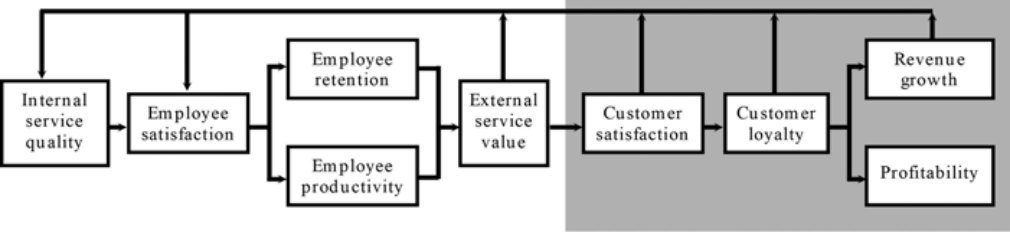
Figure: Service Value-Profit Chain
HRM theories and strategies are deeply advanced within the field of marketing. As a student of management and specifically a specialist in marketing, though certainly a student of HRM, I believe this is a fundamental truth, even if it sounds slightly exaggerated.
service marketing, “People” serves as the fifth P among the foundational 7Ps (the primary marketing tools). To achieve specific marketing goals, these tools must be tailored to the target market. The ideal blend of Product, Price, Place, Promotion, People, Process, and Physical Evidence is designed to fulfil both marketing and overarching organisational objectives. The question then becomes: how do you develop the right people?
a stronger reputation. The company needs to position itself so effectively that a vast pool of talent is inspired to apply, ultimately establishing itself as an employer of choice.
Furthermore, hiring the right individuals through detailed screenings of their physical and mental attributes is only part of the equation. Selected employees must be more than just competent. They must possess genuine enthusiasm for the role. When individuals are passionate about their work, aligning their duties with their personal interests and natural abilities, they perform more efficiently, produce better results, put in greater effort, and show less concern for high monetary demands.
True recruitment does not begin with matching qualifications to a job description, nor with posting vacancies to generate a large applicant pool, selecting fairly among candidates, or actively avoiding nepotism. Instead, recruitment begins with public relations.
Developing the right people does not begin with simply publishing job vacancies in hopes of attracting competent candidates. Before placing announcements across effective media, an organisation must actively build
You will not have a real choice if you fail to attract a broad pool of candidates. While vacancy announcements generate applicants, they cannot guarantee a high volume unless job seekers hold a favourable perception of your organisation. Public relations (PR) builds that positive corporate image. Although the methods of establishing strong PR fall outside our scope today, our focus remains squarely on HRM.
Beyond the initial hire, HR
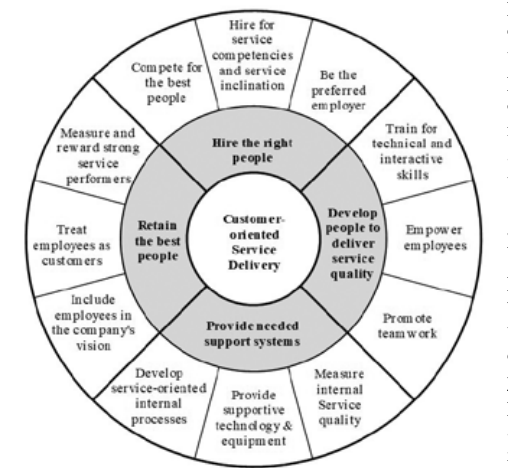
management encompasses a broad spectrum of practices: delivering proper orientation, providing tailored job training, empowering staff, encouraging teamwork, measuring performance, monitoring output, recognising and rewarding high performers, and supplying supportive technologies and tools.
Figure: Human Resource Strategies for Delivering Service Quality through People
Indeed, human resources represent the single most vital factor of production. Even AI acknowledges its limitations: AI cannot succeed in isolation, but human capability enhanced by AI yields the greatest results. The logic is straightforward, AI is built and operated by humans. Ultimately, AI exists to serve humanity, not the other way around.
It also involves designing service-oriented processes from both customer and employee perspectives, aligning staff with the company vision, treating employees as internal customers, ensuring overall job satisfaction, practicing participatory decision-making, and offering competitive fringe benefits alongside fair
The service sector continues to expand, now contributing 63% to global GDP. Within
Figure: Harvard Business Review highlights the Importance of Employees on its Front Cover
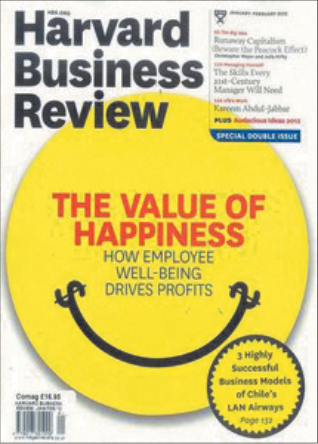
compensation. In marketing terms, this entire ecosystem is known as internal marketing or internal branding.
When a company satisfies its employees, those satisfied employees remain with the organisation. Over time, they specialise in their roles, becoming significantly more productive and efficient. Customers highly value these efficient services, leading to greater customer satisfaction. Satisfied customers then become loyal to both the brand and the organisation, actively spreading positive word-of- mouth. Ultimately, this expands the organisation’s overall business, driving higher revenues and increasing profits.
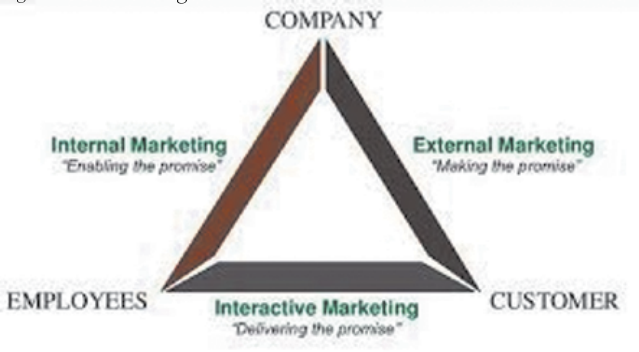
Role of people (human) is emphasised more in the Service Triangle. I call it a love triangle.
Service Triangle is made up of Company, Employees, and Customer.

A traditional love story between companies and customers has existed since ancient times. Yet, in successful service organisations, the bond between the company and its employees is found to be even stronger. Ultimately, exceptional service is born from positive interactions between employees and customers.
Howard Schultz, founder of Starbucks, famously asked, “How can I expect my employees to fulfil customer expectations if I do not fulfil theirs?” Similarly, renowned marketing scholar Karl Albrecht stated, “An unhappy employee can become a terrorist to
the organisation.” Indeed, research shows that most companies fail or underperform because they fail to satisfy their employees.
Therefore, the human factor remains paramount in achieving organisational objectives.
(Dr. Awale is head of Marketing Department at Tribhuvan University Campus. He is founder secretary of Nepalese Marketing Association and chairperson of Service Sector Marketing Council within the organisation. He has authored 11books and contributed seminal research papers in his filed.)
Figure: Service Triangle