
Understanding HRIS, HRMS, and Digital Transformation in Nepal
HUMAN RESOURCE MANAGEMENT (HRM) is fundamentally the process of designing systems for the effective utilisation of human resources within an organisation. It integrates legal frameworks, ethical standards and performance metrics to support effective policy implementation. A well-designed HRM system facilitates workforce management and improves organisational efficiency.
Moving beyond manual processes, companies and organisations are increasingly adopting digital tools to manage various functions. In Nepal, the development of locally designed Human Resource Information Systems (HRIS) has been gradually advancing.
Globally, HRM has been shift ing from an administrative function towards a strategic role that focuses on the optimum utilisation of human resources to support organisational growth, improve productivity and maximise revenue. Although the adoption of strategic HRM in Nepal’s public sector remains slow, improving public service delivery and citizen satisfaction also requires robust human resource management systems in public institutions.
Modern HRM increasingly integrates digital technologies, performance management and ethical governance. Almost every operational function of HRM can be digitised, including recruitment and selection, training and development,

performance management, reward and compensation, and employee relations.
From HR Administration to Workplace Management
An HR Information System (HRIS) is the digital infrastructure through which an organisation stores, processes and uses employee information. A broader Human Resource Management System (HRMS) typically incorporates operational HR functions such as payroll,
attendance, recruitment, performance management, learning and employee self- service.
In Nepal, the terms HRIS, HRMS and HR software are often used interchangeably. The market is gradually moving beyond basic attendance and payroll systems towards integrated platforms that support the entire employee lifecycle.
An effective HRM system should address three fundamental questions: Where is the
workforce? What is happening within the workforce? And what information does management need to make better decisions?
For organisations, the value of HR technology lies not simply in adopting digital tools, but in connecting HR processes, ensuring reliable workforce information and improving visibility across the employee lifecycle. As experts note, this enables HR teams to spend less time managing fragmented administrative processes and more time using workforce data to support organisational performance and strategic decision-making.
HRIS providers customise their systems to meet the specific needs and requirements of companies and organisations. These systems allow organisations to define their own policies, workflows and approval structures without having to move to a separate version of the product. Customers continue to benefit from improvements to the shared platform, while implementation begins with tested configurations rather than building a system from scratch.
As HR software becomes easier to develop and the market grows more competitive, feature lists alone reveal less about a system’s quality and effectiveness. Attendance, payroll, performance management, recruitment and learning may all appear as standard features in a product presentation. The real differentiator is how seamlessly these functions integrate and perform in practice, meeting an organisation’s specific needs and supporting its day-to-day HR operations.
HRIS Providers in Nepal
Current Nepali HRIS providers include Nimble HRMS, Nepal HRM, HajirHR,
CATEGORIES OF THE HRIS/HRMS
Category Typical functions
Basic HR software Employee records, attendance, leave, documents
Payroll/attendance systems Biometric attendance, shifts, overtime, payroll, tax
HRIS/HRMS Employee lifecycle, attendance, payroll, recruitment, performance, ESS
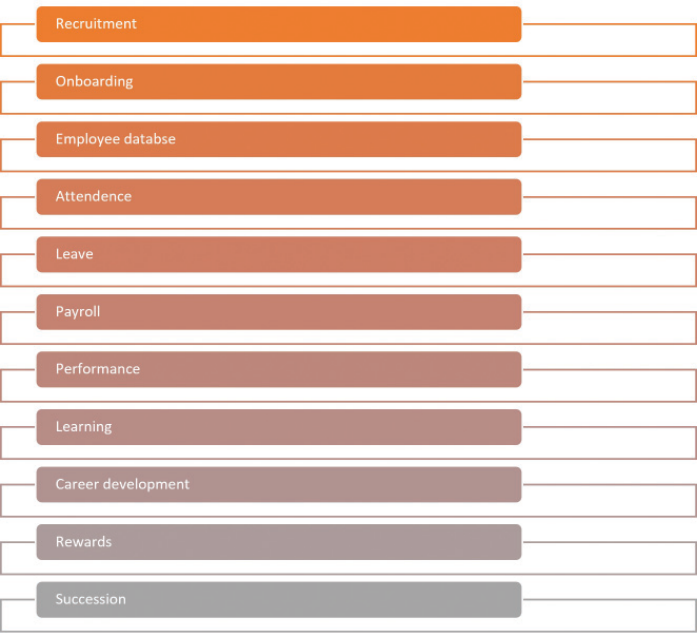
Enterprise HRMS Recruitment → onboarding → performance → learning → compensation → succession → analytics
ERP (Enterprise Resource Planning)-integrated HRM
HR + payroll integrated with finance, accounting and other business processes
Neo Soft ware, RigoHR, Bidhee HRMS, Pace HRMS, Agile HRMS, Hajir Khata, NitiERP, and Real HRSoft , alongside other emerging platforms.
“We view Human Resource Management (HRM) not simply as a digital replacement for HR paperwork, but as an integrated system for managing the entire workforce lifecycle,” said Shreeya Rai, Marketing and Communication Manager of Neo Soft ware. “Our HRM, Empower, is designed to bring employee information, HR processes, attendance, payroll-related activities, performance, learning, and other workforce functions into one connected environment.”
Some local HRIS/HRMS solutions are not confined solely to the Nepali market. RigoHR, founded in Kathmandu in 2010, has been providing cross-border services. Rigo initially became known for getting salaries and taxes right, and that strong foundation gradually grew into RigoHR: a single platform for hiring, employee records, attendance, payroll, performance, learning, employee services, and insights. RigoHR now provides services to more than 500 organisations across seven countries, according to Mukund Pokharel, Founder & CEO of RigoHR.
The more sophisticated providers are attempting to move HR from record keeping

to workforce management and analytics.
Why crucial for companies and organisations?
A major competitive advantage of local providers is Nepal-specific statutory and payroll requirements. For example, platforms are increasingly incorporating Social Security Fund, Provident Fund, Citizen Investment Trust savings, Tax Deduction at Source, Nepal’s income tax slabs, B.S. calendar, payslips and statutory reporting. NepalHRM, for example has said that its platform integrates PF, CIT, SSF and eTDS, while NitiERP similarly incorporates these elements into its HRM/ payroll module.
“This matters because a multinational HR platform may
provide sophisticated global HR functionality but still require substantial localisation for Nepal’s payroll and statutory environment,” according to HRIS service providers.
For example, Nimble describes functionality covering recruitment, HRIS, payroll, employee self-service and 360-degree performance appraisal, while newer platforms such as NepalHRM are combining recruitment, onboarding, payroll, attendance, performance and reporting.
The biggest opportunity: HR analytics
The next stage of HRIS in Nepal is likely to be people analytics. Once an organisation has reliable employee data, the system can potentially help answer questions regarding department-wise turnover, reasons for employees leaving or quitting, learning retention and skilling requirements, better recruitment sources, minimising time to fill positions, comparative performance, calculation of return on training investment, analysing equitable compensation structures, future workforce requirements, and identifying employees for promotion or succession, among others.
On the flip side, HRIS deals with extremely sensitive personal information like salary, attendance, performance ratings, disciplinary records, tax information, health-related employment data, personal documents, and sometimes biometric data. Against this backdrop, continuous digital monitoring aimed at improving performance could create a hostile environment in companies if employees perceive such monitoring as surveillance. At the same time, the sophistication of

the technology must ensure that more data-driven HR does not become less human HR.
A 2026 large-scale study by the Stanford Institute for Human-Centred Artificial Intelligence (HAI) analysed four million job applications and found that 26% of Black applicants faced algorithmic discrimination. Because over 90% of U.S. employers use AI screening from a handful
of the same third-party tech vendors, a qualified candidate rejected by one algorithm faces a highly correlated risk of being automatically filtered out by other companies using the same software.
Likewise, in performance management, the question arises: can algorithms improve consistency and fairness without making compensation decisions feel opaque to employees?

Subash Sapkota Founder & Chairperson
Bidhee
Bidhee- Building smarter, transparent and data-driven workplaces through technology
BIDHEE’S HRIS IS DESIGNED AROUND the complete employee lifecycle, starting from recruitment and onboarding and continuing through attendance, workforce scheduling, payroll, performance, development and eventually offb oarding.
Employee Information & Lifecycle Management The system provides a central employee database covering personal and employment information, digital documents, contracts, department and designation changes, reporting structures, organisational assets and other important employee records. This enables organisations to maintain a consistent employee history rather than having critical information distributed across files, spreadsheets and individual departments.
Attendance, Leave & Workforce Management Attendance can be integrated with biometric devices and other supported attendance mechanisms. Organisations can manage working hours, shifts, leave, holidays, overtime, attendance regularisation and related approval processes from the same ecosystem. This is particularly valuable for organisations managing multiple branches, field employees or complex attendance and workforce policies.
Roster & Shift Management for 24/7 Operations For sectors where workforce availability directly affects service delivery particularly hospitals, hotels and hospitality businesses, manufacturing companies, security services and other 24/7 operations Bidhee’s HRIS supports structured roster and shift management.
HR and operations teams can prepare employee rosters, assign employees to different shifts, manage rotating schedules, weekly offs, shift changes and workforce availability through a centralised system. More importantly, roster management does not have to operate as an isolated function. It can be connected with attendance, leave, overtime and payroll, allowing organisations to compare scheduled working hours with actual attendance and manage workforce related calculations more systematically.
For example, a hospital may need to maintain continuous staffing across morning, evening and night shifts, while a hotel may need different
staffing levels across front office, housekeeping, food and beverage, security and other operational departments. A structured roster system gives management better visibility into who is scheduled, who is available and where workforce gaps may exist.
This helps shift based organisations reduce manual scheduling complexity, manage overtime more effectively and maintain appropriate workforce coverage while improving coordination between HR and operational teams.
Payroll & Nepal-Specific Requirements A major strength of Bidhee’s approach is its understanding of the Nepali business and regulatory environment. The payroll system is designed to support local salary structures and requirements, including applicable income tax calculations, SSF, EPF/CIT, allowances, overtime, leave without pay, deductions, festival-related benefits and organisation-specific payroll policies. By connecting attendance, leave, roster information, overtime and employee data with payroll, organisations can significantly reduce repetitive calculations and manual intervention.
Recruitment & Onboarding Recruitment processes can be structured from manpower requisition and candidate management through interview and selection stages, helping organisations maintain a more organised recruitment pipeline and transition selected candidates into employee records.
Performance & Talent Management Organisations can structure performance processes around KPIs, objectives, appraisal cycles, employee evaluations and feedback mechanisms. This creates a stronger connection between individual performance, organisational objectives and employee development.
Training & Employee Development Training activities and employee development records can also be maintained systematically, helping HR teams understand employee development history and future capability requirements.
HR Analytics & Management Reporting Bidhee provides management with structured HR information through dashboards and reports covering areas such as headcount, attendance, absenteeism, employee movement, payroll, workforce costs and shift-related workforce information. This gradually changes HR reporting from simply answering “What happened?” to helping management understand “What does this mean for our workforce?”

Khem Raj Ghimire Founder & Managing
Director Nimble Infosys Pvt. Ltd.
NIMBLE HRMS IS AN integrated platform we have built and refined over more than 14 years, alongside Nimble FIMS (asset management), Nimble Workflow (process automation) and Nimble Analytics (reporting and decision support). Our approach is simple: people, the assets they use and the approvals they depend on should run on one platform, from a single source of truth.
At its centre is a unified employee record that follows each person through the lifecycle: from recruitment and onboarding, through attendance, leave, payroll, performance and development, to separation. Data captured once is reused
Transparency, Consistency, Accountability and Data Control: Four Pillars of Nimble
across every connected process, reducing duplicate entry and inconsistencies.
Nimble Workflow lets organisations configure their own approval routes, policies and rules rather than bending their processes to fit rigid software. Employees and managers use self-service through web and mobile, while HR manages the workforce from a central, role- based platform. Integration with attendance devices, ERP systems, Active Directory and other applications means HR works as part of the organisation’s wider digital ecosystem, not as a standalone tool.
Range of HR services and processes • Core HR and employee lifecycle: employee records, organisation structure, documents, recruitment and onboarding, transfers and promotions, HR letters, and exit management with clearance and full-and- final settlement • Time, leave and payroll: device, mobile and GPS-based attendance, shifts and rosters, configurable leave policies, and multi-company payroll with Nepal statutory compliance (income tax, SSF, CIT, provident fund, gratuity), loans and advances, plus payroll for India and other countries • Performance and development: goals and KPIs, appraisal cycles up to 360-degree, training management, certification and online examinations • Employee services: self-service, an employee service desk, grievance management, travel and expense claims, insurance and medical claims, and engagement surveys • Planning and analytics: workforce planning and HR budgeting, project and task tracking, and reporting on headcount, workforce cost, attrition, attendance and compliance
For larger and multi-company organisations, these processes can also connect with fixed assets, inventory, procurement and organisation-wide approval workflows.
Improving efficiency, accuracy and effectiveness The biggest gains come from removing manual handoffs between disconnected systems, spreadsheets and people. When attendance flows directly into payroll, employee data is reused across processes, and approvals move through defined workflows, repetitive data entry and calculation errors largely disappear. HR teams spend less time processing transactions and more on workforce planning, employee development and strategic decisions.
One business group, for example, runs around 40 companies and nearly 5,000 employees on a single Nimble installation. Each company keeps its own policies, structures and approval rules, while group management sees consolidated HR information across all of them.
Today more than 500 organisations use Nimble, from smaller workforces to enterprises with thousands of employees, across banking, insurance, telecommunications, technology, hospitality, healthcare, manufacturing and retail. Our clients include Chaudhary Group, WorldLink, Nepal Rastra Bank, Rastriya Banijya Bank, F1Soft , Soaltee Hotel, Nepal Life Insurance, Novic, Mediciti and otthers.
Building and maintaining trust HR systems hold some of the most sensitive information in an organisation, so trust cannot come from technology alone. In our experience it rests on four things:
• Transparency: employees can see their own payslips, leave balances, attendance, requests and appraisal status without depending on HR for routine information. • Consistency: policies and approval rules are configured once and applied the same way to everyone. • Accountability: workflows and audit trails record what happened, when, and who approved it. • Data control: role-based access ensures each user sees only what their role requires, and Nimble can be hosted on-premise or locally where data residency and security matter.
Looking ahead, we are working on applying AI to analytics, workflow recommendations and the automation of repetitive tasks, so the system helps organisations interpret information and not only record it.
Aft er more than 14 years of building systems for Nepali organisations, we believe trust comes from combining technology with a sound understanding of local HR practice, regulation and organisational realities. In short, HR technology should make organisations more transparent and accountable, not just more automated.
Nimble is offered in two deployment modes: as a cloud-based SaaS subscription, or as a licensed system installed on the organisation’s own premises. Organisations choose the model that best suits their IT policies, data requirements and budget.

Mukund Pokharel
Founder & CEO
Rigo HR
SIXTEEN YEARS, MORE THAN 500 ORGANISATIONS ACROSS SEVEN COUNTRIES, OVER 100,000 EMPLOYEES ON THE PLATFORM AND MORE THAN NPR 300 CRORE IN SALARIES PROCESSED EVERY MONTH. RIGOHR HAS GROWN FROM A STRONG PAYROLL SYSTEM BUILT FOR NEPAL INTO A COMPLETE PEOPLE MANAGEMENT PLATFORM COVERING ALMOST EVERY STAGE OF THE EMPLOYEE JOURNEY.
RigoHR: Built for the Way Organisations Really Work
Every month-end, HR and finance teams face the same struggle: match attendance with leave, verify overtime and allowances, apply salary changes, recalculate taxes, and prepare bank files. When this work is scattered across spreadsheets and disconnected systems, data is entered twice, and hours disappear into reconciliation.
Rigo was founded in Kathmandu in 2010 became known for getting salaries and taxes right, and that strong foundation gradually grew into RigoHR: one platform for hiring, employee records, attendance, payroll, performance, learning, employee services and insights.
The philosophy behind that growth remains straightforward: HR software should reduce administrative work rather than to create more of it.
One Employee Record, One Connected Platform At the centre of RigoHR is a single employee record. A promotion or salary revision is entered once and reaches payroll automatically. Approved leave shows up in attendance and, where relevant, in payroll. Performance results can inform increments, promotions, and development plans, and completed training becomes part of the employee’s record.
This connection is central to RigoHR’s design. Payroll, attendance, performance, learning, and employee services are not separate applications under one menu. Information moves through the employee lifecycle, which means less duplicate entry, fewer manual reconciliation, and a clearer history of each employee.
Everyone works from the same data according to their role. Employees use the mobile app for leave, attendance, and payslips. Managers review and decide; HR administers processes, finance works with approved payroll data, auditors follow changes through the system history, and senior management tracks engagement, people cost and attrition.
Recruitment extends the lifecycle through RigoJobs, Rigo’s talent acquisition platform. Once a candidate is selected, their information moves straight into the employee record instead of being entered again. In a crowded HR software market, the value of a platform lies not in how many features it lists, but in how well they work together.
Built Around Nepal, Designed to Scale Being developed in Nepal has allowed RigoHR to build local requirements into the core of the product. Payroll supports projected annual income for tax deduction, Social Security Fund, Citizen Investment Trust, provident fund, insurance, festival allowance, loans and advances, bonuses, arrears and final settlement. The platform also works with both Nepali and English calendars.
This local understanding matters most in payroll, where even small errors can cause operational and compliance problems. Salary structures, attendance, leave, overtime, allowances, statutory contributions, taxes, loans and adjustments must all come together in one result, with a clear trail back to the rules and approved transactions behind it. That foundation has let RigoHR grow beyond payroll while keeping the depth larger organisations need.
Beyond Administration: Performance, Learning and Employee Experience As organisations digitise basic HR administration, expectations move beyond records and payroll towards performance, development and better management information. RigoHR supports goals and KPIs, review structures, rating scales, evidence, feedback and multiple levels of review. Instead of a once-a-year form, performance builds throughout the cycle and later informs increments, promotions, training and development.
The platform also covers everyday employee experience: self-service, appreciation, feedback, grievances, helpdesk and notices. Usability matters here. Employees should not need training to apply for leave or view a payslip, and managers should see what needs their attention without extra clicks. Most employee activities, and over 95 percent of routine manager activities, can be done on the mobile app.
Configuration Instead of Repeated Customisation One of RigoHR’s more deliberate choices is how it handles customer requirements. Enterprise software becomes hard to maintain when every organisation gets its own customised version. A change that helps one customer can eventually split the product into many versions and make every upgrade more complex.

Roshan Adiga Chief Executive Officer, Neosoftware Private Limited
AT NEO SOFTWARE, we view Human Resource Management (HRM) not simply as a digital replacement for HR paperwork, but as an integrated system for managing the entire workforce lifecycle. Our HRM, Empower, is designed to bring employee information, HR processes, attendance, payroll-related activities, performance, learning, and other workforce functions into one connected environment.
Empower operates through a centralised employee and organisational database. Employee information is maintained throughout the employment lifecycle, beginning with recruitment and onboarding and continuing through attendance, leave, payroll, performance, training, development and other employment-related processes. Changes made to relevant employee information can therefore be reflected across connected HR processes, reducing repetitive data entry and the possibility of inconsistencies.
The system is also designed to support organisations with distributed or complex workforces. Attendance can be captured through supported attendance machines or mobile devices, while organisations can manage shifts, working hours, overtime and leave through the system. This is particularly important for organisations operating across multiple branches, locations or shifts, where maintaining a consistent view of the workforce can otherwise become difficult.
Building an Integrated HR System for Modern Organisations
Range of services
the same information across different systems.
Core HR and Employee Information Management Employee information management is at the foundation of Empower. The system provides a structured environment for maintaining employee records and managing information throughout the employee lifecycle. HR teams can manage employee profiles, organisational information, employment- related records, and other relevant workforce information from a central system. Onboarding is also digitised, making it easier to add new employees and maintain their information as their employment progresses.
Attendance, Time and Shift Management Attendance and time management are another important component of the system. Empower supports attendance through machines and mobile devices, allowing organisations to capture workforce attendance digitally rather than relying heavily on manual records. The system supports time-sheet management, working hours, overtime tracking, and multi-shift scheduling. This becomes particularly valuable for organisations where employees work different shifts, locations, or schedules. By bringing attendance and time information into the HR system, organisations can establish a more structured connection between employee attendance, working hours, leave and other downstream HR processes.
Leave and Employee Administration Empower digitises routine employee administration, including leave management. Employees and HR teams can manage leave requests through the system rather than depending entirely on paper forms, emails or spreadsheets. This creates a more organised process in which leave information is recorded centrally and can be accessed when required. The same principle applies to other employee-related processes such as expenses, advances, loans, incentives and related administrative activities. These functions can be managed within the broader HR environment rather than treated as completely separate processes.
Recruitment and Onboarding Modern HR management begins before an employee joins an organisation. Empower therefore extends into recruitment and onboarding, helping organisations manage the transition from candidate to employee in a structured way. Once an employee joins, onboarding information can be captured within the system and connected to the employee’s ongoing HR record. This reduces the need to repeatedly collect and maintain
Performance and Workforce Development HRM should also support organisations beyond administration. Empower incorporates performance management, employee training and development, and skills-related information to help organisations manage workforce development more systematically. Performance information can be maintained alongside employee records, while training and development activities can be tracked as part of the wider employee lifecycle.
Reporting and Management Insights A key strength of an integrated HRM is its ability to turn operational HR data into usable management information. Empower provides reporting capabilities that allow organisations to generate HR reports and analyse workforce information. Rather than depending entirely on manually prepared spreadsheets, HR teams can work with information maintained within the system and generate reports according to organisational requirements. Empower also supports custom reports and insights, allowing organisations to use HR information according to their own reporting requirements rather than being restricted to a fixed set of standard reports.
Mobile and Integrated Access Modern workforces are not always operating from a single office, so HR systems also need to support mobility. Empower includes mobile functionality and supports attendance through mobile devices, helping organisations manage workforce activities beyond a traditional desktop environment.
More broadly, Empower is designed to operate within an integrated business technology environment. Neo Soft ware’s wider ERP platform connects HRM with functions such as finance, accounting, inventory, procurement, sales and other business processes. This creates an opportunity to connect workforce information with the wider operational information of an organisation rather than keeping HR completely isolated from the rest of the business.
From HR Administration to Workforce Management The larger objective of Empower is therefore to move HR from fragmented administration towards integrated workforce management. An effective HRM should answer three fundamental needs: Where is the workforce? What is happening within the workforce? And what should management know to make better decisions? Empower addresses these needs by connecting employee information, attendance, leave, shifts, payroll-related processes, recruitment, performance, training, expenses and reporting within a common HR environment.

