
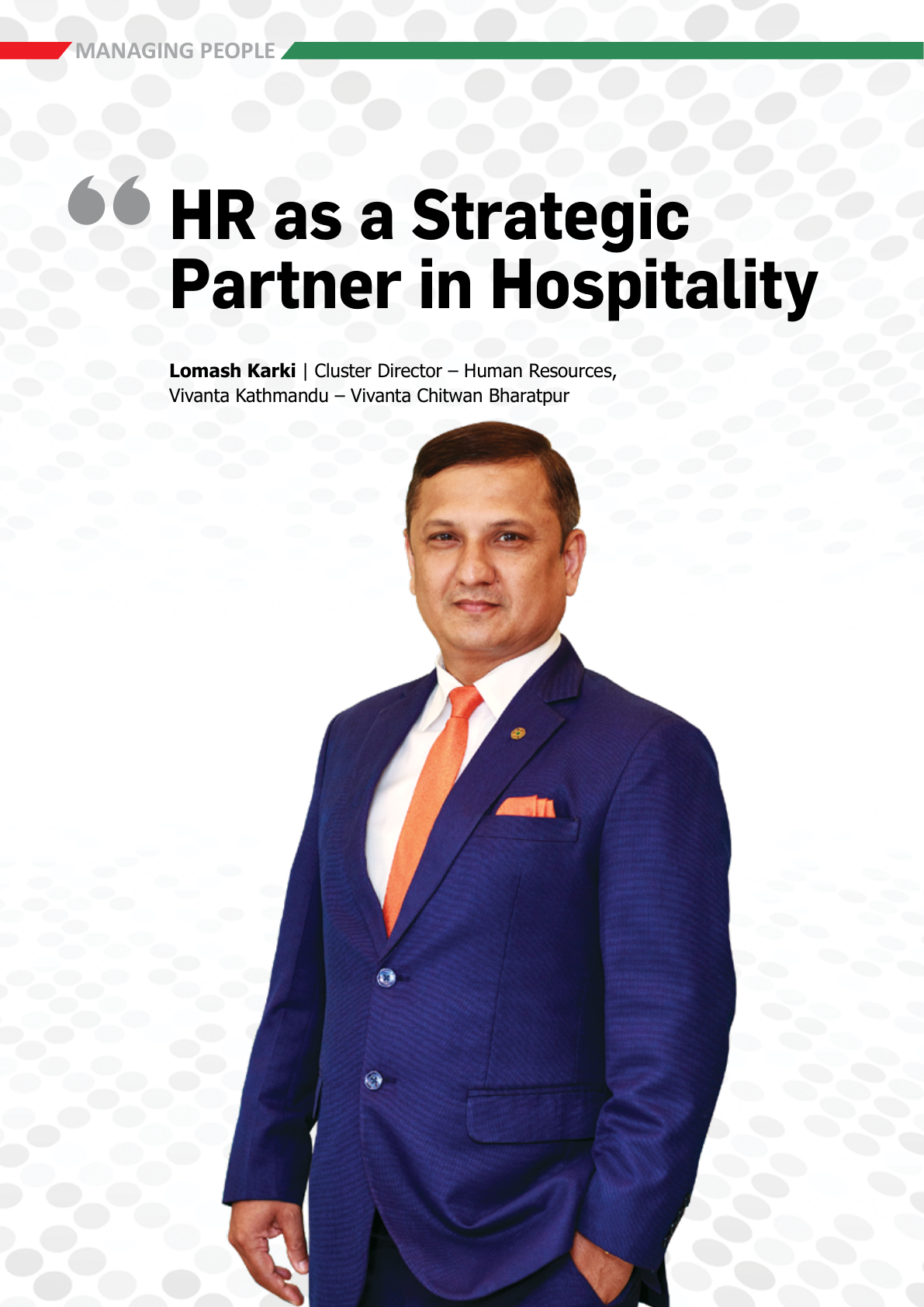
Lomash Karki | Cluster Director – Human Resources, Vivanta Kathmandu – Vivanta Chitwan Bharatpur

L omas Karki is a seasoned HR professional with a passion for fostering exceptional workplaces, bringing rich expertise in talent acquisition, employee engagement, performance management, and organisational development. In his current role, he leads HR initiatives designed to ignite talent, fuel innovation, and deliver outstanding guest experiences. The HRM Nepal caught up with Karki to discuss the evolving dimensions of HR strategies and functions. Below are excerpts from the interview.
Q: What makes HR a strategic function rather than just an administrative function in an organisation?
A: HR stops being administrative the moment it starts influencing decisions before they are made, not just processing them after. In a hotel, that means being at the table when we plan a new pre-opening, a rebrand, or a market repositioning – not brought in afterward to write job descriptions. Administrative HR manages payroll, leave, and compliance. Strategic HR asks whether our workforce plan actually supports for minimum the three-year business plan, whether our culture will carry the brand promise we’re selling to guests, and whether our leadership pipeline can survive the next five exits.
Across my time with Taj, Shangri-La and Wyndham, the properties that performed best were the ones where HR shaped structure, cost, and service capability alongside Finance and Operations, rather than reacting to what those functions decided. Strategic HR is measured by business outcomes – revenue per available room, guest satisfaction, retention of critical talent – not by how efficiently forms get processed.
Q: Why does every organisation need a clear HR strategy aligned with its business strategy?
A: Without alignment, HR ends up optimising for the wrong things – hiring fast when the business needs hiring right, or building generic training when the business needs a very specific service capability to differentiate itself. A luxury hotel and a budget property need entirely different HR strategies even if they sit on the same street, because the guest promise, the margin structure, and the skill intensity are different.
A clear HR strategy translates the business strategy into people terms: what capabilities do we need, by when, at what cost, and how do we retain them once built. It also gives every HR initiative – recruitment,
L&D, engagement, compensation – a shared purpose, so they reinforce each other instead of competing for budget and attention. When HR strategy and business strategy diverge, you get symptoms leadership feels immediately: high cost of hire, disengaged talent in mission-critical roles, and a culture that doesn’t match what the brand is promising guests or investors.
Q: How important is job analysis in defining clear roles, responsibilities and Key Result Areas?
A: It’s the foundation everything else sits on. I’ve seen organisations design elaborate KRA frameworks and performance scorecards on top of job descriptions that were never properly analysed – copied from a previous property, translated loosely, or written once at opening and never revisited. The result is KRAs that sound comprehensive but don’t map to what the role actually does day to day, so appraisals become arguments about definitions instead of conversations about performance.
Proper job analysis – understanding the tasks, the decision rights, the interfaces with other departments, and what ‘good’ looks like in that specific property’s context – is what lets you write KRAs that are specific, measurable and genuinely owned by the employee. In pre-opening projects particularly, where roles are being defined for the first time, rigorous job analysis upfront saves months of role confusion and turf disputes once the hotel is operating.
Q: How should HR define KRAs for employees whose roles involve different departments?
A: Cross-functional roles are where most KRA frameworks fall apart, because a single reporting line rarely reflects how the work actually happens. My approach is to map the role against every function it genuinely touches, then agree KRAs with each stakeholder department before finalising anything – a banquet coordinator’s targets, for instance, should be signed off by both Food & Beverage and Sales, not
written by one and imposed on the other.
Weigh each KRA by where the real business impact and time investment sit, not by which department shouts loudest. It also helps to separate individual KRAs from shared, joint KRAs – outcomes that two or more departments are accountable for together, like a successful event or a smooth guest handover – so nobody can hit their own numbers while the cross-functional outcome fails. Finally, review these KRAs more frequently than single-department roles, because the balance of work across functions shifts with seasonality and occupancy.
Q: How can organisations align individual KPIs with their overall business goals?
A: Start from the top and cascade deliberately – the hotel’s annual business plan should translate into departmental goals, and departmental goals into individual KPIs, so a housekeeping supervisor’s targets are visibly connected to the property’s guest satisfaction and cost goals, not invented in isolation. The mistake I see most often is KPIs being set from historical templates rather than from the current year’s actual priorities, so people are measured on what mattered two years ago.
I also insist KPIs mix outcome and behaviour – revenue and guest scores alongside how the goal was achieved – because in hospitality, hitting a number by damaging team morale or guest trust is not real performance. Involving employees in setting their own KPIs, within the boundaries of business goals, builds ownership that a purely top-down target never does. And KPIs need to be revisited mid-cycle, not just at year-end, because business priorities in this industry shift with demand faster than annual plans account for.
Q: What makes a performance appraisal system fair and effective?
A: Fairness starts long before the appraisal conversation – with clear KRAs agreed at the start of the cycle, consistent documentation of performance through the year, and calibration across departments so a ‘meets expectations’ means the same thing in Housekeeping as it does in Sales. A system becomes unfair the moment it relies on a manager’s memory of the last two months rather than evidence gathered continuously.
Effectiveness comes from the conversation being two-way – the employee should walk in knowing roughly where they stand, because there have been no surprises saved up for one meeting a year. I also believe ratings should be defensible with specific examples, not adjectives, and that the system needs a genuine appeal or review mechanism so employees trust the outcome even when they disagree with it. And it must feed forward – into development plans, succession conversations and rewards – otherwise it becomes a paperwork exercise that people rightly stop taking seriously.
Q: How can senior management build trust in the performance evaluation system?
A: Trust is built through consistency and visible fairness, not through communication campaigns. Leaders build it by applying
the same standards to themselves and their direct reports as they expect at every other level, by calibrating ratings across departments so outcomes aren’t dependent on which manager you happen to report to, and by acting on the results – promotions, rewards and development opportunities need to visibly follow strong appraisals, and underperformance needs to be addressed rather than carried indefinitely. Transparency about the process itself matters as much as the outcome: employees trust a system they understand, even one with hard conversations in it, far more than one that feels opaque even when the ratings are generous. I’ve also found that senior leaders walking the floor and knowing their people directly – not just reading dashboards – is what makes an evaluation feel accurate rather than administrative, especially in a people-intensive business-like hospitality.
Q: What are the major challenges organisations face in attracting and retaining talented employees today?
A: In today’s hospitality landscape, our market’s greatest challenge is competing with international opportunities. Once trained to global brand standards, skilled hospitality professionals become increasingly mobile, attracted by compensation packages in Gulf, Southeast Asian, and Western markets that we cannot always match. Retention has become as much about growth pathways and exposure as it is about pay. Employees want to know that two or three years in, they’ll have moved somewhere, whether that’s a bigger role, a different market, or a pre-opening assignment.
Another real challenge is the gap between the skills fresh graduates bring and what a luxury property actually needs at the guest interface, which means organisations have to invest heavily in onboarding and training rather than expecting job- readiness. And in a relatively small talent pool like Nepal’s, the same experienced professionals move between the same handful of properties, so building genuine loyalty and a strong employer brand matters more here than in larger, deeper labour markets. Q: In the hospitality sector, why do skilled employees often leave, and what can employers do to retain them?
A: It’s rarely pay alone, though pay is always part of it. Skilled hospitality employees leave because the work is physically and emotionally demanding – long hours, split shifts, constant guest- facing pressure – and if that demand isn’t matched by recognition, career movement and a workplace culture that treats them with respect, the relationship erodes. Many also leave because they don’t see a next step: hospitality careers can plateau quickly if organisations don’t actively plan progression.
What works is treating retention as a deliberate strategy rather than a reaction to resignations – clear career ladders, cross-training that keeps roles interesting, genuine investment in wellbeing given the demands of shift work, and recognition that’s specific and frequent rather than an annual award ceremony. Pre- opening and expansion opportunities are also powerful retention tools in our industry – the chance to build something new keeps ambitious talent engaged in ways a stable, unchanging role often cannot.
Q: How frequently should organisations assess employees’ skill gaps and training needs?
A: I don’t believe this should be a once-a-year exercise tied only to the appraisal cycle – skill gaps in hospitality show up in real time, through guest feedback, service audits and operational data, and training needs should be identified as close to that moment as possible. That said, a structured, formal skills and training needs assessment should happen at least twice a year, aligned with seasonal business cycles, so training calendars can be planned around occupancy rather than disrupting peak periods.
New brand standards, new technology rollouts, or a change in market segment should each trigger their own targeted assessment outside the regular cycle. The frequency also depends on the role: guest-facing and technically skilled positions need more continuous attention than back-of-house administrative roles, because the cost of a skill gap shows up immediately in the guest experience. If an employee’s skills fall below expectations, we can conduct monthly performance assessments, provided the employee receives prior notification. Otherwise, an annual review remains sufficient for an established company in today’s context.
Q: What role does workplace culture play in employee engagement and productivity?
A: In hospitality, culture is not a soft add-on – it is the product. Guests can feel, within minutes, whether a team genuinely enjoys working together or is simply performing service because they’re told to, and that difference shows directly in guest scores and repeat business. A strong culture – where people feel respected, where effort is recognised, and where there’s psychological safety to raise a problem before it becomes a guest complaint – produces employees who go beyond their job description because they want to, not because they’re monitored.
I’ve consistently seen that engagement scores and productivity move together with culture, not with compensation alone; two properties paying the same salaries can have very different performance purely based on how leadership treats people day to day. Building that culture is deliberate work – it comes from how managers behave under pressure, how recognition is given, and whether the organisation’s stated values actually show up in daily decisions.
Q: How can organisations ensure fair pay, promotion and rewards across different types of jobs and professions?
A: Fairness requires a structured, evidence-based framework rather than case-by-case decisions – clear job grading that reflects skill, responsibility and market value across departments, so a chef’s grade and a front office manager’s grade are comparable on consistent criteria even though the jobs look nothing alike. Regular market benchmarking is essential in hospitality because skill scarcity shifts quickly, and pay structures that made sense two years ago can quietly become unfair or uncompetitive.
Promotion criteria need to be equally transparent and applied consistently across departments, with calibration at a senior level to prevent one department’s standards from being softer
than another’s. I also believe pay equity reviews should be done proactively and periodically, not only when someone raises a concern, because by the time a complaint surfaces, trust has usually already been damaged. Fairness is ultimately demonstrated through consistency over time, not through a single well-designed policy document.
Q: Could you share an HR initiative or practice that you introduced and found particularly effective?
A: One of the initiatives I’m most proud of came out of pre- opening work, where the challenge is building a cohesive culture among a team that has never worked together before, often from very different professional backgrounds. Rather than relying only on classroom induction, I built a structured cross-exposure programme where new joiners – regardless of department – spent time actually working shifts in two or three other departments before settling into their own role. It sounds simple, but the impact on collaboration was significant: a front office associate who has worked a housekeeping shift handles a guest complaint about a room very differently, and departments stop treating each other as obstacles once people have stood in each other’s shoes. It also gave us far better placement decisions, because we could see where people naturally performed best rather than relying only on their CV. It has become something I carry into every property I open. Different fun activities what we’ve introduced at work on a weekly basis are a few initiatives.
Q: How are AI, automation and data analytics changing the role of HR professionals?
A: They are removing the transactional work that used to consume most of an HR team’s time – scheduling, leave processing, first-round screening, routine reporting – and that shift is forcing HR to become genuinely strategic rather than merely claiming to be. Data analytics now allow us to predict attrition risk before someone resigns, identify which training investments actually move guest satisfaction scores, and make workforce planning decisions based on evidence rather than intuition.
In hospitality specifically, AI is starting to support recruitment screening and even elements of guest-facing service, which changes the skill profile HR needs to hire and train for. The risk is treating these tools as a replacement for judgement rather than an input to it – in a people-intensive business, the final decisions about culture, fairness and individual circumstances still need a human HR professional who understands the context data can’t fully capture. HR professionals who will thrive over the next decade are those actively building genuine data literacy today. However, the emotional connection, originality, and personal care provided without AI remain among the key elements that artificial intelligence lacks.
Q: What major changes do you expect in HRM over the next five to 10 years?
A: Where there are challenges, there are also solutions – when one door closes, another opens. However, I expect HR
to become far more predictive and far less reactive, using data to anticipate attrition, skill gaps, and workforce needs rather than merely responding after the fact. I also expect a real shift in what employees expect from employers – wellbeing, flexibility and purpose will matter as much as compensation, especially as younger talent enters the workforce with different priorities than the generations before them. In hospitality specifically, I think we’ll see skills-based hiring take over from purely credential- based hiring, because the pace of change in guest expectations and technology means adaptability matters more than a fixed qualification. Hybrid and cross-border talent mobility will also increase, which means HR will need to think regionally rather than property by property. And I expect the HR function itself to keep shrinking in headcount while growing in influence – smaller teams doing more strategic, higher-value work, supported by technology handling the transactional layer.
Q: Finally, what is your key message to HR professionals and business leaders about effective people management?
A: People management is not a support function sitting alongside the business – it is how the business actually gets delivered, especially in an industry like hospitality where the product is the people. My message to HR professionals is to earn a seat in business conversations by speaking the language of business outcomes, not just HR process, and to never lose sight of the fact that behind every KPI is a person whose trust has to be earned continuously, not assumed.
To business leaders, my message is that investing in people development, fair systems and genuine culture is not a cost centre to be trimmed in difficult years – it is the very thing that determines whether the organisation survives those years well. The organisations that treat their people strategy with the same rigour as their financial strategy are consistently the ones that outperform over the long term, and that has been true in every property and every market I have worked in.
Ultimately, motivation is inherently fluctuating: a factor that drives you today may lose its impact over time. Therefore, discipline remains the core foundation, providing lasting satisfaction and leading to consistent, steady success.


