The only certainty going forward is uncertainty

T he world order set up after WWII is being dismantled. But this dismantling is not coming from new challengers. It is in fact largely coming from the country that set-up this world order – the United States of America. US economic policy and military actions are now among the most immediate sources of global risk and uncertainty. A trigger-happy US, which has reverted to calling the Department of Defence the “Department of War”, has launched yet another war of choice in West Asia — this time against Iran — without again any evidence of weapons of mass destruction and without even the pretense of a United Nations resolution. Coming soon after Russia’s uncalled for invasion of Ukraine, jungle-raj where might-is-right prevails in the world.
Mr. Trump’s America First slogan is “Make America Great Again” (MAGA) and has become a movement. His weapons in this quest include withdrawing from existing global agreements (Paris climate accord) and many UN institutions, including the World Health Organisation, ask allies to pay more (North Atlantic Treaty Organisation) by raising their defence spend to over 5% of gross domestic product (GDP), threatening to take-over Greenland from Denmark ( a NATO ally) and deport millions of illegal migrants.
He has forced the World Bank and the International Monetary Fund to give up support for climate change projects and undercut the World Trade Organisation – with his unilateral tariffs – to make it largely ineffective.
Despite the welcome US Supreme Court decision declaring the unpopular and harmful “reciprocal tariffs” under the International Emergency Economic Powers Act (IEEPA) Act illegal, President Donald Trump has not backed off. He quickly imposed a 10% tariff on all imports under Section 122 of the Trade Act of 1974, effective for 150 days in addition to the 25% tariffs on steel and aluminium which he imposed under
Section 232 of the Trade Expansion Act of 1962. He has now used these at the end of July when his tariffs under Section 122 expired to extend his tariffs using Section 301 of the Trade Act of 1974 to place 10% to 12.5% tariffs on goods from 60 trading partners over allegations regarding forced labour imports and Section 338 of the Tariff Act of 1930 to place 50% retaliatory tariffs on specific Canadian goods (such as cars, dairy, and alcohol) citing discriminatory trade practices. These twists and turns have raised dramatically the tariff rate for the United States (Figure 1).
But the tariffs have not helped to make any substantial dent in its very
Figure 1: Trumps has Raised Tariff rates Substantially
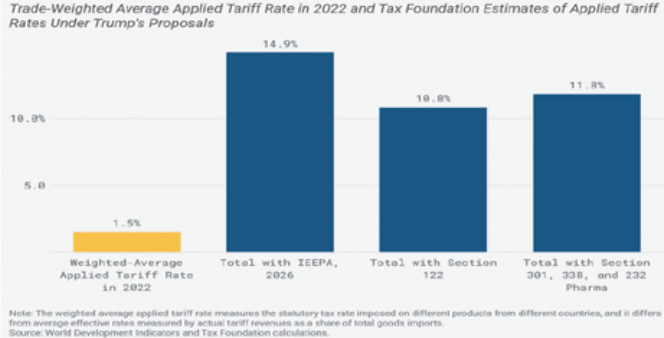
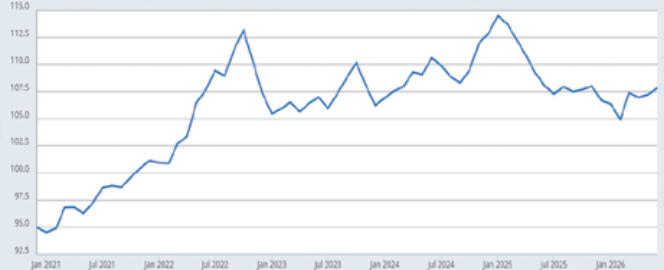
Figure 2: But Dollar Appreciation has tempered their impact Real Effective Exchange Rate Index for US $
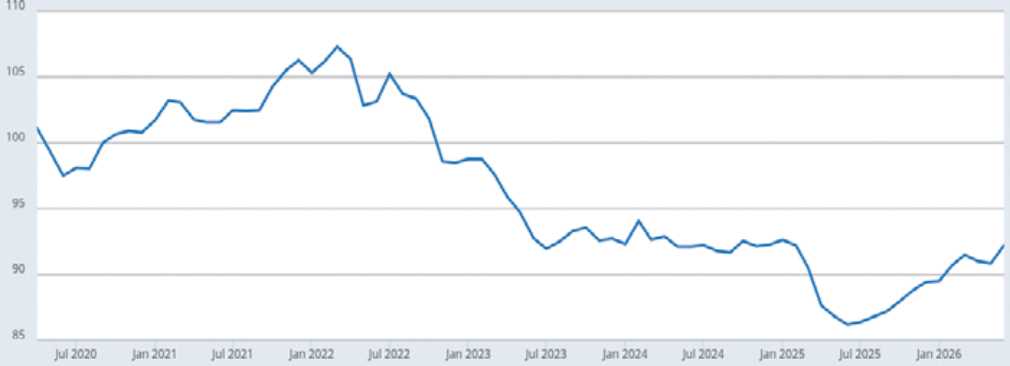
subsidies and an undervalued exchange rate (see Figure 4).
The IMF ‘s latest ESR estimates that China’s exchange rate is undervalued by over 20%. Its exports to the US have declined, but its overall trade surplus in 2025 increased to over $1 trillion (5% of gross domestic product). The International Monetary Fund says, “China’s reliance on manufacturing-led growth is creating significant internal and external imbalances, … causing ‘adverse spillovers’ for global trading partners.” These policies are hurting many of China’s trading partners and hollowing out their manufacturing sectors. These post- pandemic policies may be causing greater damage than even the COVID pandemic itself which originated in China and cause considerable health and economic damage around the world in 2020 and 2021.
Source: Bank for International Settlements (BIS)
high external deficit, because its fiscal deficit remains very high and the US dollar appreciated hugely since the pandemic in 2020 (see Figure 2) and according to the 2026 IMF External Sector Report (ESR) remains over valued by around 19%. This has helped businesses exporting to the United States manage the higher tariffs and kept demand for imports elevated. The US Current Account deficit was 3.6% of GDP in 2025, down only a bit from 4% in 2024 (the 2016-19 average deficit was about 2%).
in the oil price showing the return of stagflationary pressures. And for countries like Nepal which are highly dependent on remittances, the effects of this war may be larger.
With the G2 (US and China) following mercantilist policies, the rest are trying to accelerate trade and investment agreements with one another. A flurry of such agreements – Korea-Japan, India-European Union, EU-Mercosur, to name a few – which would have dragged on for years have been signed. A broader trade agreement between the EU and 12 countries – Australia, Brunei, Canada, Chile, Japan,
With the US inexplicably damaging its economic and strategic relationships around the world, China is trying to position itself as the more responsible global power and to some extent even a supporter of the existing world order. But China is no help. Instead of rebalancing towards higher domestic consumption, China has doubled down on exports with huge industrial
The war in Iran continues to linger with no end in sight. Iran has discovered that the Strait of Hormuz is more lethal than even having a nuclear weapon. And with no lasting peace agreement in place the International Energy Agency (IEA) now projects that a $20 per barrel higher for 2026 from its pre- war projected price may well materialise. Figure 3 shows my estimates of the higher oil prices in the world economy and individual countries for a $20 per barrel increase
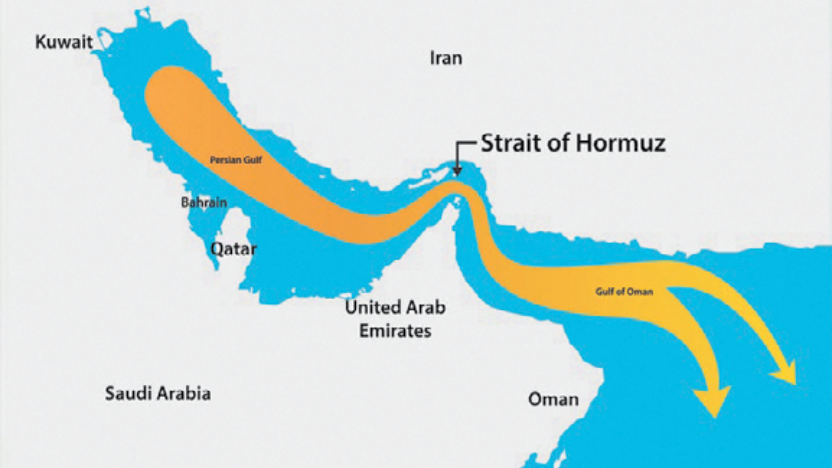
Figure 3: Stagflation Returns: Growth and Inflation impact due to $20 per barrel higher Oil Price
Country % points of GDP decline
% point CPI increase
USA -0.2 0.4-0.8
Japan -0.4 to -0.8 0.6-1.4
EU -0.3 to -0.4 0.6-0.8
China -0.2 to -0.4 0.2-0.6
Thailand -0.2 to -0.4 0.8- 1.0
Korea -0.4 to -0.6 0.4-0.6
Philippines -0.4 to -0.5 0.7-1.2
Vietnam -0.4 to-0.6 0.5-1.0
Pakistan -2.0 to -3.0 1.0-1.2
Nepal -0.8 to -1.2 0.6-1.0
India -0.6 to -1.0 0.6-0.8
Russia +1.4 to +2.0 uncertain
World -0.2 to -0.4 0.8 Source: Author’s Estimates from Country and International Sources
Malaysia, Mexico, New Zealand, Peru, Singapore, UK and Vietnam under the Comprehensive and Progressive Agreement for Trans-Pacific Partnership (CPTPP), basically every important trading country of the Pacific Rim – will form the world’s biggest trading bloc without the US and China. This will help.
The headwinds the world faces are being caused by the economic policies of both the G2 – the United States and
China – as well as the wars in Ukraine and now with Iran. Artificial Intelligence (AI) offers great promise or peril depending on how you see it but is also adding to the uncertainty. What is clear is that we are in a world of great uncertainty, which every country and every business must factor in and deal with by building resilience in their supply chains using buffers and hedging their finances. But all this comes at considerable cost.
(Chhibber is Distinguished Visiting Scholar, Institute for International Economic Policy, George Washington University, former Assistant Secretary General at the UN and senior World Bank official.)
Figure 4: Chinese Yuan has depreciated hugely since COVID Real Effective Exchange Rate Index Chinese Yuan
Source: Bank for International Settlements (BIS)