

There is a peculiar moment in almost every significant organisational transformation when the formal change programme and the lived experience of change begin to separate.
The leadership presentation says the transformation is progressing. The milestones are largely green. The new structure has been announced. Consultants have completed the workshops. Leaders have conducted town halls. Yet conversations in corridors sound different. People are uncertain about what the change will mean for them. Some quietly question whether the new strategy will work. Others agree publicly and resist privately. Managers caught between senior leadership and employees begin translating, softening or selectively interpreting messages simply to keep the system functioning.
At this point, leaders often conclude that the organisation has a resistance problem. Sometimes it does; but more often than not, it has an honesty problem.
The distinction matters enormously. Resistance assumes that leadership understands reality and employees
need to be persuaded to accept it. An honesty problem raises a much more uncomfortable possibility: perhaps different parts of the organisation are seeing different pieces of reality, and power is determining which pieces are allowed into the conversation.
That is where power, Dharmic Leadership and change intersect.
Change is never merely the movement from one organisational state to another. It is a redistribution of certainty, resources, status, identity, opportunity and, frequently, power itself. Someone gains responsibility. Someone loses familiarity. Some capabilities become valuable while others become obsolete. Some people see opportunity; others see risk. The same restructuring that represents strategic renewal to a chief executive may represent the possible end of a twenty-year professional identity to an employee.
To lead such moments and lead in such moments, only through plans, targets and communication is to misunderstand the human architecture of change.
The deeper responsibility of leadership is to create enough honesty
for the organisation to see what is actually happening, enough clarity to understand what could happen, enough safety to acknowledge what people fear may happen, and enough imagination to explore what else might happen.
That is Honest Power. And it may be one of the most practical expressions of Dharmic Leadership.
Change is where power becomes visible Power is relatively easy to hide, mask, or emphasize conveniently during stability.
When revenues are growing, roles are settled and resources are plentiful, the interests of different stakeholders can coexist comfortably. Leadership can appear participative because few consequential choices need to be made between competing interests.
Change removes that comfort. A restructuring reveals whose role is protected. A cost programme reveals which stakeholder bears the sacrifice. A technology transformation reveals whose expertise remains valuable. A merger reveals whose culture dominates. A succession reveals where authority really resides.
Change therefore acts almost like an organisational X-ray. It makes the underlying distribution of power visible.
This is also why change creates such strong psychological reactions. What senior leadership describes as “transformation” may be experienced elsewhere as loss of competence, status, relationships, predictability or control. These are not necessarily signs of irrational resistance. They are often rational human responses to uncertainty.
Research on psychological safety makes another dimension clear. Amy Edmondson’s original field research across 51 work teams found that psychological safety: the shared belief that interpersonal risk-taking is safe, was associated with learning behaviour, which in turn supported performance. Later research has continued to connect psychological safety with the behaviours organisations need during uncertainty: asking questions, reporting mistakes, seeking feedback, reflecting and experimenting.
This gives change leaders a difficult paradox.
The moment when an organisation most needs inconvenient information is often the moment when power makes inconvenient information hardest to express.
John Kotter’s long-standing work on transformation reached a related conclusion from another direction. Studying more than one hundred organisational transformations, he identified recurring failures including weak coalitions, under-communication, failure to remove obstacles, premature declarations of victory and failure to embed change in culture. But underneath many of these failures sits a more fundamental issue: the quality of reality available to leadership. If people cannot tell leaders what is actually happening, even an excellent change methodology
Copyright © Sai Kumar Chandran
eventually begins operating on fiction.
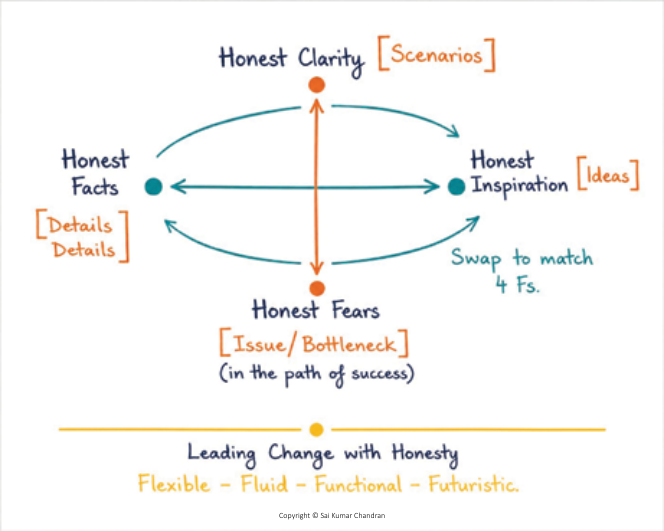
The four honest conversations of change A useful way of thinking about this is to imagine change leadership operating across four directions. To one side sit Honest Facts: what we genuinely know. On the opposite side sit Honest Inspirations: what we genuinely believe could become possible. Below sit Honest Fears: what people believe could obstruct, damage or derail success. Above sit Honest Clarity: the scenarios that emerge when facts, aspirations and fears are considered together.
These are not four stages to be completed sequentially. They are four conversations that must continually correct one another.
Take away facts and transformation becomes fantasy. Take away inspiration and it becomes administration. Take away fears and it becomes propaganda. Take away scenario clarity and it becomes gambling.
The task of leadership is to keep all four in conversation.
Honest facts: begin with reality, not the change story Every transformation develops a story: “We need to become more agile.”; “We are becoming customer-centric.”; “Artificial intelligence will transform our business.”; “This merger will create synergies.”; “We need a new operating model.”
Some of these statements may be entirely correct. The danger begins when the narrative becomes stronger than the evidence. Honest Facts require leaders to temporarily suspend advocacy and ask: What do we actually know? What are customers telling us? Which products are losing relevance? Where is profitability genuinely generated? Which capabilities do we possess, rather than merely claim to possess? What has failed previously? What constraints are non- negotiable? What are competitors doing better? What do frontline employees understand that headquarters does not?
This sounds obvious. It rarely is. Power affects information flows. Research on power and perspective- taking has found considerable evidence that greater power can reduce attention to others and willingness to accept advice, although importantly the effect is not inevitable: when power is
accompanied by a sense of responsibility for others, perspective-taking can improve.
That qualification is important for Dharmic Leadership. Power itself is not the problem. Unsupervised power is. The Dharmic leader therefore does not surrender authority. They discipline it. Before asking people to believe the future, they make it safe to describe the present.
Honest inspiration: give people a future worth moving toward Facts alone cannot lead transformation. A spreadsheet can prove that the existing business model is deteriorating. It cannot make people care about what replaces it. Human beings do not move only away from problems. They also move toward possibility.
This is where leadership must create Honest Inspiration, not exaggerated optimism, not manufactured urgency, but a credible picture of a future worth building.
Satya Nadella’s transformation of Microsoft after becoming chief executive in 2014 offers a useful illustration. The strategic shifts toward cloud computing and subscription businesses mattered enormously, but so did the cultural shift away from an organisation often characterised internally by competition and knowing, toward one that increasingly emphasised learning, curiosity and empathy. Nadella has continued to describe empathy as central rather than peripheral to leadership.
The important point is not to romanticise Microsoft’s transformation. It is to recognise that sustainable change requires both strategic movement and a different human possibility.
Honest Inspiration answers: If we undertake all this disruption, what genuinely better condition are we trying to create? For customers? For employees? For the institution? For society?
A Dharmic aspiration cannot merely ask people to sacrifice so that the organisation becomes larger. It must demonstrate how growth contributes to a larger good while preserving the legitimate interests of those who make
that growth possible. That is where purpose stops being communication and becomes an ethical test of strategy.
Honest fears: bring the bottlenecks into the room This may be the most neglected conversation in transformation. Leaders commonly ask employees whether they “support the change.” It is often the wrong question.
Ask instead: What are you honestly afraid will happen if we do this?
The answers may be uncomfortable: “I may no longer be competent.”; “My role may disappear.”; “The leadership team will abandon this in six months.”; “We tried this three years ago.”; “The new structure gives one function too much power.”; “Our customers don’t actually want this.”; “My manager says one thing privately and another publicly.”; “The targets make the new behaviours impossible.”
These are not irritants around the transformation. They are data about the transformation. Edmondson’s research on organisational learning is particularly relevant here. Her work has shown that perceptions of interpersonal risk and power affect the quality of reflection within teams and therefore their ability to learn and change.
This is where Dharmic Leadership becomes demanding. A leader committed only to successful implementation may instinctively suppress fear because fear appears to weaken momentum.
A leader committed to Dharma must examine fear because some fears contain truth. Not every fear should determine strategy. Not every objection is correct. Some resistance is self-interest. Some is inertia. Some is politics. But the ethical and strategic obligation is to hear it before judging it. Fear spoken early becomes intelligence. Fear suppressed becomes resistance. Fear repeatedly ignored becomes cynicism. And cynicism institutionalised becomes culture.
Honest clarity: replace
prediction with scenarios Once facts, aspirations and fears become visible, leadership can do something far more sophisticated than announcing a plan. It can develop scenarios.
What happens if adoption is faster than expected? What happens if customers resist? What if the technology works but capabilities lag? What if the regulatory environment changes? What if a key leader leaves? What if our assumptions about cost savings are wrong? What if the transformation succeeds technically but damages trust?
Scenario thinking converts honesty into preparedness. This matters because one of the hidden abuses of power during change is false certainty. Senior leaders frequently know less about the future than their communication suggests. Yet organisational expectations encourage them to project confidence. Employees, meanwhile, often know that leadership cannot possibly know everything being claimed. Trust then begins to erode in an unnecessary way.
Dharmic Leadership permits a stronger stance: “This is what we know. This is what we believe. This is what we do not yet know. And these are the possibilities for which we are preparing.”
That is not weak leadership. It is epistemic honesty. And paradoxically, it can create greater confidence because people no longer have to pretend uncertainty does not exist.
The four conversations must keep moving
The model becomes particularly powerful when understood dynamically.
Honest Facts should continually challenge Honest Inspiration: Is our aspiration still grounded in reality?
Honest Inspiration should challenge Honest Facts: Are we treating current constraints as permanent simply because they exist today?
Honest Fears should challenge both: What could prevent this from working, and what consequences are we underestimating?
Honest Clarity should integrate all three into scenarios, choices and action.
And then action generates new facts. The cycle begins again. This makes change less like executing a blueprint and more like navigating a living system. It also changes the meaning of leadership communication. Communication is no longer the transmission of leadership’s answer. It becomes the infrastructure through which organisational reality is continuously updated.
From Honest Conversation to Dharmic Action Honesty by itself, however, is not enough. An organisation can have extraordinarily candid conversations and still fail to act. This is where Dharma enters.
Dharma asks what right action is required once reality becomes visible. If facts reveal that a business is no longer viable, leadership must act. If fears reveal genuine capability gaps, the organisation must invest. If customers are being harmed, processes must change. If a senior executive is undermining the transformation while producing excellent numbers, leadership must choose between short-term performance and institutional integrity.
Dharmic Leadership therefore cannot be reduced to kindness or consensus. Sometimes the Dharmic decision will disappoint people. It may involve closing a business, eliminating roles, changing leadership, rejecting a lucrative opportunity or confronting a powerful stakeholder.
The distinction lies elsewhere. Dharmic leaders do difficult things without unnecessarily violating truth, fairness, responsibility or human dignity. They explain what they can. They acknowledge what they cannot. They distinguish confidentiality from deception. They do not manufacture hope they cannot justify. They do not call predetermined decisions “participation.” They do not invite employee voice and then punish inconvenient voices. Most importantly, they accept responsibility for the consequences of exercising power.
Flexible, Fluid, Functional, and Futuristic This approach’s formulation ends with four useful words: Flexible. Fluid. Functional. Futuristic.
They deserve to be more than adjectives. They can become four tests of honest change.
A transformation must be flexible enough to change when evidence changes. Rigidity masquerading as commitment is not leadership. It must be fluid enough for information to move across hierarchy, function and status. When truth travels only upward after being sanitised, leadership is flying with faulty instruments. It must be functional enough to produce actual improvement. A transformation that creates workshops, vocabulary and excitement without changing customer experience, capability or performance is organisational theatre. And it must be futuristic in the serious sense of the word: not fascinated by fashionable technology, but capable of building for conditions that do not yet fully exist.
Together these four tests protect transformation from four familiar failures: dogma, information blockage, symbolism and short-termism.
Honest power is perhaps the real work of Change Leadership We often describe change leadership as the ability to persuade people to move from where they are to where the organisation needs to be. That definition now feels incomplete.
The leader does not possess the whole truth about where the organisation is. Employees do not possess the whole truth either. Customers see another part. Data reveals another. Competitors, regulators, technologies and social changes continually alter the landscape.
The real work of leadership is therefore not to know everything. It is to create an organisation in which enough truth can move quickly enough for wise action to remain possible. That requires power. Someone must choose. Someone must allocate resources. Someone must
resolve competing interests. Someone must eventually say yes or no.
Dharmic Leadership does not apologise for this power. It asks that power submit itself to a higher discipline: truth before convenience, duty before ego, stewardship before possession, and the wellbeing of the whole before the comfort of the powerful.
This is why honesty is not softness. It is governance. And it is why psychological safety cannot mean endless agreement. A psychologically safe organisation should make disagreement easier, not decision-making impossible. Leaders must listen deeply and still decide.
The mature change leader therefore learns to hold two apparently contradictory capabilities simultaneously: the humility to remain corrigible and the courage to remain accountable. That may be the deepest connection between power, Dharma and change.
The organisation that can correct itself
Perhaps we have been measuring transformation incorrectly. We ask whether the ERP was implemented. Whether costs came down. Whether the merger achieved synergies. Whether the restructuring met its targets. Whether the new culture scores improved.
All of these matter. But an organisation that will last requires another capability: Can it correct itself before reality corrects it violently?
Can bad news travel upward? Can leaders revise assumptions without humiliation?
Can employees surface fears without being labelled resistant?
Can aspiration survive contact with facts?
Can power hear truth? Can strategy change without leadership pretending the previous strategy was never wrong?
These may be among the strongest indicators of institutional longevity; because no organisation can predict

every disruption. No leader can make all correct decisions or correct every decision. No strategy can survive unchanged forever.
The enduring institution is therefore not the institution that avoids error. It is the institution that remains capable of recognising and correcting error. That is why Honest Power matters. And that is why Dharmic Leadership matters.
The ultimate test of change leadership may not be whether leaders can convince thousands of people to follow their transformation. It may be whether they can create an organisation honest enough to tell them when the transformation itself needs to change.
When leaders can hold Honest Facts without defensiveness, Honest Inspiration without fantasy, Honest Fears without intimidation, and Honest Clarity without pretending certainty, change becomes something very different.
It stops being something leadership does to the organisation. It becomes something the organisation learns to do intelligently to itself. And perhaps that is what the organisations that truly last have always understood: the highest expression of power is not the ability to force change.
It is the ability to build a system
capable of seeing truth, choosing responsibly, changing courageously, and correcting itself long after today’s powerful leaders are gone.
That is change governed by Dharma. That is power made worthy of leadership. And that is how institutions learn to endure.
References and Further Reading • Edmondson, A. C. (1999). Psychological Safety and Learning Behavior in Work Teams. Administrative Science Quarterly, 44(2), 350–383. Her study of 51 work teams established the relationship between psychological safety, learning behaviour and team performance. • Edmondson, A. C. (2002). The Local and Variegated Nature of Learning in Organizations: A Group-Level Perspective. Organization Science, 13(2), 128–146. Particularly relevant to how perceptions of power and interpersonal risk affect reflection and organisational learning. • Galinsky, A. D., Rucker, D. D., & Magee, J. C. (2016). Power and Perspective-Taking: A Critical Examination. Journal of Experimental Social Psychology, 67, 91–92. Reviews evidence on power, perspective-taking and the important moderating effect of
Truth before convenience, duty before ego, stewardship before possession, and the wellbeing of the whole before the comfort of the powerful.
responsibility toward others. • Kotter, J. P. (1995). Leading Change: Why Transformation Efforts Fail. Harvard Business Review, 73(2), 59–67. Based on observations of more than 100 organisational transformations and the recurrent causes of transformation failure. • Edmondson, A. C. (2019). The Fearless Organization. Wiley. • Heifetz, R. A. (1994). Leadership Without Easy Answers. Harvard University Press. • Heifetz, R. A., Grashow, A., & Linsky, M. (2009). The Practice of Adaptive Leadership. Harvard Business Press. • Schein, E. H., & Schein, P. A. (2018). Humble Leadership: The Power of Relationships, Openness, and Trust. Berrett-Koehler. • Kahneman, D. (2011). Thinking, Fast and Slow. Farrar, Straus and Giroux. • Bridges, W. (2009). Managing Transitions: Making the Most of Change (3rd ed.). Da Capo Press. • Nadella, S. (2017). Hit Refresh. Harper Business.
(Sai Kumar Chandran is the founder of OrbiShift. He is a coaching and consulting practitioner and an entrepreneur at heart. He can be reached at saikumarchandran@orbishift. com)

