
NEPAL’S ECONOMY HAS BEEN repeatedly battered by shocks of enormous magnitude, ranging from natural disasters and the COVID-19 pandemic to political uprisings and social movements. Each shock has left deep scars on the economy, disrupted livelihoods and weakened the country’s development momentum.
The year 2026 is set to draw to a painful close for the country, with two devastating flood events adding to this accumulated distress. The transboundary flash flood in the Bhotekoshi River on August 26 and the subsequent flash flood in the Budhigandaki River on October 11 caused colossal losses of life and physical assets, including critical lifeline infrastructure. Roads were severed, bridges swept away, houses uprooted and agricultural land devastated. Hydropower tunnels were buried, while dams and powerhouses were washed away. The scale of destruction has once again exposed the vulnerability of Nepal’s infrastructure, livelihoods and productive assets to increasingly severe disasters.
The economy, already rattled by the pandemic, the Gen Z uprising, and last year’s floods, has been shattered by an even greater disaster this year, frustrating high growth ambitions.
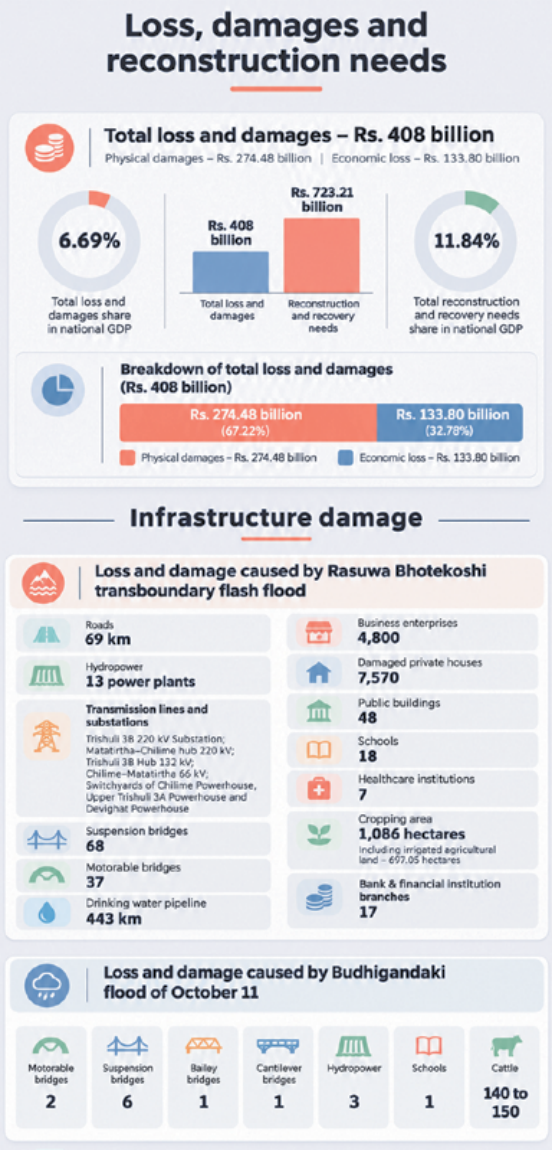
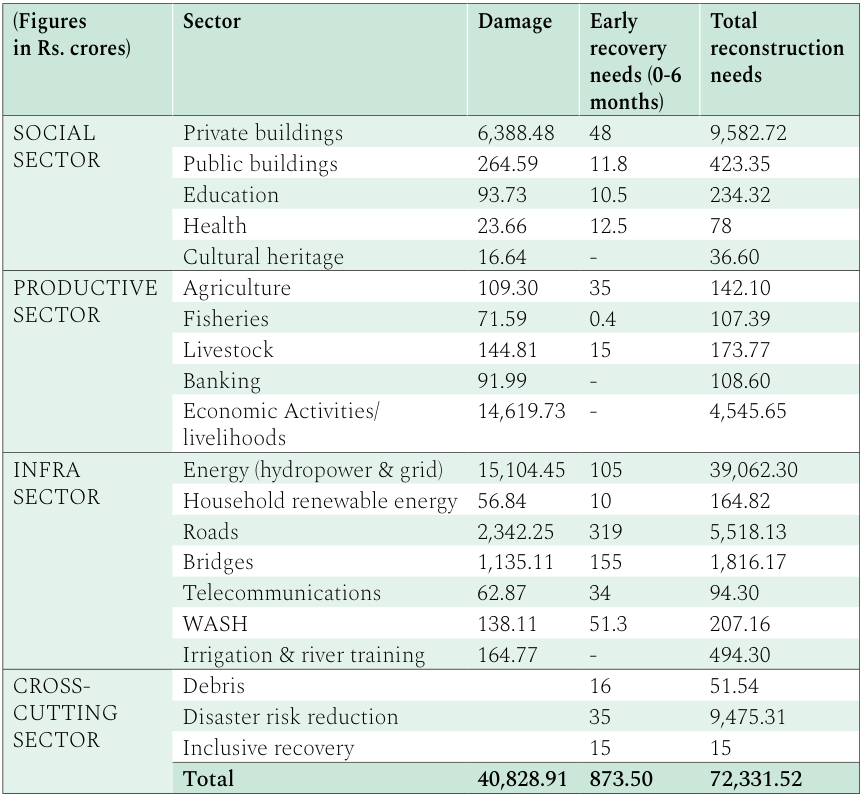
A rapid assessment conducted by the NDRRMA (National Disaster Risk Reduction and Management Authority) shows the loss and damage worth $1.81 billion in physical damage and $883.32 million in economic losses, totalling at $2,695.33 million.
It is reported that the reconstruction cost could hover around $4.7 billion and the early recovery and rehabilitation requirements for the initial six months requires $57.66 million.

“Disaster may cause manifold impact for the longer term. The cost of rebuilding is high, on the other hand, it will force the force vulnerable governments like Nepal to take on emergency debt to finance recovery,” according to Gopi Khanal, public finance expert.
Nepal at the moment could fall in the vicious cycle of disaster and recovery as the community is hit by a crisis, struggles through a slow recovery, and gets struck by another disaster before rebuilding its core safety nets.
The flood claimed 1,462 lives, while 5,285 remain missing. The country lost many skilled individuals and professionals in the tragic incident, including engineers, managers, drivers, traders, construction workers, electricians, and tourism workers, among others. This irreversible human loss is a deeply painful trauma for generations to come, and it could take the country years to produce such a skilled and highly qualified workforce.
The transboundary flashflood caused a loss of 6.69% of the country’s GDP of Rs. 6,600 billion, according to NDRRMA’s Rapid Loss and Damage assessment report.
Subdued growth
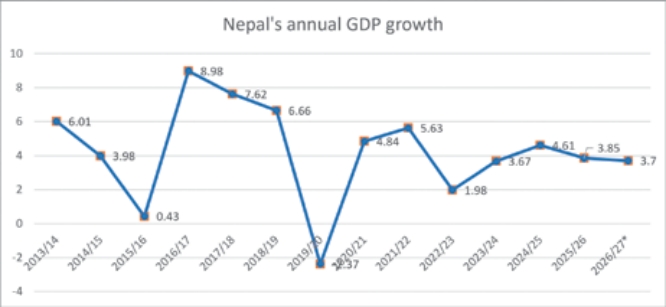
Nepal’s average annual growth over the past decade remains at merely around 4.5%, despite the country’s ambition to achieve high growth exceeding 6%. Various factors have driven this meager growth in the past, however, in recent years, unforeseen shocks have further weakened economic performance. The World Bank’s latest development update projects that growth in Nepal could slow to 3.7% in FY27 following disruptions to industry and services caused by the August 26 flood. Nevertheless, reconstruction and rehabilitation activities are expected to begin supporting economic activity, driving a recovery in growth to 5.2% in FY2028, according to the report.
The World Bank Development Update, titled ‘Building Back Differently for the Future’ underlined that industry is expected to be the primary drag on growth, reflecting extensive damage to hydropower, solar energy, electricity transmission, and transport infrastructure, which will constrain electricity generation, production, and the movement of goods. Services are expected to be affected through disruptions to trade, transport, tourism, and financial activity. Agricultural losses, while limited in the effects on aggregate output, are expected to have significant impacts on livelihoods in affected areas.
In the previous fiscal year too, economic growth was affected due to adverse impacts of September 8-9, 2025 uprising particularly in tourism and non-life insurance sector. The economy slowed down by the slumping aggregate demand further rattled by the Gen Z movement.
Losing confidence
Investors were upbeat about developments in the energy sector and infrastructure as key propellers of economic growth. However, frequent economic shocks have exposed the country’s vulnerability. The Rs. 6,600 billion economy has been facing unprecedented loss and damage, increasing its long-term liability as the country must spend substantial resources on disaster preparedness, reconstruction, and rehabilitation.
Investors have been losing confidence due to repetitive shocks, with their capital (equity) even eroding, according to industry sources.
Insurers have been trapped in huge liabilities almost every year due to these repetitive shocks and are struggling for survival.
Rajendra Malla, President of the Non-Life Insurance Association of Nepal, has underlined that insurance premiums could rise, as claims to reinsurance companies from Nepal have been increasing substantially due to repetitive shocks.
It is reported that domestic insurers retain 35% of the sum insured amount up to Rs. 100 million and cede 65% to reinsurance companies. Domestic insurance companies more often increase this reinsurance placement to transfer greater risk when the size of the sum insured amount is higher.
As 13 hydropower plants, substations, and transmission lines, among other insured properties, were damaged, insurance claims will definitely soar. Although the deployment of surveyors has taken longer due to a lack of road connectivity and landslides at hydropower sites and disaster areas, the insurance regulator,
Nepal Insurance Authority (NIA), has allowed companies to release advance payments to the insured that can be adjusted later during claim settlement, according to Nirmal Adhikari, Director of the NIA.
Moreover, according to a quick assessment by the Nepal Bankers’ Association (NBA), around Rs. 600 million worth of assets was washed out across as many as 17 bank branches and extension counters in the flood zones of Rasuwa and Nuwakot. Nepal Rastra Bank has urged banks to grant borrowers a three-month extension for repayment and stated that additional flexibility for restructuring will be provided. The NBA noted that around Rs. 2.43 billion in credit from BFIs had been mobilised to 2,125 borrowers through bank branches in the disaster-hit area.
Disaster risk finance
It is true that disasters are inevitable, however, losses and damages can be minimised through effective disaster preparedness.
“A small economy like Nepal cannot afford the huge loss and damage caused by disasters, which is why we must focus on minimising the impact,” said Shanti Mahat, spokesperson for the NDRRMA. “It is said that a Re. 1 investment in preparedness can save a potential loss of Rs. 7. This means we have to invest in advanced equipment for early warning systems, relocation of vulnerable settlements, tracking the movement of glaciers and the Himalayas, timely procurement of clear satellite imagery from low Earth orbit, precipitation forecasts, and monitoring potential landslides and permafrost that can block snow-fed rivers at narrow gorges, among other measures.” She further stated that enhancing capacity for quick response in the aftermath of a disaster is equally important.
Moreover, Nepal has been eyeing concessional loans, grants from bilateral and multilateral partners, alternative financing sources, and compensation as climate justice from the UN-backed Fund for Responding to Loss and Damage (FRLD). The Ministry of Finance (MoF) noted that the FRLD has set aside $20 million for Nepal, though this is an insignificant amount compared to the country’s requirement of $4.7 billion for reconstruction and rehabilitation.

