
AI hallucinations in parliamentary discourse highlight the need for evidence-informed policymaking
 A major shift in Nepal’s political landscape by the youth intervention has been drawing attention across the world. And the House of Representatives election in March this year elected a majority of youth and mostly new faces. Parliament as the supreme policymaking body, youth representing to the parliament are responsible for setting the rules of the game for the executive, judiciary, and non-state actors including the private sector.
As Nepal remains laggard in growth, underdeveloped, and burdened by geographical disparities in development, the parliament should break the status quo in policy and lawmaking, according to Prof. Bipin Adhikari, a senior legal expert. “Parliamentarians must initiate innovative approaches in lawmaking, that must be evidence-informed and based on rational choices, which minimise externalities for better payoffs to society.”
In addition, spatiality must be adhered to in policies and programming to achieve inclusive and equitable development, which was not duly taken care of in the past despite constitutional promises.
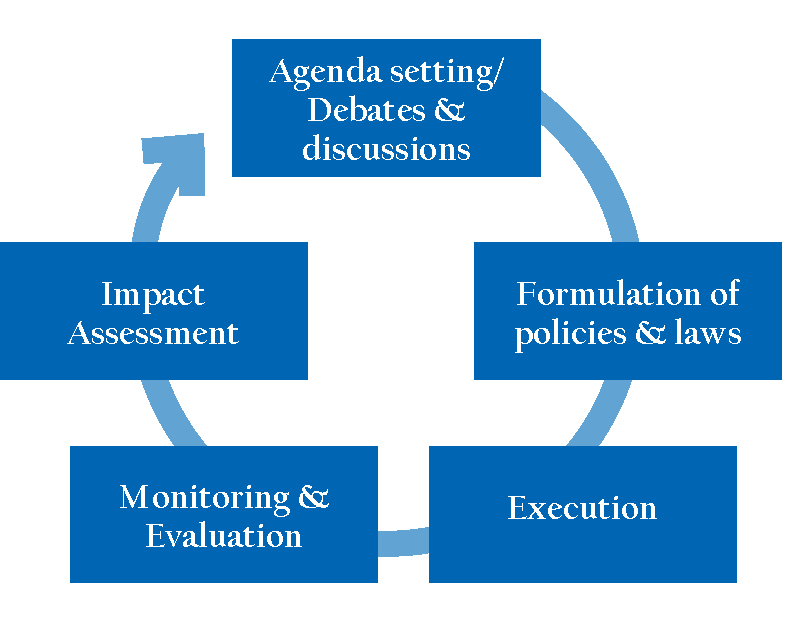
Though there are different phases of policy/lawmaking and execution, known as the policy cycle, the legislative parliament engages in agenda-setting through parliamentary debate, lawmaking, providing guidance to the government, and also monitoring or scrutinising whether the government has executed the policies, programmes, and laws properly. Parliamentary oversight is fundamental for holding the government accountable.
Moreover, parliamentarians themselves can register private bills and also motions of national importance from their own initiative. Normally, the government (executive) formulates the first draft of the bill and registers it in the parliament for discussions, review, and endorsement.
However, Young Turks in the parliament being overly reliant on artificial intelligence (AI) platforms has sparked the need for credible, evidence-informed policymaking collaborations with independent institutions in the country. The largest party in the parliament, the Rastriya Swatantra Party (RSP), has drawn the attention of parliamentarians regarding their overreliance on AI and the chances of hallucinations. “AI can be used, but a cautious approach, verification of information, and rational evidence are required to substantiate any concerns that parliamentarians raise in the parliament,” media reports mentioned, citing the message of RSP whip Krantishikha Dhital to the parliamentarians of the ruling party.
Even the Deputy Speaker of the House of Representatives, Ruby Kumari Thakur, who is an ex-officio member of the Constitutional Council, presented her research from an AI platform to substantiate the nomination of the Supreme Court Chief Justice based on a standard benchmark of performance, which was found to be misleading in the ground reality.
Forging partnerships for evidence-informed lawmaking
As the collaboration with the supply side is strongly lacking in public policymaking, the parliamentarians are expected to forge collaborations with universities, think tanks, and private sector umbrella organisations among other stakeholders to formulate the policies and laws that can easily foster complementarities for sectoral policies. In the past, sectoral policies and laws were formulated in isolation. As a result, they contradict each other and failed to create a synergy.
Nepal’s developmental challenge underlines contradictory policies and laws, weak execution, procedural delays caused by a cumbersome bureaucracy, and coordination failure among others. In this regard, the legislative parliament should take the initiative to overhaul the system and reset it through robust legal infrastructure.
The evidence-informed policymaking practices in collaboration with independent think tanks, universities, the private sector, and other stakeholders do not just justify the lawmaking process but also support legislative and executive approval with wider acceptance to enhance policy legitimacy. As there were evident cases of parliamentarians relying on artificial intelligence platforms for information and research, some were already caught with AI hallucination. To avoid such misleading information traps, the parliamentarians can collaborate with the aforesaid credible and independent institutions.
At the same time, constant oversight, feedback, and corrections at the execution level will be a contribution to the effective and efficient use of public funds towards achieving the desired results. Some of the parliamentarians have said that they will encourage the government to conduct impact assessments of key policies and programmes and improve execution based on the findings by streamlining strengths and minimising or avoiding weaknesses.
Balancing rationalism and public aspirations in policy design
To address the choices of the aspirational society, the country must opt for evidence-informed policies instead, based on the assessment of needs for the right intervention and achieving the targeted results. The significant shift in the political landscape is a result of the people’s unmet aspirations and the traditional rhetoric of the old political parties. Mostly, policymaking on an ad hoc basis and serving the interests of interest groups couldn’t address the public at large, as per experts.
Aspiration created by overpromising turned into despair due to little delivery from the government. The issues of the public were ignored and interest groups captured government policies and regulatory bodies, which triggered despair among youth, leading to the September 8-9 Gen Z uprising in 2025.
Further, the implementability of policies is crucial to achieve the intended results. Nepal has successfully implemented only a handful of policies because most policies are isolated and lack programmes and budget, according to Dr. Minendra Rijal, a former minister, academic, and political architect.
Rationalism and constructivism have their own core values and choices in public policymaking. However, the influence of elites in the name of rationalism or the capturing of narratives can mislead parliamentarians in political parties, which is why the lived experiences of people, lay knowledge, ethnographic experiences, historical accounts, and public consultation are equally important. Constructivism particularly emphasises policy choices on account of pluralism. Public policy design should strike a balance in the rational approach, and the accuracy of data and information must be verified, according to Nara Bahadur Thapa, an economist and Former Executive Director of Nepal Rastra Bank.
Nevertheless, the rise of the Young Turks in national politics is strongly supported by their promise to deliver public goods and services efficiently and in a non-rival manner for the satisfaction of the public at large.
Upholding parliamentary supremacy and executive accountability
Nepal’s bicameral parliamentary system is a key feature of the traditional Westminster system. Nepal’s Constitution of 2015 outlines the specific role of the parliament. Recently, as the head of the government ignored the parliament and tried to undermine parliamentary supremacy, parliamentarians opposed the move and obstructed the House of Representatives (HoR) in a bid to hold the Prime Minister accountable to the parliament.
“In a democratic system, we (parliamentarians) never act in a submissive way that compromises the supremacy of the parliament,” said Ain Bahadur Mahar, Chief Whip of the CPN-UML. “The parliament supports the government to serve the aspirations of the people and puts the brakes on any undemocratic and oppressive attitudes.”
Basically, the role of the parliament, other than its legislative functions, is the formation of an accountable government. In a parliamentary system, the parliament forms the government and seeks its accountability. As per the Constitution of Nepal, the Prime Minister is elected by the parliament and remains accountable to it.
The ruling party with a popular mandate, the Rastriya Swatantra Party (RSP), organised an orientation on parliamentary proceedings for its lawmakers, as most of them were elected for the first time. Addressing that orientation, RSP Chairperson Rabi Lamichhane sought strong parliamentary oversight of the government, even though they are members of parliament from the ruling party. Simultaneously, he urged them to visit their constituencies and strongly present the needs of the people and their lived experiences in parliament.
It is obvious that the parliament provides a forum for thorough debates and discussions on various issues. These deliberations help shape policies by allowing different perspectives to be considered, and members can propose amendments or alternatives.
Moreover, spatiality and minority views cannot be overlooked by parliamentarians. At the same time, parliamentarians have to play an effective role in parliamentary committees, arriving with adequate preparation to translate evidence-informed policymaking into practice.
Most importantly, as the government has been preparing debate notes for constitutional amendments, the issue will eventually come to the parliamentary floor and require a two-thirds majority of the parliament for approval. This comes as parliamentarians have been proactively moving toward a system reset or significant policy changes that may require amendments to the constitution.
 Yubaraj Dulal
Chief Whip, Nepali Communist Party
Nepal has long experience with parliamentary democracy. However, from the Old Guards to the Young Turks, they share similar characteristics in terms of undermining the parliament once they are elected Prime Minister by it. In the parliament, the leader (Speaker of the HoR) must ensure all-party ownership and maintain the trust of the parties represented in the HoR.
 Aren Rai
Chief Whip, Shram Sanskriti Party
The parliamentarians have been following standard practices based on the House regulations. We have been drawing the attention of the Speaker to rule-based proceedings rather than suppressing the voices of the opposition. The evidence-informed practices in policymaking could narrow the differences between members of parliament from the ruling party and the opposition once we start discussing on the grounds of rational evidence.
 Khusbu Oli
Chief Whip, Rastriya Prajatantra Party
Considering the composition of the parliament, the opposition is in the minority and the ruling party holds a popular mandate. However, the way members of parliament from the ruling parties have compromised their self-dignity and self-esteem under the dominance of the executive (government) is concerning. This extent of irrationality and submissiveness in the parliament is probably a first in parliamentary history. Ruling party parliamentarians have been behaving as though they lack critical opinions. A few days ago, following the controversial remarks of the Prime Minister in the Parliament, these parliamentarians were seen safeguarding the PM by providing not just incorrect information, but standing against the country while defending those controversial remarks. In this view, evidence-based policymaking practices are expected to serve the national and larger interests of the country and its people. The loyalty of the people’s representatives should be sought on the grounds of the interests of the public at large, who elected these parliamentarians as their representatives.
 Kabindra Burlakoti
Chief Whip, Rastriya Swatantra Party
The Pprliament has its sanctity as a public policy and lawmaking body for the public at large. As members of parliament, we are representatives of the people and accountable to the public. Primarily, parliament has its legislative function, where parliamentarians can contribute to evidence-based policy formulation. The quality of discussions on agendas, the people’s voices, and minority perspectives must be heard in the parliament. We shouldn’t waste the precious time of the parliamentary tenure by obstructing the House for no reason, and instead fully utilise our time to discuss crucial national issues and pass more laws, or scrap antiquated laws, to minimise legal compliance burdens and create opportunities for investment, production, and job creation in the country. This tenure of parliament will set a new culture in terms of simplifying parliamentary proceedings and making House sessions more fruitful.
 Basana Thapa
Chief Whip, Nepali Congress
The parliamentary system carries the essence of democracy. However, there has been a lack of distinction between the parliament and the government, and the way the Speaker advances proceedings while ignoring the voices of the opposition has undermined the country’s golden history of parliamentary democracy. In the parliament, each member is equally important as they represent the people, and as the supreme public policymaking institution, parliament should honour the voices of all. Indeed, the policymaking process and legislation must abide by standard principles and practices within the parliament.
 Ain Mahar
Chief Whip, CPN UML
The entire effort of the opposition parties in this session of the House of Representatives was spent holding the government accountable. The government boasts an almost two-thirds majority in the Lower House and continually undermines the parliament. The pre-announced session of the parliament was postponed, and the government has ruled by ordinance. There is no adequate discussion on bills, and the amendment proposals lodged by opposition parties with rational justification have been ignored. The government has been making crucial decisions, like the eviction of squatters in an inhumane way without proper notice and alternatives. The government skipped parliamentary sessions to fulfil its ill-intended actions. Even so, we (the opposition) are committed to reinforcing democratic functioning and fairness in House proceedings, which are fundamental to paving the way toward stakeholder engagement in public policymaking.

