
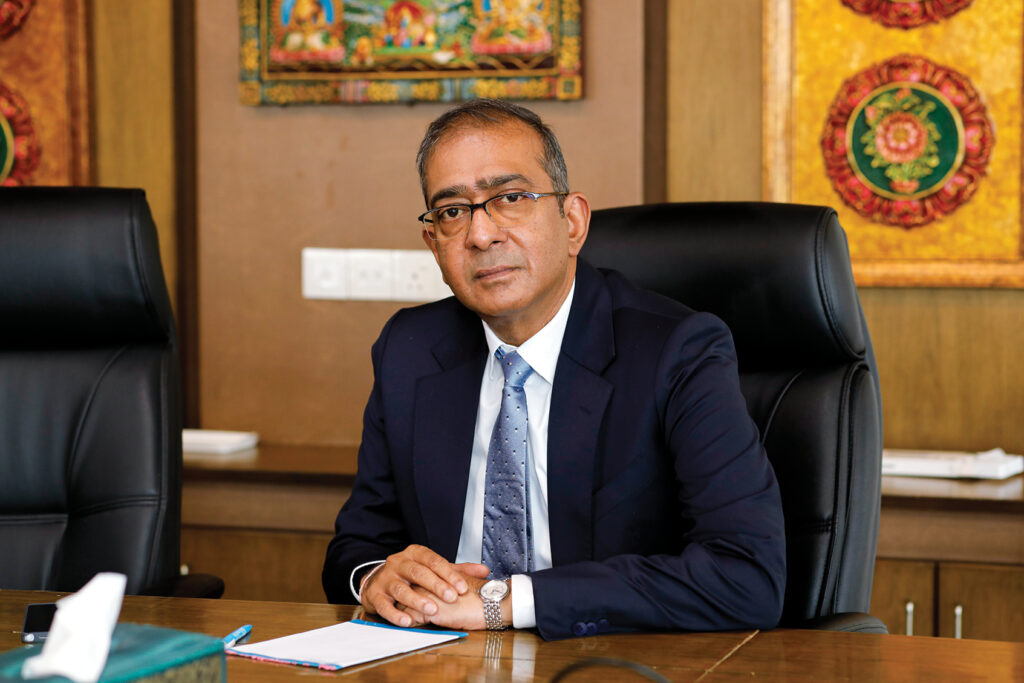
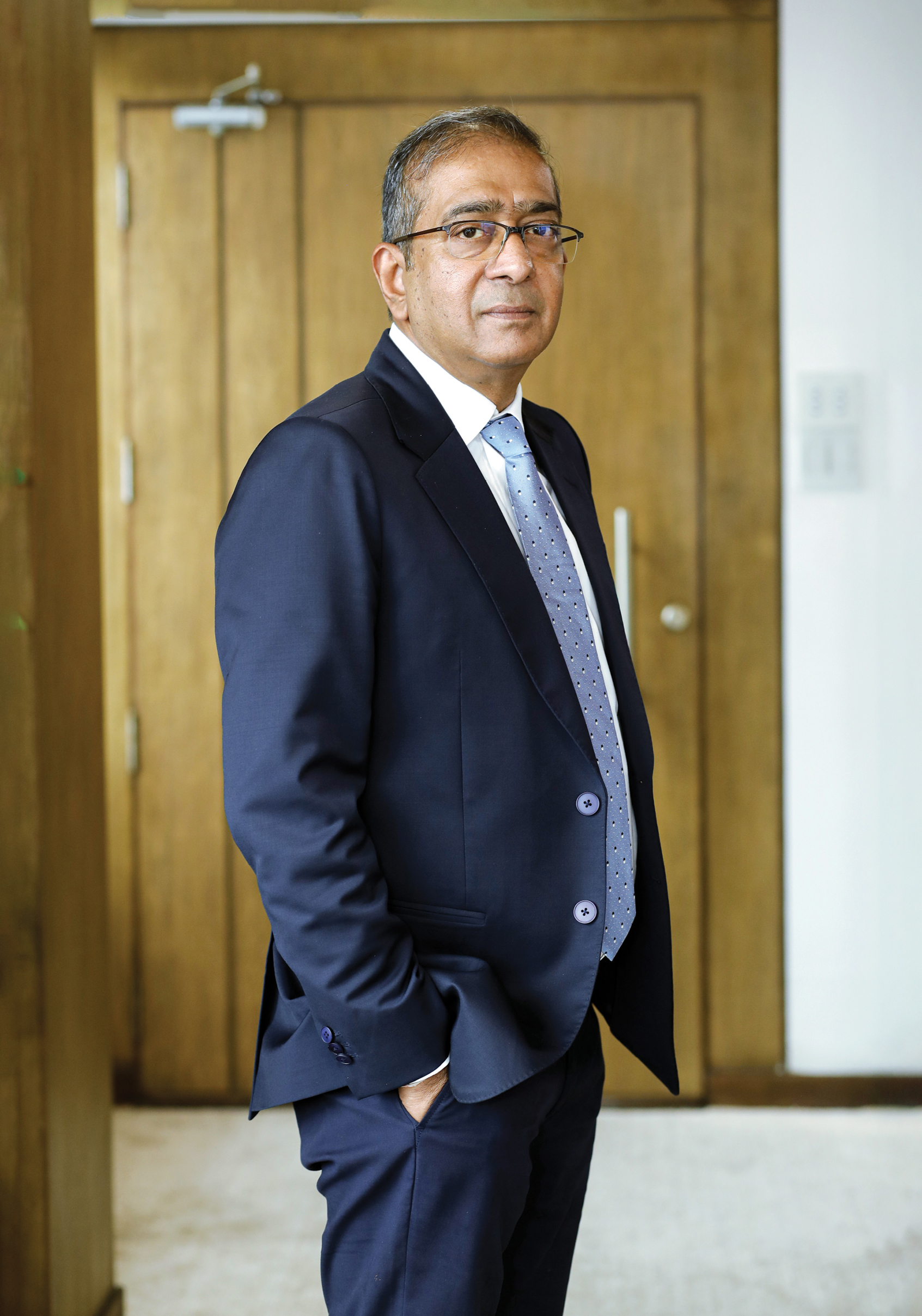
 Manoj Kumar Goyal is a renowned banker, fund manager, and seasoned management professional. Currently, he serves as the chairperson of NMB Bank Ltd., a position he has held for the last two-and-a-half years. He is also associated with Maruti Cement Ltd and chairman of Blackbox Records Management, which is engaged in safe record keeping and retrieval system for all business organizations.
Goyal has built a long and distinguished career in Nepal’s banking sector. His early career began with Nabil Bank (then Nepal Arab Bank), where he worked for 8 years with progressive career. He handled corporate banking division that helped propel the corporate sector development in the country in early stage of Nepalese banking system. He then moved to establish Nepal Merchant Banking and Finance Co. Ltd. in February 1997 (which has since been upgraded to NMB Bank Ltd.). He was founding CEO of the company and introduced the modern merchant banking services such as public issue management, investment management and personal finances.
After his stint as merchant banker, he took over the charge of Bank of Kathmandu, as CEO, then an ailing bank faced with multiple severities and stressed business, taking a challenge to revive the bank where he worked from October 1998 to November 2002. During his tenure, he successfully turned around the bank and made the bank as one of the top 5 performing banks in Nepal.
Goyal was awarded with “Manager of the Year 2001” recognition, by the Management Association of Nepal.
He also served as a credit advisor specialist at the Agricultural Development Bank Ltd. from 2005 to 2006.
In the year 2006, he conceptualized the Clean Energy Development Bank to finance clean and renewable energy in the country, subsequently establishing the bank and taking responsibility for its management, as CEO. Under his leadership, the bank initiated foreign direct investment (FDI) on a project basis and secured foreign investment from FMO Netherlands for the Bank itself, significantly contributing to clean energy financing in Nepal. Clean Energy Development Bank later merged with NMB Bank.
His professional journey in the banking industry now comes full circle with his current role as the Chairperson of NMB Bank. The HRM Nepal recently sat down with Goyal for a wide-ranging conversation on prevailing issues in the banking fraternity, including sustainable and value-based financing approaches. Excerpts of the interview are presented below.
Q: How would you assess the current performance of Nepal’s banking sector, particularly commercial banks, in terms of profitability, non-performing loans (NPLs), risks, challenges and opportunities?
A: The banking industry in Nepal, like many others globally, faced significant setbacks in the aftermath of COVID-19. During the pandemic, banks were required to offer loan concessions as per government directives, which adversely impacted their profitability. While banks continued to pay interest on deposits, they were unable to collect payments from borrowers, as many businesses had either shut down or were operating at reduced capacity.
As debt burdens mounted to unsustainable levels, depleted cash flows, diminished business viability, and falling collateral values left many unable to service their loans. Consequently, banks had to make substantial provisions, significantly denting their profitability and returns.
Compounding the pressure, a few years ago the government introduced a tax liability on companies that had issued shares at a premium and merged with a bargain purchase gain. In some cases, the tax impact was substantial—reaching as high as 10% of the bank’s paid-up capital.
Let me share with you also that banks have been blamed for being profit monger, helping only short-term financing to get quick return and ignore productive sector. Since banks are also business organizations, they are bound to go into the sectors that are available in the market to service their stakeholders’ interest. Banks are ever willing to embrace the productive sector if govt. creates a conducing environment and projects are available there.
The banking sector is now eagerly awaiting a correction in property prices, a revival of the construction industry, and the execution of capital-intensive projects by both government and private entities. These developments are expected to unlock new opportunities and restore confidence in the banking sector.
In the near term, the banking sector is likely to face subdued returns and capital constraints due to excess liquidity, high NPA and suppressed credit demand.
Nevertheless, bank lending remains predominantly collateral-based, primarily secured by land and buildings. There are no fundamental structural weaknesses in the banking system. Once property prices stabilize at reasonable levels, real estate demand recovers, and broader economic activity revives, banks are expected to return to a stronger position.
Q: Banks are currently flush with liquidity, with nearly Rs. 1,200 billion in excess funds. What kind of fiscal, monetary, and regulatory policies are required to effectively utilize these accumulated resources?
A: The economy moves in cycles. If it peaks, it may also slow down over time before heading back up. We should not resort to rampant lending just to mobilize liquidity in the economy. Doing so carries a high risk of channeling loans into unproductive and speculative areas, which creates asset bubbles. If we truly want a positive departure from this trend, loans must be mobilized into productive sectors (the real sector) and export-oriented businesses. If the government accelerates investment in development projects, the construction sector will become more vibrant. Infrastructure development creates multiplier benefits across the economy in terms of production, employment, import substitution, and exports.
The government’s capital expenditure must be properly mobilized for capital formation, which has lagged for the last several years. Government spending acts as a major catalyst for private sector investments. For example, if the government executes multiple development projects, the construction industry drives demand for construction materials (cement, iron rods, aggregates, and sand), consultancy services, transportation services, and wholesale and retail trade, causing aggregate demand to surge. As the government has allocated a substantial budget for development projects in the 2026/27 fiscal budget, we are optimistic about its execution. Furthermore, Nepal shows great promise in the ICT sector, and digitalization has also been addressed in the budget. As a short-term measure, central Bank can allow banks to park their excess liquidity in the Indian government and RBI investment instruments where return is relatively higher and exchange risk is minimal due to currency peg.
Q: The government is planning to raise domestic debt worth Rs. 410 billion. Considering the excess liquidity, the government had more room to mobilize domestic debt by issuing project-specific bonds. What are your thoughts on the volume of domestic debt the government intends to raise in the upcoming Fiscal Year 2026/27?
A: Contrary to the common perception that debt is inherently harmful, I believe it is often essential for growth and prosperity. When internal resources are insufficient, debt enables businesses and governments to pursue opportunities and investments that would otherwise remain out of reach.
The key is the productive use of borrowed funds. Debt should be invested in projects that generate returns exceeding the cost of borrowing. For governments, this principle is particularly important. Borrowing should be directed toward high-impact projects that deliver strong financial and economic returns. Even where financial returns are modest, borrowing may still be justified if the project generates significant economic and social benefits, such as improved infrastructure, education, or technological advancement.
Debt used for genuine nation-building initiatives is especially valuable, as it allows the current generation to invest in assets that enhance future productivity, economic capacity, and overall development.
That said, the government’s planned domestic borrowing appears substantial. Debt on this scale inevitably increases interest obligations, which are ultimately borne by taxpayers. Therefore, the effectiveness of such borrowing depends on its productive deployment. If the government successfully mobilizes these funds and accelerates development spending, demand for private-sector credit is also likely to rise, reducing the current excess liquidity in the financial system. Moreover, the prevailing low-interest-rate environment presents an opportune time for the government to finance development projects at a relatively lower cost, further strengthening their viability.
Q: As a pioneer in hydropower investment, how can NMB Bank explore and expand new financing avenues in the energy sector?
A: We have been consistently exploring new avenues. Opportunities may emerge in transmission and power trade, as these two sectors are opening up to private sector investment. The promisingly announced unbundling of the Nepal Electricity Authority (NEA) into separate generation, transmission, and distribution entities will create channels for private investment in transmission alongside generation. So far, national policies and the private sector have focused on generation and I believe a major milestone has been achieved there through the substantial contribution of private sector financing.
Simultaneously, we must emphasize developing robust transmission networks and boosting the electricity consumption or demand side, such as through e-mobility (clean transport) and clean cooking solutions. In addition, we need to invest in solar energy for an optimal energy mix and the optimization of generation projects. Along with this, Nepal must consider battery storage projects, bio-energy, and other alternatives, and NMB Bank stands ready to finance such ventures. Furthermore, while hydropower equipment fabrication work was previously initiated in Nepal, it failed to gain momentum. We are also ready to finance such fabrication industries if they operate within the country.
Q: The government has envisioned public-private partnerships for infrastructure projects, including roads and tunnels. Are banks considering financing such projects?
A: Normally, due to the long gestation periods of infrastructure projects, it is not convenient for banks to commit to large-scale, long-term financing using short-term mobilized capital. Despite this, we are financing energy (generation) projects, and banks hold a sizeable portfolio in energy. Therefore, financing could be made available to the extent possible for infrastructure projects executed under public-private partnerships, provided these are immaculately planned by serious developers and bank is confident about the capacity of developers.
Furthermore, it is high time that we adopt Project Financing practices in its true spirit for large hydropower, infrastructure and industrial projects. Under this approach, funding is provided purely on the strength and viability of the project itself, without the need for personal guarantee and additional collateral.
Q: NMB Bank has been issuing Energy Bonds, in which other banks, including those without significant expertise in energy project financing, are also investing. Given the capital-intensive nature of hydropower projects, do you think this could affect portfolio diversification? What is your perspective on this issue?
A: We were on the higher side of the 10% credit mobilization requirement for the energy sector set by Nepal Rastra Bank, which got changed recently to 20% incorporating more sectors, not necessarily into hydro sector alone. We are equally conscious of credit concentration risks within any single sector.
Q: Can Nepalese banks alone support an ambitious plan envisioned by the government to develop 28,500 MW capacity hydropower projects by 2035?
A: This ambitious plan requires a massive amount of investment that is currently insufficient within the country. Therefore, we must attract foreign investment (FDI) to achieve these national objectives. It is equally beneficial proposition through project financing as mentioned earlier thereby combination of foreign investment, taking loan from outside and both the options with local chipping-in in the projects.
One of the major risks with foreign borrowing and investment is exchange rate risk while financing energy sector projects. NMB Bank has deep expertise in energy sector financing, and we can work alongside foreign entities to structure fund mechanisms for highly potential sectors like energy. However, if we cover the foreign exchange risk, the total interest rate of these funds rises. For instance, covering exchange rate risks on a 6% base interest cost brings the final rate to around 9%. NMB Bank has already been taking the initiative to manage exchange rate risks in its financing. To truly attract foreign investment/borrowing and achieve accelerated growth, the government must establish robust hedging provisions to cover these exchange rate risks.
Q: Critics blame Nepal Rastra Bank’s directed lending policy for the rise in non-performing loans. Do you think the central bank should revisit its directed priority sector lending policy?
A: The country requires balanced sectoral growth to achieve its national priorities. There is little room to disagree with the government providing guidance for lending in priority sectors, as it ensures private sector credit mobilization is not just concentrated in highly profitable but unproductive sectors.
However, we are currently failing to create the necessary ecosystem where government support is equally crucial. For example, a mandatory lending provision in agriculture alone is not enough. While it helps channel resources from banks to the agricultural sector, it cannot deliver the intended objectives unless we develop the entire ecosystem, including backward and forward linkages, market facilities, transportation, warehouse and cold storage infrastructure, extension services, irrigation, and access to improved seeds and fertilizers.
Forcefully pushing loans into agriculture or any other sector without creating this supporting ecosystem can lead to non-performing loans (NPLs). This is why the government must focus on supporting ecosystem development to achieve sustained growth. Additionally, the priority sector lending policy should be dynamic rather than static. If a particular sector is lagging, such a policy, backed by a proper ecosystem, can uplift it. I believe the government is actively looking into alternative resource mobilization, as seen with the parliament’s recent endorsement of the Alternative Development Financing Law. If multiple stakeholders work together collectively, we will definitely be able to deliver results.
Q: NMB Bank has been promoting value-based and sustainable banking in Nepal as a member of the Global Alliance for Banking on Values (GABV). Could you elaborate on your approach toward sustainable and green financing, inclusivity and women’s empowerment, supporting the real economy, and digital transformation?
A: Our financing in hydropower, solar energy, clean transport (green mobility), and agriculture serves as a prime example of our commitment to sustainable and green financing. Moreover, our partner, FMO Netherlands, possesses extensive expertise in sustainability-related financing, and we work closely in collaboration with them. We have consistently taken the lead in green and sustainable financing, irrespective of the risks involved.
In terms of inclusivity, we provide targeted financial support to women entrepreneurs and have collaborated with UN Women to ensure the sustainability of women-led micro, small, and medium enterprises. We are also aiming to achieve a 50% female workforce within the bank, and we have already established women-led and women-only branches across all seven provinces.
Our primary focus remains on supporting the growth of the real sector, and we are keen to finance industries that substitute the use of plastics and fossil fuels without being overly concerned about our immediate financial yields. We carry out these value systems to foster a sustainable, resilient, and more inclusive national economy.
Finally, as the digital sector emerges and the youth engage in cloud computing and various IT-related services, we are exploring how to support them in expanding and deepening the industry. Furthermore, the government has prioritized bringing data centers to Nepal, which could serve as another major area for financing in the near future.
Q: Despite regulatory efforts, it is often argued that Nepali banks remain heavily concentrated in urban and semi-urban areas, with a tendency toward herd behavior in lending practices. How can banks become more geographically inclusive and diversified in the future?
A: Banks in Nepal are not merely urban centric. They have expanded their branch networks across the entire country and are serving communities nationwide. However, it is true that the volume of credit mobilized for the urban and that too under corporate sector versus the rest remains highly disproportionate. To fix this, the readiness of rural areas to secure credit needs to be enhanced. Fundamental requirements for obtaining a loan, such as formal business registration, proper bookkeeping, and structured business proposals, are frequently lacking due to the capacity constraints of local entrepreneurs. In this situation, the government must focus on building the capacity of these entrepreneurs and enabling the environment with introduction of conducive policies and administrative support to make them credit-ready for commercial banks.
Businesses in rural areas are small in nature and meant for local ecosystem support for which there an intense need to develop a market backward/forward integration, that incentivize the banks going into safe market, where these can contribute in inclusive banking yet being assured of safety and acceptable return.
Looking at the industry’s loan products, banks already offer everything from small MSME financing to massive, capital-intensive energy project loans. Against this backdrop, the government should play a catalytic role in addressing capacity constraints and ensuring entrepreneurs are equipped to avail themselves of banking credit.
Q: How do you assess the ongoing recovery challenges and the overall asset quality of Nepali banks? Do you think the level of non-performing loans has reached an alarming stage?
A: The economy has been moving through the lower end of its business cycle, which we believe is a temporary phenomenon. Once the economy shifts back into a positive trajectory, loan recovery will definitely improve. While it is true that NPL growth has been exponential over the last three to four years, this spike was triggered by frequent shocks to the broader economy. It is akin to a high fever in the human body that can be easily medicated. It is certainly not a chronic disease. That being said, as I mentioned earlier, if the economic slowdown prolongs, the problem could easily escalate.
The chances of revival are high and certain if we act prudently and in a timely manner.
Q: Nepal Rastra Bank has announced plans to establish an Asset Management Company to manage stressed assets. What kind of governance structure and operational modality would you recommend for this AMC, particularly regarding its board composition and functioning?
A: The role of an AMC is to rescue distressed assets and rehabilitate them with a sharp business mindset, whether that means changing the company’s management, chipping in new investment, introducing new products, adopting better technology, or utilizing other strategic tools to turn them back into profitable assets. Commercial banks simply cannot provide that level of intensive handholding support, which is why the AMC should be established as a high-powered, autonomous authority. It must hold a broad mandate to issue bonds and commercial papers, take over corporate managements, and place its representatives on boards of directors. There should be absolutely no intervention from regulatory bodies or state mechanisms. It must function completely autonomously.
The board itself should be authorized to recruit an efficient, highly capable management team. Professionals and industry experts should serve on the executive board committee and be well-remunerated for their roles. Establishing an AMC does not require massive upfront capital, and both commercial banks and the government can contribute to its setup. Finally, the AMC must not operate with the profit-maximizing orientation of a typical financial institution.

