
Fixing past biases, present traps and the structural limits of growth
 Unlike previous monetary policies, the Monetary Policy 2026/27 does not bear the responsibility of fixing all prevalent economic issues. It simply attempts to reduce the hindsight biases of the past, when monetary policy instruments were haphazardly used to propel growth and rescue borrowers without analysing the severity on a case-by-case basis. In the past, over-leveraging without proper needs assessments during the Covid-19 pandemic, followed by tightening the next year as a forced stopper, badly shook the country’s economy.
The Monetary Policy 2026/27, unveiled amidst economic chaos marked by a constant slowdown, plummeting aggregate demand, and low investor confidence, outlines its openness and flexibility: “If inflation cannot be tamed to the desired level, and the private and public sectors cannot reap the benefits of a low-cost economy with excess liquidity, or if challenges to macroeconomic stability surface, Nepal Rastra Bank will change its stance.”
The shift from monetary panacea to fiscal accountability
As the government’s fiscal policy (budget) implementation has been consistently ineffective in fulfilling its promises over the last several years, primarily regarding capital expenditure (Capex), monetary policy has been viewed as a panacea by policymakers and stakeholders. Even issues that should have been addressed by fiscal policies were transferred to the domain of monetary policy. When monetary policy deviated from its core objective and started prescribing pills for economic and financial ills, the problems in the economy did not just accumulate, they became chronic.
Rather than relying on fiscal stimulus during the Covid-19 pandemic, a monetary policy with a serious deviation was introduced, offering ‘out-of-the-box’ solutions. The FY 2020/21 monetary stimulus, featuring a massive, unfunded refinancing package and a flexible moratorium that allowed borrowers to reschedule and restructure, ultimately resulted in an asset price bubble in the stock and real estate markets. The refinancing package of Rs. 150 billion was widely assumed to be misused, tempting the central bank to slam on the brakes for a forced landing using highly stringent policy measures consecutively in FY 2022/23 and 2023/24.
 The financial sector has since been grappling with the consequences of recovery challenges and subdued credit growth. Private sector borrowers lost their appetite for credit as they were forced to adjust their working capital loans down to between 20% and 35% based on their annual transaction volumes. These stringent provisions were introduced immediately after borrowers had enjoyed a massive wave of cheap credit mobilised to revive enterprises affected by the pandemic.
The contractionary monetary policies of FY 2022/23 and 2023/24 are blamed for the subsequent economic slowdown. The private sector opposed these harsh measures aggressively and abruptly, rather than taking a stance to gradually minimise working capital over a fixed period of years. The rationale behind these stringent provisions, which included import restrictions on certain products and a 100% cash margin for Letters of Credit (L/C), ultimately resulted in plummeting imports as well as a sharp drop in government revenue.
Against this backdrop, the Monetary Policy 2026/27 underscores the primary role of the fiscal sector in accelerating the economy, positioning the central bank in a supportive role to channel resources once the government creates an enabling environment for private sector investment to pivot economic growth. Rather than instigating arbitrary measures to revive the economy, this monetary policy has been formulated on rational ground.
Overleveraging and flushed liquidity deepen the financial trap
From the year 2024/25, NRB changed its stance from contractionary monetary policies to ‘cautiously accommodative’ policies, as growth remained continuously laggard, the economy delicate, and risks to the financial sector aggravated.
 The current state of the economy is characterised by poor growth despite unused resources that could otherwise spur expansion. Conversely, the private sector remains over-leveraged.
Financial sector growth has long overshadowed real sector growth, with credit mobilised in the economy now sitting nearly equal to the country’s Gross Domestic Product. A total credit of Rs. 5.9 trillion was mobilised in FY 2025/26, whereas the GDP size in the same year was approximately Rs. 6.6 trillion. Deposit collection has already surpassed the GDP, reaching Rs. 7.18 trillion by mid-May of FY 2025/26.
Against this backdrop, Nepal’s financial sector is caught in a trap of unbearable private sector credit caused by over-leveraging, inferior asset quality, and flushed liquidity contrasted against retarded credit growth.
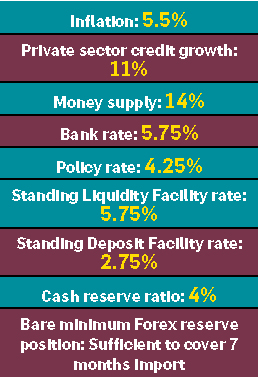
Banks and the financial sector are in peril as they have lost interest income due to constrained credit growth. The interest rate on deposits is literally ‘zero’ at the moment, and a bare minimum interest rate is being borne by Nepal Rastra Bank to safeguard depositors. The central bank has been providing a 2.75% standing deposit facility rate to BFIs, which is transferred to depositors. In this spectrum, the central bank has been spending a huge amount to safeguard depositors. NRB stated that the outstanding dues under the Standing Deposit Facility have accrued to Rs. 111.90 billion.
The monetary policies since 2025/26 have been accommodative, with a sizable credit growth estimation of over 12%. Conversely, credit growth in the first 10 months of Fiscal Year 2025/26 appeared to be merely 6.5%. The dismal reality of weak business confidence has not been properly addressed by the state authorities. Ineffective fiscal policies have consequently led to a monetary overhang, presenting as repressed inflation and crisis-induced savings triggered in the economy until just a few months ago.
Over-leveraging in private sector credit to attain growth in the past created an asset price bubble. However, the real estate and share markets are almost bust at the moment, further exacerbating recovery challenges.
 Rising non-performing loans and urgent push for balance sheet repair
The non-performing loan ratio surged more than threefold over the last four years to exceed 5%, which has been affecting the solvency of banks. This means the lending capacity of bank and financial institutions has been shrinking, as BFIs were compelled to allocate a huge amount to cover loan loss provisioning, deteriorating their profits in the short term. Further, the increased volume of risk-weighted assets is adverse to the capital adequacy and solvency of the banks in the medium term, according to Nepal Rastra Bank officials.
It is reported that approximately Rs. 349.67 billion is locked in static loan-loss provisioning due to stringent regulatory provisions to cover up potential losses.
Recently, a loan portfolio review of 10 commercial banks was conducted to gauge the asset quality of the banks, and the report has been sent to them for the implementation of recommendations, according to Nepal Rastra Bank.
BFIs are coping with a stressful situation and making efforts to repair their balance sheets. Indicators such as asset quality, earnings, and profitability are discouraging, leading to stress on capital adequacy. However, NRB has instructed the BFIs to focus on recovery and has also facilitated support through a partial moratorium in some crucial sectors, such as construction, land development, and building construction. In addition, the Monetary Policy 2026/27 stated that it would facilitate the management of NPL-distressed industries.
Against this backdrop, banks are making their best efforts to reduce non-performing loans. Legislation on an Asset Management Company (AMC) is currently underway to restructure assets and strengthen capital ratios. Repairing balance sheets requires increasing equity capital, improving asset quality, and implementing tighter risk management as per the instructions of Nepal Rastra Bank.
 NRB initiates gradual relaxation of mandatory sector lending targets
Nepal Rastra Bank has signalled that it will gradually relax directed sector lending. NRB has stated that a study is currently underway regarding the effectiveness of both deprived sector lending and directed sector lending. While the existing mandatory provisions have been relaxed to some extent, commercial banks are still required to lend 30% of their portfolio – 10% in agriculture and 20% in other sectors – to the priority sector, followed by 20% required for development banks and 15% for finance companies.
Previously, Nepal Rastra Bank Governor Biswo Nath Poudel noted that NPLs in agriculture have been high, which might be a direct result of these mandatory lending provisions. Currently, 38.85% of commercial banks’ total loans have been mobilised in the prescribed sectors, which include agriculture, tourism, micro, cottage and small industries, energy, IT and communications, and export industries using domestic raw materials, apart from deprived sector lending.
Against this backdrop, the regulatory body is no longer doubling down on the strict ratios of prescribed or directed sector lending, as these mandates have been unable to deliver the expected economic results in several of the targeted sectors.
Accommodative monetary policy targets strategic credit mobilisation
Amidst rising uncertainties and vulnerabilities in the domestic economy, Nepal Rastra Bank (NRB), the central regulatory and monetary authority, has unveiled a monetary policy aimed at addressing the bottlenecks of private sector credit mobilisation, facilitating an improvement in aggregate demand to push the sluggish economy forward onto an accelerated path.
Kiran Pandit, Deputy Governor of Nepal Rastra Bank, said that the monetary policy envisions managing liquidity and foreign exchange to help achieve the government’s 7% economic growth target.
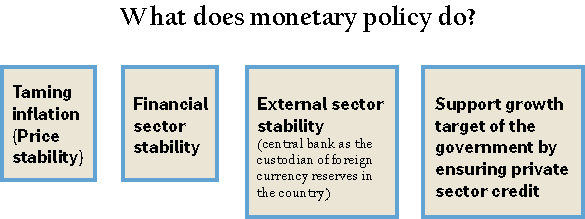
Though the central bank’s core mandates are confined to taming inflation (price stability), financial sector stability, and external sector stability, it has aimed to facilitate broader economic growth. In the Monetary Policy 2026/27, Nepal Rastra Bank underlined that the economic reform initiatives of the government, improvements in private sector investment, and increased government capital expenditure, along with a favourable external sector, could spur growth. Government expenditure, the expansion of the income tax threshold, and excess liquidity could collectively increase aggregate demand in the economy. However, increased remittance inflows, tourism earnings, and public expenditure could simultaneously create challenges in managing this excess liquidity, according to the central bank.
The monetary policy explicitly targets facilitating the growth goals set by fiscal policy. Considering the base effect of the previous year’s 6.5% credit growth, Kamlesh Kumar Agrawal, President of the Nepal Chamber of Commerce, argues that at least a 25% credit growth rate is required to achieve the ambitious 7% economic growth target in FY 2026/27.
The pegged exchange rate between the Nepali Rupee (NPR) and the Indian Rupee (INR) remains the constant nominal anchor and intermediate target for Nepal Rastra Bank’s monetary policy. Moreover, the policy states that the weighted average interbank interest rate will continue to serve as the operating target of monetary policy, and open market operations will be conducted to keep the interbank interest rate close to the policy rate.
Furthermore, as the monetary policy is accommodative, transmission pathways such as the interest rate channel and credit channel are expected to lower the cost of borrowing and expand the actual supply of loans, respectively. In the first phase, directives relating to loan disbursement, interest rates, and financial consumer protection will be reviewed and revised.
Analysing these transmission pathways of monetary policy, financial sector analyst Anal Raj Bhattarai noted that the lending rate channel remains constrained as private sector credit expansion stalled at half of its target. He added that policy rate reductions failed to lift credit demand due to core structural barriers, low market confidence insulated real estate to make the asset price channel ineffective, and the exchange rate peg independent of domestic reserves isolates the Balance of Payments from rate moves.
Other announcements in the monetary policy include encouraging commercial banks to invest in foreign government securities to avert risks and diversify portfolios, alongside minimising financial intermediation costs through digital finance.
As blacklisting issues related to cheque bounces are on the rise, the Monetary Policy 2026/27 states that special policy measures will be introduced to eliminate unlimited liability arising from personal guarantees provided as loan security. In addition to this, the monetary policy underscores the introduction of measures to reduce barriers to banking services for borrowers who have been blacklisted specifically due to dishonoured cheques.
Additionally, the monetary policy emphasises the reclassification of banks and financial institutions. The current financial architecture was created before the introduction of federalism. Following the completion of an ongoing study by Nepal Rastra Bank, the financial sector architecture is expected to be reshaped.
Most importantly, a study will be conducted on the operation of peer-to-peer (P2P) lending transactions based on an individual credit scoring system, and the loan-to-value ratio of electric vehicles used in public transport will be relaxed.
Threat of an economic downward spiral
Between the lines, the monetary policy also indicates a potential downward spiral trap in the economy if fiscal policy once again fails to be executed properly. Though it has guaranteed to facilitate the channelling of resources by utilising excess liquidity and a comfortable foreign exchange reserve position, the monetary policy underlines both headwind and tailwind risks in the economy.
Supply constraints caused by global geopolitical tensions have escalated inflationary pressure and slowed down economic growth. On the other hand, the policy highlights that monetary policy alone is not sufficient to minimise systemic risks in specific sectors of the economy or to counter the ineffectiveness of fiscal policy.
 Accommodative monetary policy to accelerate economic activity
Federation of Nepalese Chambers of Commerce & Industry (FNCCI)
The balanced Monetary Policy 2026/27 has boosted private sector confidence by co-opting its critical role in achieving the 7% economic growth target. In fact, this policy strikes a vital balance among price stability, financial sector stability, and economic growth. Its accommodative stance will directly accelerate economic activities. Long-urged provisions by private sector umbrella bodies have finally been appreciated and addressed, such as eliminating unlimited liability arising from personal guarantees as loan security, managing non-performing loans (NPLs) for sick and distressed industries, and offering restructuring facilities to borrowers. Other positive aspects include aligning margin lending with the borrower’s institutional capacity and relaxing the loan-to-value (LTV) ratio for electric vehicles used in public transport.
 Addressing constraints of blacklisting and cheque bounces
Nepal Chamber of Commerce
The Nepal Chamber of Commerce has long raised concerns regarding blacklisting and the dishonour of cheques, which have now been addressed by Monetary Policy 2026/27. The policy explicitly notes that measures will be introduced to reduce barriers to banking services for borrowers blacklisted due to dishonoured cheques (cheque bounces). The chamber also expresses its heartiest thanks for the elimination of unlimited liability arising from personal guarantees as loan security.
 Ensuring policy stability
Nepal Bankers’ Association
Monetary Policy 2026/27 ensures robust policy stability by keeping the policy rate, standing deposit facility rate, bank rate, cash reserve ratio, statutory liquidity ratio, and standing liquidity facility rate entirely unchanged. Meanwhile, quarterly reviews will make the policy more dynamic and rational. Most importantly, several key provisions will streamline operations and minimise costs for banks and financial institutions (BFIs). These include removing complexities, duplications, and linguistic barriers from directives, alongside minimising financial intermediation costs through improved branch management and digitalisation. Furthermore, the provision encouraging commercial banks to invest in foreign government securities is highly appreciated, opening new investment avenues for portfolio diversification.

Monetary policy overlooks ground realities
Nara Bahadur Thapa, Former Executive Director, Nepal Rastra Bank
Monetary Policy 2026/27 represents a continuity of complacency despite deep systemic challenges within the economy and financial sector. The current financial sector architecture remains incompatible with the country’s federal structure, even though the policy states that the ongoing reclassification of banks and financial institutions (BFIs) will be completed. The financial sector faces various constraining issues, such as alarming non-performing loans (NPLs) and asset management challenges, with rising NPLs actively exacerbating BFI solvency issues. On the other hand, leveraging digital finance to substantially minimise intermediation costs has been limited to mere words and is not properly addressed. Simply put, the monetary policy has passed the ball to the fiscal policy’s court by underlining that the effectiveness of monetary measures relies heavily on fiscal policy execution.
 Utilising excess liquidity and forex reserves for growth target
Kiran Pandit, Deputy Governor, Nepal Rastra Bank
The Monetary Policy envisions effectively managing liquidity and foreign exchange reserves to achieve the government’s 7% economic growth target. NRB is carefully delving into streamlining the transmissions and anchors of monetary policy to enhance its effectiveness and successfully achieve these desired targets.
 The necessity of consistency in LTV ratios
Nepal Automobile Importers and Manufacturers Association (NAIMA)
Monetary Policy 2026/27 is accommodative and expected to inject vibrancy into economic activities, which will certainly support a rebound in the automobile market. Previously, inconsistent policies, mainly regarding the loan-to-value (LTV) ratio, hindered the sector, as the LTV for electric vehicles was frequently changed in the past. While Monetary Policy 2026/27 states that the LTV for public transport electric vehicles will be relaxed, the central bank should go further. Because vehicle loans are backed by collateral and carry a lower risk of default, the central bank should be flexible in relaxing the LTV for all types of vehicles, treating automobiles as a necessity rather than a luxury.

