
Formalising and Strengthening MSMEs for Sustainable Economic Growth in Nepal
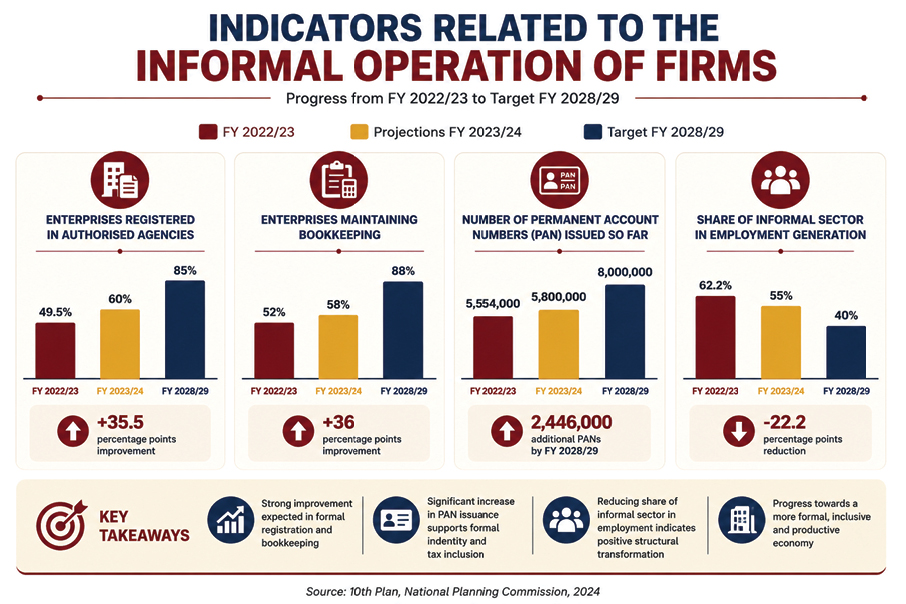
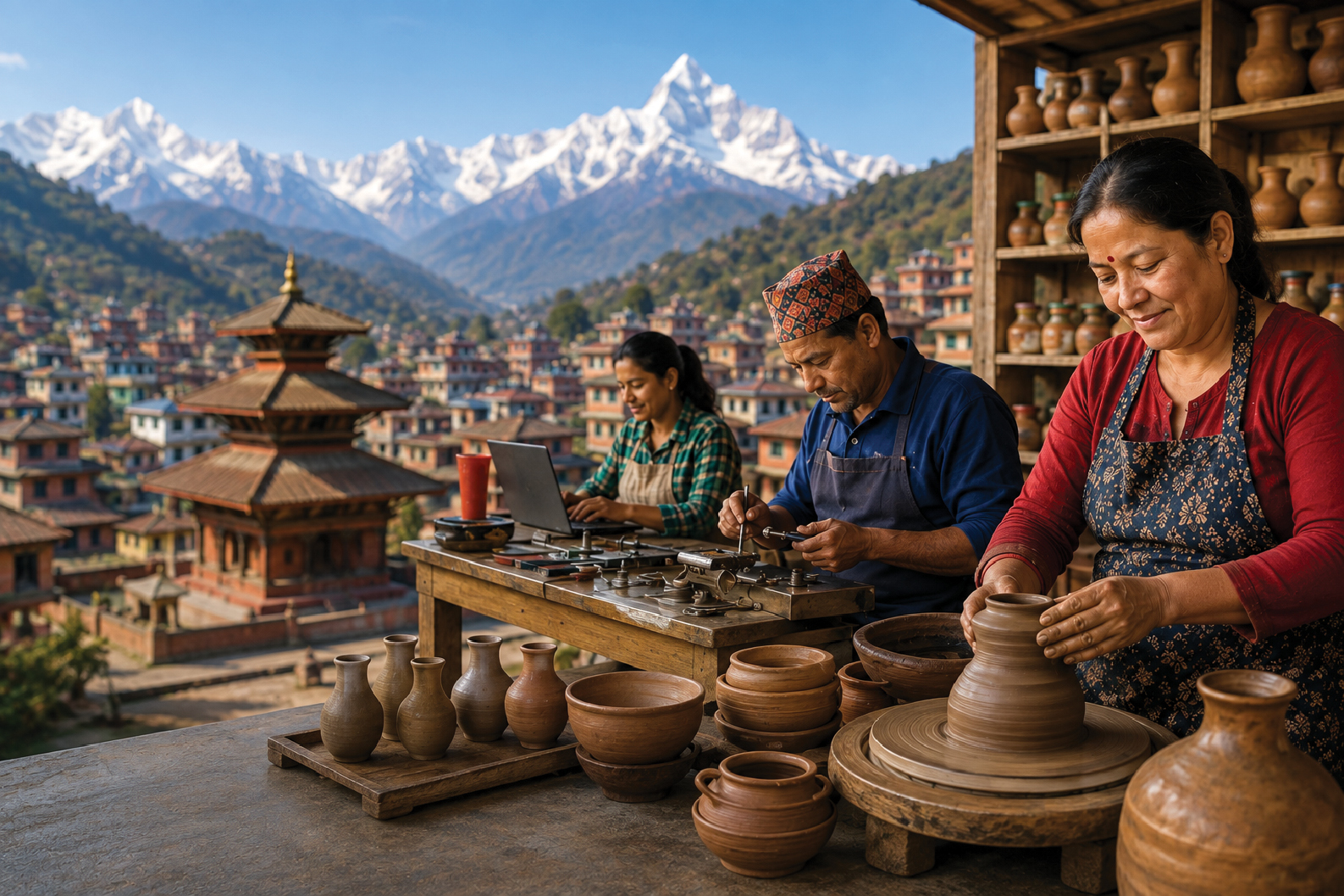 Micro, Small, and Medium Enterprises (MSMEs) are considered the backbone of the economy. In Nepal, the share of SMEs in the Gross Domestic Product (GDP) accounts for 22%. MSMEs generate a significant number of jobs, production, and government revenue. However, the government has underlined that the informal operation of MSMEs is the biggest challenge for Nepal. The National Planning Commission (NPC) – the apex planning body of the government – in the 16th Periodic Plan (FY 2024/25–2028/29) has highlighted that the informality of such enterprises hinders accurately gauging the actual size of the country’s GDP.
 “We are thinking of realigning our policies to provide incentives and social security to encourage formalisation of enterprises given the alarmingly high number of informal enterprises operating out of the government records. This will be a crucial step towards achieving the government’s target of a $100 billion economy in the next few years,” according to NPC Vice Chairperson, Gunakar Bhatta.
MSMEs are the lifeline of the economy. Their significance extends far beyond growth alone, as they contribute to inclusive, broad-based, and sustained development, which is highly crucial for macroeconomic stability.
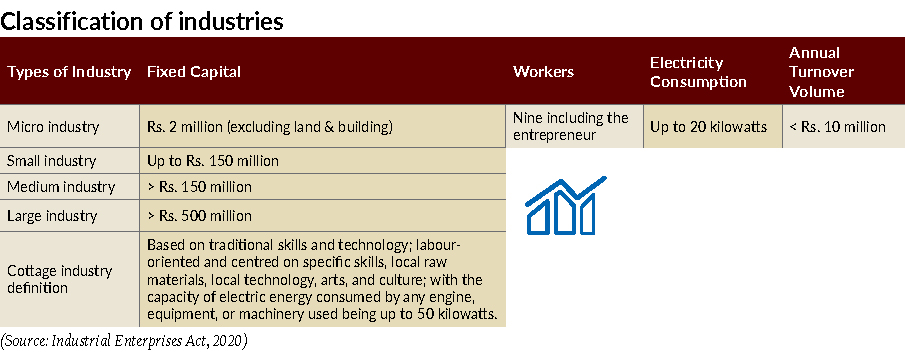
Recently unveiled data from the Department of Industry (DoI) highlights that a total of 755,563 micro, cottage, and small industries at the local level have generated 3.89 million jobs nationwide, a significant figure, particularly when considering the indirect beneficiaries of these employed individuals. “Firms registered as private limited entities, sole proprietorships, and partnerships from FY 1989/90 to 2024/25 have contributed significantly to employment creation across the nation,” according to the DoI.
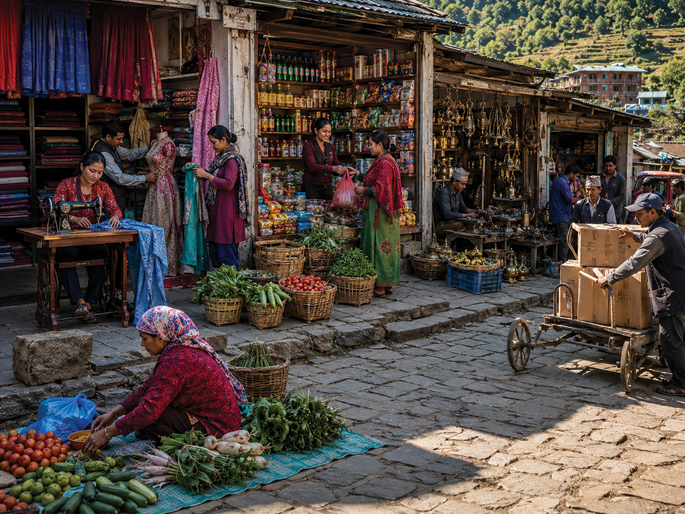
 These locally operating enterprises span sectors including agro- and forestry-based products, food processing, handicrafts, readymade garments, furniture, construction, services, and manufacturing, among others. The crowning achievement is not merely the increase in the number of enterprises; the rise of women-led enterprises is equally encouraging.
“Industrialisation is the primary means to develop a production-led, self-reliant economy, specifically to substitute imports and generate employment. No other intervention can effectively stem the outmigration wave of youth. As Nepal aspires to graduate to the status of a developing nation, we must combine our local raw materials with our skills, capital, and modern technology,” underscored DoI Director General Jitendra Basnet. “Nepal can minimise its alarming trade deficit by enhancing the quality and competitiveness of Nepali goods and services, while also boosting exports. The DoI is committed to reforming the policies, laws, and institutional bottlenecks that currently constrain the country’s potential.”
There is significant room for creating a conducive investment climate in the country. The potential to attract large-scale investment has been constrained by various factors, including a lack of trust in the government, investment security concerns, high logistics costs, a yawning infrastructure gap, procedural delays, a lack of policy predictability, red tape, poor governance, political instability, mob activity and impunity, oppressive tax policies, inadequate facilitation for the private sector, regulatory barriers, an unlevel playing field, differential treatment, exit barriers, an electricity tariff structure that favours minimal consumption, and the massive outmigration of the youth demographic, among others.
“The trend of embracing entrepreneurship is truly rewarding for the local economy, particularly when no major investments are being made in large-scale industries. A value chain integrated with large-scale industries could not only sustain cottage and small enterprises but also unlock upscaling potential for these firms in the future,” according to Darshana Shrestha, President of the Federation of Woman Entrepreneurs’ Associations of Nepal (FWEAN).
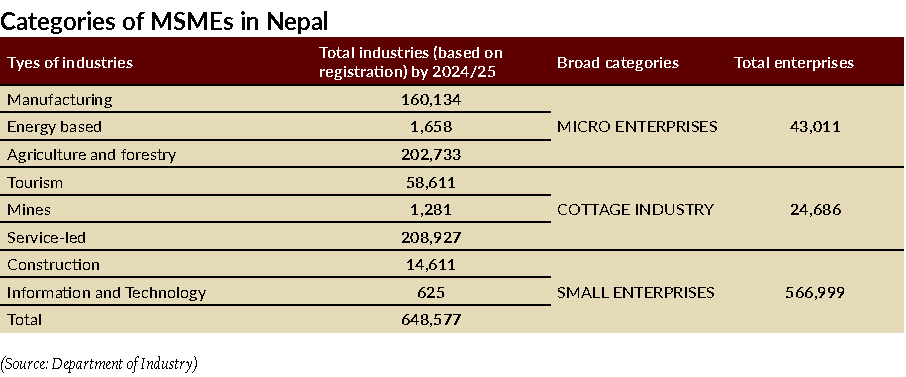 Nevertheless, large-scale industries in the country serve as a pivot for upscaling opportunities and long-term sustainability for micro, small, and medium enterprises. While the increase in the number of MSMEs is encouraging, the government should simultaneously prioritise attracting large-scale investments to foster value chain development opportunities for these enterprises, according to Kamalesh Kumar Agrawal, President of the Nepal Chamber of Commerce.
MSME Credit Mobilisation and Banking Support in Nepal
MSMEs contribute to equitable, inclusive, and sustainable growth. They are the lifeline for any economy seeking self-reliance.
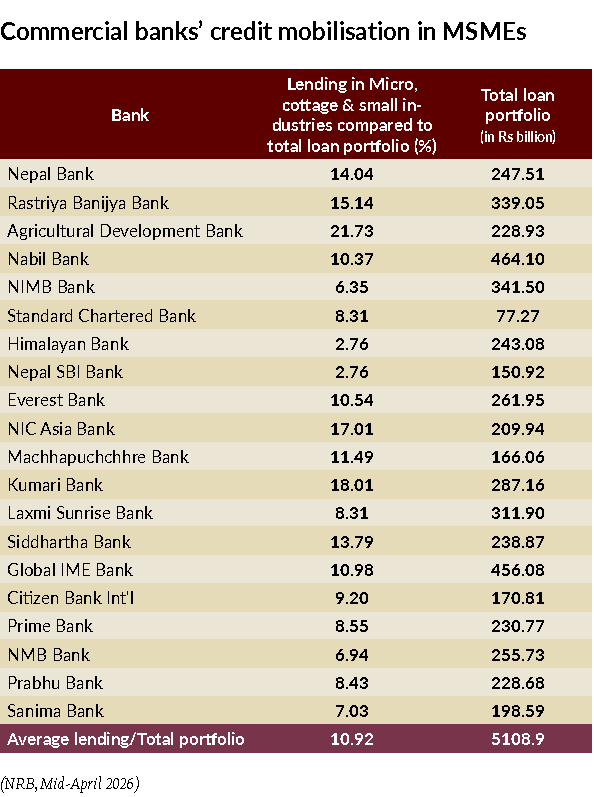
According to Nepal Rastra Bank, the central regulatory and monetary authority, around 10.9% of the credit portfolio, or Rs. 557.89 billion, was mobilised in micro, small, and medium enterprises by mid-April 2026. A debate continues regarding which sectors spur economic growth when viewed through the lens of employment, inclusivity, and environmental impact. MSMEs help prevent growth that is rootless, jobless, ruthless, and futureless.
Although commercial bank credit mobilisation to MSMEs is a result of targeted lending policies for the deprived sector, youth, and women entrepreneurs, Nepal Rastra Bank has also introduced provisions for non-collateral loans of up to Rs. 1 million through digital means. Under the new rules, MSMEs can avail of up to Rs. 1 million as a long-term working capital loan, with the concerned banks and financial institutions (BFIs) and borrowers allowed to decide the repayment schedule, according to Guru Prasad Poudel, Spokesperson for Nepal Rastra Bank.
Microfinance institutions (MFIs) have also expanded access to credit in remote parts of the country by mobilising funds received under the commercial banks’ deprived sector lending requirements.
Informal Credit Dependence and the Role of Business Development Services
However, the Nepal Living Standards Survey (NLSS) 2024 underscores the issue; a significant number of firms still depend on informal credit sources. Madhesh Province stands out, where 30.4% of firms rely on moneylenders, fuelling cycles of debt and, in some cases, asset loss due to predatory lending practices. Loan sharks charge exorbitant interest rates on such lending and sometimes seize borrowers’ collateral (land, ornaments, jewellery, etc.). The informal operation of a large number of firms is the primary reason behind their ineligibility to secure credit from banks and financial institutions.
NLSS 2024 has shown borrowing from relatives is the largest source of credit in households.
 “Nepal must think about developing Business Development Services (BDS) as a financial auxiliary to facilitate and support informal firms in building their capacity for bookkeeping, registration, renewals, paying taxes, developing business plans, exploring market opportunities, leveraging technology, and navigating or mitigating potential risks,” said Manish Shrestha, Immediate Past President of the Confederation of Nepalese Industries Young Entrepreneurs Forum (CNIYEF).
As a financial auxiliary, BDS should also form part of a unified ecosystem. Traditionally, BDS refers to non-financial services, such as training, technical assistance, and marketing, and was used interchangeably with business incubators and accelerators in the past.
When developed as a financial auxiliary, BDS acts as a structural extension of the financial system, specifically designed to bridge the gap between financial institutions and micro, small, and medium enterprises. According to entrepreneurs, “This will support in unlocking MSMEs’ potential.”
A study conducted by the World Bank Group shows that the formalisation process is smoother for larger informal firms compared to smaller ones. Small firms remain constrained by capacity gaps and limited inventories, requiring dedicated support in their formalisation process.
Nepal also has a significant corporate social responsibility (CSR) fund that can be utilised for Business Development Services. CSR funds contributed by medium and large industries can be leveraged for business development across the country. As per the provisions of the Industrial Enterprises Act, any medium or large industry, or any cottage or small industry with an annual turnover exceeding Rs. 150 million, must set aside at least one percent of its annual net profit each fiscal year to fulfil its corporate social responsibility. Utilising such funds in BDS represents the best way to give back to society and the community. As the number of enterprises grows, they will further contribute to national production, job creation, and government tax revenue.
Japan’s SME Policy Framework and Support Pillars
Japan’s SME policy is exemplary, outlining a principle of ‘providing constant support to enterprises until they grow and achieve independence’. Core pillars of government support include subsidised technical and digital upgrades, phased policy-based financing, hands-on incubation, and business succession assistance. Japan considers MSMEs to be the primary source of dynamism for the Japanese economy.
Japan offers several grants, subsidies, and innovation centres aimed at modernisation, mainly technical and digital upgrades. Grant programmes provide funding for manufacturing and services optimisation, helping MSMEs adopt advanced technology such as robotics, artificial intelligence, and machinery. IT introduction subsidies cover a significant portion of the costs for software, cloud computing tools, and digital infrastructure to boost back-office productivity. Additionally, innovation centres connect local businesses with public research institutes to test products and facilitate technology transfer.
Secondly, policy-based financing includes collateral-free, low-interest loans as well as government-backed loans during economic downturns and disasters to maintain cash flow. Under growth-phased financing, the Japan Finance Corporation provides subordinated risk capital and credit guarantees as businesses scale.
Thirdly, hands-on incubation support from one-stop consultation hubs in each prefecture offers free expert advice on marketing, management, and legal matters. Certified SME consultants are directly deployed to firms to diagnose operational inefficiencies and draft restructuring plans. Most importantly, these hubs integrate startups and SMEs into regional industrial clusters to foster value chain integration and collaboration.
Lastly, specialised business succession assistance centres offer counselling to match ageing business owners who lack heirs with aspiring entrepreneurs or corporate buyers. Under this succession assistance, tax incentives, such as the deferral or exemption of inheritance and gift taxes, are provided when business ownership is transferred to the next generation, thereby preventing forced liquidations. There are also provisions for enterprise mergers and acquisitions (M&A), which partially reimburse structural and advisory fees incurred during M&As to preserve local employment and institutional knowledge.
Driving Green Transformation and Value Chain Upgrading through MSMEs
MSMEs hold significant potential to drive Nepal’s transition toward green value chains (GVCs) by adopting environmentally sustainable production processes, improving resource efficiency, and reducing carbon emissions throughout the production cycle. As suppliers, processors, service providers, and innovators, MSMEs can mainstream cleaner technologies, renewable energy, eco-friendly packaging, sustainable sourcing, and responsible waste management. Their relatively small scale and operational flexibility enable them to adapt quickly to changing consumer preferences and environmental standards, making them key actors in building climate-resilient and low-carbon industries.
The principles of the circular economy, reducing resource consumption, reusing materials, repairing products, remanufacturing, and recycling waste, provide MSMEs with opportunities to lower production costs while creating new business models and employment. In Nepal, Leaf Plus, a startup producing biodegradable plates from betel nut (supari) leaves, demonstrates how agricultural waste can be transformed into commercially viable, environmentally friendly products.
Such enterprises illustrate that sustainability can become a source of innovation, value addition, and competitive advantage rather than merely a compliance requirement. Expanding similar initiatives in agro-processing, tourism, handicrafts, textiles, forest products, and renewable energy would strengthen Nepal’s green industrial ecosystem while contributing to its climate commitments and Sustainable Development Goals.
The contribution of MSMEs becomes even more strategic when viewed through the SMILE Curve, which argues that the greatest value addition in a product’s lifecycle occurs at the upstream stages, such as research and development, innovation, product design, and technology creation, and at the downstream stages, such as branding, marketing, logistics, digital services, and after-sales support, rather than in routine manufacturing or assembly.
Currently, most Nepali MSMEs continue to operate in the middle segment of the value chain, where margins are relatively low and competition is largely price-driven. Green value chains and circular economy practices provide an opportunity for these enterprises to move upward along the SMILE Curve by developing eco-designed products, obtaining green certifications, building sustainable brands, leveraging digital platforms, protecting intellectual property, and accessing premium domestic and international markets that increasingly reward environmentally responsible production.
Supported by enabling public policies, innovation financing, technology transfer, and stronger linkages with research institutions, MSMEs can evolve from low-value producers into knowledge-intensive and innovation-driven enterprises, according to Shova Gurung, President of the Federation of Nepal Cottage and Small Industries (FNCSI).
Such upgrading would not only enhance productivity and export competitiveness but also accelerate Nepal’s structural transformation towards a high-value, green, inclusive economy and sustained growth.
 We are considering realigning our policies to offer incentives and social security that encourage the formalisation of enterprises, given the alarmingly high number operating off government records. This will be a crucial step toward achieving the government’s target of a $100 billion economy in the coming years.
– Gunakar Bhatta
Vice Chairperson, National Planning Commission
 While the increase in the number of micro, small, and medium enterprises (MSMEs) is encouraging, the government should simultaneously prioritise attracting large-scale investments to foster value chain development opportunities for them. Large-scale industries in the country serve as a pivot for upscaling opportunities and long-term sustainability for MSMEs.
– Kamalesh Kumar Agrawal
President, Nepal Chamber of Commerce
 Industrialisation is the primary means to develop a production-led, self-reliant economy, specifically to substitute imports and generate jobs. No other intervention can effectively address the outmigration wave of youth. As Nepal aspires to graduate to the status of a developing nation, we must combine our local raw materials with our skills, capital, and modern technology. Nepal can minimise its alarming trade deficit by enhancing the quality and competitiveness of Nepali goods and services, while also boosting exports. The DoI is committed to reforming the policies, laws, and institutional bottlenecks that currently constrain the country’s potential.
– Jitendra Basnet
Director General, Department of Industry
 The trend of embracing entrepreneurship is truly rewarding for the local economy when no major investments are made in large-scale industries. Integrating value chains with large-scale industries could not only support the sustainability of cottage and small enterprises but also unlock the potential for these firms to scale up in the future.
-Darshana Shrestha
President, FWEAN
 Non-collateral loans of up to Rs. 1 million are available through digital means as well. Under the new rules, MSMEs can avail of up to Rs. 1 million as a long-term working capital loan, with the concerned banks and financial institutions and borrowers allowed to decide the repayment schedule.
– Guru Prasad Paudel
Executive Director and Spokesperson, Nepal Rastra Bank
 Supported by enabling public policies, innovation financing, technology transfer, and stronger linkages with research institutions, MSMEs can evolve from low-value producers into knowledge-intensive, innovation-driven enterprises.
– Shova Gurung
President, Federation of Nepal Cottage and Small Industries (FNCSI).
 Nepal must consider developing Business Development Services as a financial auxiliary to facilitate and support informal firms in building their capacity for bookkeeping, registration, renewals, tax payment, business plan development, market exploration, technology utilisation, and scaling opportunities, as well as navigating and mitigating potential risks.
-Manish Shrestha
Immediate Past President, CNIYEF

