
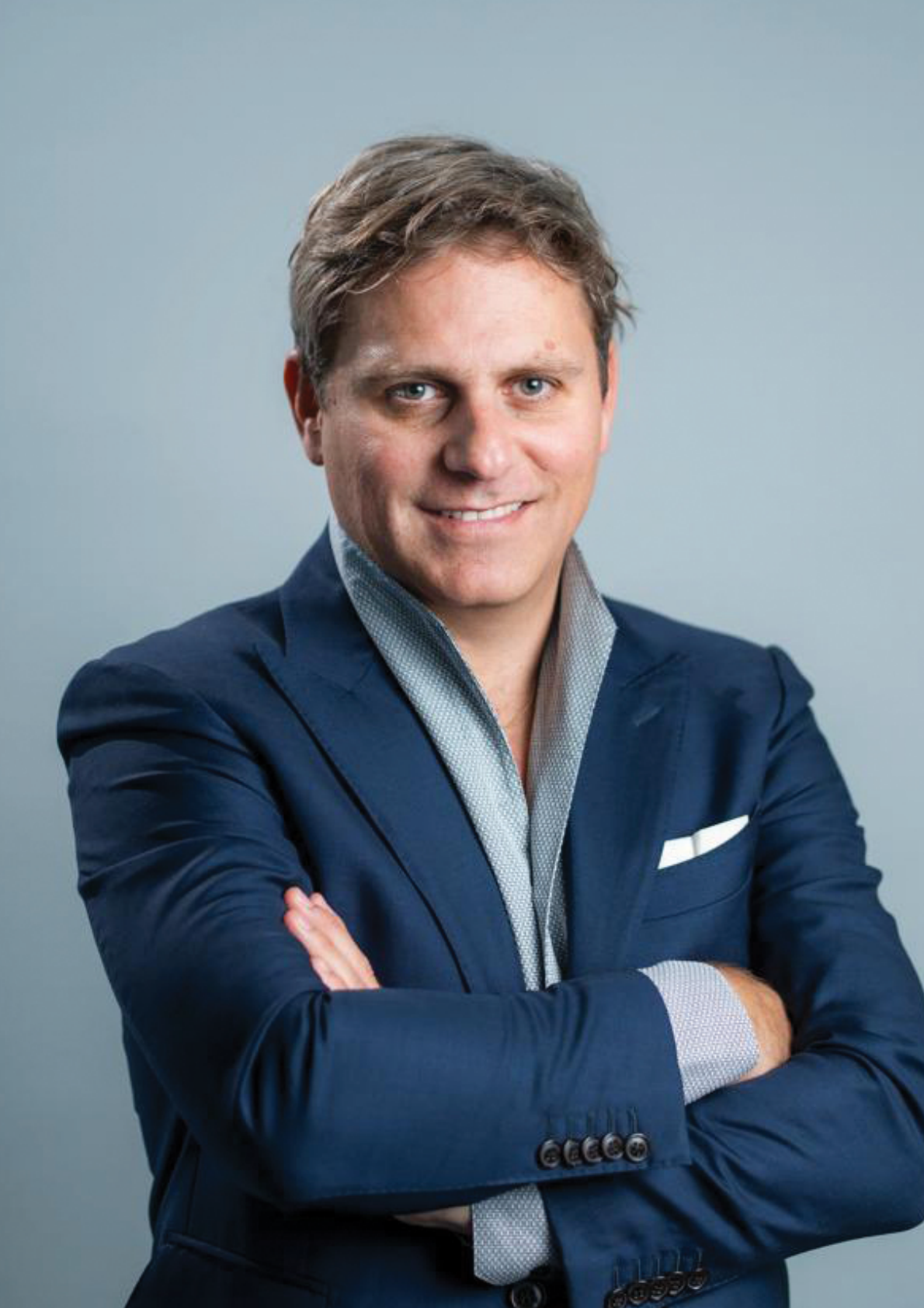
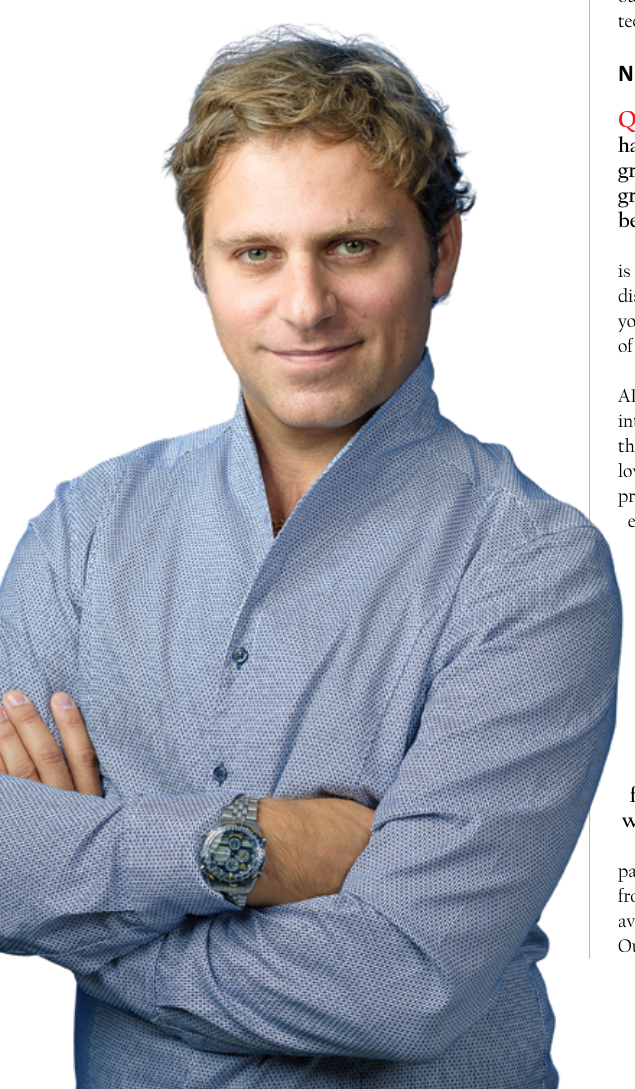
P ascal Kaufmann stands at the intersection of neuroscience, technology and artificial intelligence, bringing a distinctly human perspective to one of the defining technological transformations of this era. A neuroscientist, Swiss technology entrepreneur and AI pioneer, he has been exploring the relationship between human intelligence, machines and the future of work and innovation. Through his research, entrepreneurial ventures and advocacy for a new generation of intelligent technologies, Kaufmann challenges the conventional view that artificial intelligence should simply replicate the human brain. His work instead raises a broader question: how can technology augment human intelligence, creativity and capability rather than merely automate them?
For a country like Nepal, which is still building its technological and innovation ecosystem, Kaufmann’s perspective offers an opportunity to look beyond the race to adopt AI and consider the deeper questions of human capital, education, innovation, entrepreneurship and technological sovereignty. In this conversation, he discusses the future of intelligence, the evolving relationship between humans and machines, the implications of AI for developing economies, and what countries like Nepal need to do to prepare for a technology-driven future. During the virtual interview with Kaufmann, he shared intriguing insights on neuroscience, technology and artificial intelligence as well as applicability for Nepal. Excerpts of the interview are given below.
UNDERSTANDING AI FROM A NEUROSCIENTIST’S PERSPECTIVE
Q: You began your career as a neuroscientist before becoming an AI entrepreneur. How has studying the human brain shaped your vision of artificial intelligence?
A: Centuries ago people believed the brain contained cogwheels and little pumps, because the clock was the most impressive machine of the age. Today, most people assume there is a computer inside our heads that simply needs to run fast enough to become intelligent. I doubt that analogy deeply. Working at the interface between brains and machines taught me that intelligence is not a software feature. It emerges from billions of simple actors interacting with a body and an environment, more like an ant colony than a processor.
That perspective changes what one considers progress. Scaling a language model is engineering. Understanding why a three- year-old learns from a handful of examples is science and touching the unknown. I built businesses so that I could keep working on the second question. The brain is the last unexplored continent, and we have barely landed on the beach.
AI, Leadership and Business
Q: Many people view AI primarily as a technological revolution. From your perspective, how closely is the future of AI connected to advances in neuroscience?
Q: AI is rapidly becoming a boardroom priority rather than merely an IT issue. How should CEOs rethink leadership in an era where intelligent systems increasingly support decision-making?
A: Completely – although not in the way people expect. We will not build intelligence by copying neurons one by one, just as we did not achieve flight by copying feathers. We achieved flight when we understood the principle of aerodynamics. What neuroscience owes the world is the principle of intelligence, the “brain code”. Once that is decoded, it will be implemented in a surprisingly compact way, and today’s enormous data centres will look like the wing- flapping machines of the 19th century.
A: Three shifts. First, leaders have to use these systems personally. A CEO who delegates AI to the IT department is like a CEO in 1998 who had a secretary print out emails. You cannot truly govern a technology you have never touched, you cannot judge what it is good at or where it quietly fails.
Second, the scarce resource moves. It used to be analysis – who can produce the report. Now analysis is nearly free, so the scarce resource is judgement: which questions to ask, which recommendation to override, which risk to carry.
This is precisely why we started Mindfire: to bring the world’s sharpest minds from neuroscience, physics, mathematics and computer science together on that one question. The current generation of systems is extraordinarily useful, but it is not the destination. It is the instrument that lets us look further – the telescope, not the planet.
Third, leadership becomes an infrastructure question. Where does our data live, under whose jurisdiction, and who can switch us off? That used to be a procurement detail. Today it is strategy, and it belongs on the board agenda alongside financing and talent.
As for what machines will not replicate: I am cautious about drawing permanent boundaries, because that list has been shortened many times.
Q: There is growing discussion about human-like AI. What does “human- like intelligence” actually mean? On the flip side, what aspects of human intelligence do you believe machines are unlikely to replicate fully?
Q: Many organisations invest heavily in AI technologies but fail to realise business value. In your experience, what differentiates successful AI transformation from unsuccessful implementation?
A: Human-like intelligence means understanding rather than retrieving: forming a model of the world, transferring knowledge from one domain to a completely unfamiliar one, setting your own goals, and being wrong in interesting ways. A child who has never seen a ladder can work out how to reach the shelf. That capacity for genuine generalisation from very little data is what today’s systems still lack. What surprised the research community is how much of language and dialogue turns out to be reproducible with statistics alone. Impressive – but statistics is not compréhension nor intelligence.
A: Failed projects almost always start with the technology and look for a problem afterwards. Successful ones start with a specific, painful, high-volume process and a named owner who is measured on the outcome. In our own work the clearest example is healthcare: a physician spends a large share of the day on documentation. Give that time back and the value is obvious to everyone in the building on day one. Nobody needs a change-management programme to explain it.
As for what machines will not replicate: I am cautious about drawing permanent boundaries, because that list has been shortened many times. What I would say is that meaning, responsibility and the experience of being mortal are not computational problems. A machine can compose a condolence letter; it cannot lose anyone. Trust between people, the willingness to take responsibility for a decision, the drive that comes from having a limited life or how it feels to touch a loved one – those remain ours. And that is not a weakness in the machine. It is the reason we build them: to take the mechanical work off our hands so that we can concentrate on being human.
The second differentiator is trust. In hospitals, public administration and universities, adoption collapses the moment staff suspect their data is leaving the house. If the system runs under your own jurisdiction and people can see where the data sits, usage rises by itself.
And third: do not run 40 pilots. Run three, finish them, put them into production, and let the results recruit the rest of the organisation for you.
Q: As AI automates routine tasks, what uniquely human capabilities will become more valuable for managers and business leaders?
A: The ability to ask a good question. Judgement under uncertainty, when the data genuinely does not settle
the matter. The willingness to sign your name under a decision – accountability cannot be delegated to a model. And the capacity to build trust between people, which is slow, unscalable and precisely for that reason valuable.
companies with real manufacturing and engineering depth are better positioned there than they currently believe.
Q: There is widespread concern that AI and robotics will replace jobs. Should business leaders focus more on job displacement or on job transformation?
There is also a shift many boards underestimate. Automation is hitting white-collar work first. Skilled physical work – and any work that depends on human presence – becomes more valuable, not less. Leaders should be planning for that inversion now.
Transformation – but not as a comforting euphemism. Individual tasks will disappear quickly, and for the people affected the distinction between “displaced” and “transformed” is meaningless unless someone invests in them. So the leadership obligation is concrete: retrain, redeploy, and be honest about the timeline.
Q: You have worked extensively on knowledge- sharing and collective intelligence through Starmind. How can organisations better capture and utilise the knowledge already existing within their workforce?
Historically we have consistently overestimated permanent job loss and underestimated how strange the new jobs would be. Nobody in 1995 planned a career in cloud security. I would also point out something that gets
A: Stop trying to capture it. That was the flaw in classic knowledge management: it asked busy experts to write documents that were outdated the moment they were saved. Adoption was low, complexity was high, and the wiki became a graveyard.
lost in the debate: a great deal of the work being automated is repetitive, monotonous work – the kind that makes people ill. If AI removes the assembly line from knowledge work, that is not merely an economic gain. It is a public health gain.
Historically we have consistently overestimated permanent job loss and underestimated how strange the new jobs would be. Nobody in 1995 planned a career in cloud security.
The brain does not store knowledge in a filing cabinet either – it stores connections. So the design principle is to map who knows what, continuously and automatically from the work people already do, and then route a question to the right colleague in real time. That is the idea behind the corporate brain: to let an organisation think with the power of a thousand brains rather than one. Modern language models make this far stronger, because they can read the organisation’s own documents – but only if the organisation is willing to let a model touch its internal knowledge, which brings us straight back to sovereignty and trust.
Q: Looking ahead, what skills should today’s professionals develop to remain relevant in a workplace increasingly shaped by AI?
A: High-tech fluency, first: use these tools daily until you have an instinct for where they are brilliant and where they are confidently wrong. That instinct cannot be acquired from a seminar. Second, domain depth. AI amplifies expertise and exposes shallowness – a mediocre lawyer with AI is still a mediocre lawyer, while an excellent one becomes formidable. Third, the ability to work across disciplines. Nearly every valuable idea I have seen in 20 years came from the seam between two or more fields. Fourth, communication and trust-building, because the human interface is where the remaining value concentrates. And finally: keep a physical skill. In a world of infinite digital output, the ability to make or repair something real will be worth more than people assume today.
Robotics and the Future of Work
Q: AI is often compared to electricity or the internet in terms of its transformative potential. In your view, how will AI redefine competitive advantage over the next 10 years?
A: The electricity comparison is useful in one respect: once everyone has it, having it is no longer an advantage. Within a decade, access to capable models will be a commodity, roughly like bandwidth. So advantage will not come from the model. It will come from three things: proprietary data nobody else has, processes redesigned around the technology rather than decorated with it, and trust – the ability to tell customers and regulators exactly where their data is and who has jurisdiction over it.
Ethics and Responsible AI
Q: As AI systems become more autonomous, ethical concerns are becoming more complex. What principles should governments and businesses adopt to ensure AI remains trustworthy and beneficial to society?
I would even add a fourth: physical AI. The next wave moves from screens into the world – robotics, machines that act rather than merely answer. Countries and
A: Four principles, in order of practical importance. Sovereignty: know where your data physically sits and
Q: How can organisations strike the right balance between innovation, privacy, transparency, and responsible AI governance?
which government can compel access to it. Traceability: you must be able to reconstruct why a system produced a given output, especially in medicine, justice and public administration. Human accountability: a named person must be answerable for every consequential decision – “the model decided” is not an acceptable answer, at least not today. And proportionality: regulate the application, not the mathematics. An AI triaging patients and an AI suggesting film titles do not require the same scrutiny.
A: By treating privacy as an architectural decision at the core rather than a policy document. If sensitive data never leaves your jurisdiction, most of the governance argument evaporates and teams can move fast inside a safe perimeter. That is the whole reason we run on Swiss infrastructure, some of it in former military bunkers in the Alps – because sovereignty has to be a physical fact, not a contractual promise.
I would add a warning. Ethics debates conducted purely as risk debates end in paralysis, and paralysis is not a neutral outcome – it simply means the technology gets built somewhere with fewer scruples and then sold back to you. The most ethical position available to a democratic country is to be technologically competent and try to be at the cutting edge.
Beyond that: classify your data honestly, so that 90% of use cases are not slowed down to protect the 10% that genuinely need it. Be transparent with employees and customers about where AI is in the loop. Keep a human decision-maker on anything that materially affects a person our entire outcomes. And review frequently, because the technology will change faster than your policy cycle.
Nepal’s Perspective
Q: Nepal is at an early stage of its AI journey but has a young, digitally connected population and a growing technology sector. Where do you see the greatest opportunities for countries like Nepal to benefit from AI?
A: The greatest opportunity is leapfrogging. Nepal is not burdened with 50 years of legacy IT that has to be dismantled first – that is an advantage, and countries with young populations have historically used exactly this kind of moment to jump a generation or two of infrastructure.
Concretely, I would look at four areas: health, where AI can extend the reach of a limited number of doctors into rural districts; education, where a patient tutor in the student’s own language is transformative at very low cost; agriculture, where weather, soil and yield prediction have direct economic impact; and services
export, where a young, English-capable, digitally fluent
workforce equipped with AI can compete globally from
Kathmandu. The strategic question is whether Nepal
supplies raw labour and raw data to foreign platforms,
or builds products it owns. Only the second creates lasting wealth. All this most be grounded on a Nepal sovereign tech stack: Without tech sovereignty there is no sovereignty.
Q: Many Nepali businesses are small and medium-sized enterprises with limited financial resources. How can SMEs adopt AI without making prohibitively large investments?
A: The good news is that the expensive part is already paid for by somebody else. No SME should train a model from scratch. Excellent open-source models are freely available, and small ones now run on modest hardware. Our own approach at AlpineAI is exactly this: take
the best available open models and adapt them to the customer’s data and context. That is affordable at almost any scale.
My advice to a small business would be: pick one process that consumes real hours every week – quotations, customer enquiries, invoice handling, translation – and automate that one thing properly. Measure the hours saved. Reinvest them. Do not buy a platform; buy back time. And train two or three people internally rather than hiring consultants, because the capability has to stay in the company. Why not doing a joint project with a Swiss company and systematically exchange know-how bidirectionally so as to leverage expertise and synergies from two small countries?
Q: Switzerland has developed one of the world’s strongest innovation ecosystems. What lessons from that experience could be valuable for countries like Nepal seeking to build globally competitive technology enterprises?
A: Switzerland is small, mountainous, landlocked and has no natural resources – the parallels are worth taking seriously. Let’s focus on four comparable areas:
First, education with genuine parity of esteem between universities and vocational training. Our dual apprenticeship system is one of the most underrated Swiss exports, and it means engineering excellence is not concentrated in a tiny elite. Second, a small domestic market, which forces companies to export from year one and to compete on quality rather than volume. Third, institutional trust and stability – boring, decentralised, predictable government is a competitive weapon. Fourth, dense links between applied universities and industry, so that research reaches a factory floor rather than a filing cabinet.
And one attitude: let’s be bold, never assume to be too small. Talent and ideas paired with the right partnerships are more powerful than fast chips. A country that gets its education and its trust right can punch far above its size.
Q: If you were advising Nepal’s business leaders, universities and policymakers over the next decade, what three strategic priorities would you recommend to prepare the country for the age of artificial intelligence?
A: One: bold talents. Make AI literacy and entrepreneurship part of general education, not a specialist track. Build a small number of genuinely excellent research groups rather than many mediocre ones, and connect them internationally – that is what we do with Mindfire, and it works precisely because talent is a global network. Just as important, give the diaspora a compelling reason to come back, or at least to invest and mentor from abroad.
Two: sovereign digital foundations. Domestic compute and data centres, clear and simple data rules, and a deliberate effort to build Nepali-language datasets. There are companies across Switzerland which are ready and willing to help out. If Nepali is not properly represented in these models, Nepal becomes a permanent customer of somebody else’s technology. Language is infrastructure.
Three: apply the technology to Nepal’s own problems first. Do not try to build a frontier model – that race is expensive and not where the value is. Build the best agricultural, health, disaster-resilience and tourism applications in the world, in Nepal, for Nepal. Products that solve a hard local problem export surprisingly well.
Q: Finally, what message would you like to share with Nepal’s next generation of entrepreneurs, innovators and management professionals who aspire to lead in an AI-driven world?
A: Do not be intimidated by the size of the companies on the other side of this. The fundamental questions are still open. Nobody has decoded the principle of intelligence, and the person who does will not necessarily be sitting in a large laboratory in California – they may be sitting in Kathmandu. This is the moon landing of the 21st century, and it has not happened yet.
So, build rather than only consume. Being a skilled user of foreign AI is a job; building something the world needs is a future. Work on a problem you actually care about –preferably one you can see from your own window, because you understand it better than any outsider ever will. Team up across disciplines, because the interesting ideas live at the borders. And when somebody tells you it is impossible, take it as encouragement. That is what inspires me, let’s join forces and team up to tackle the as of yet impossible.

