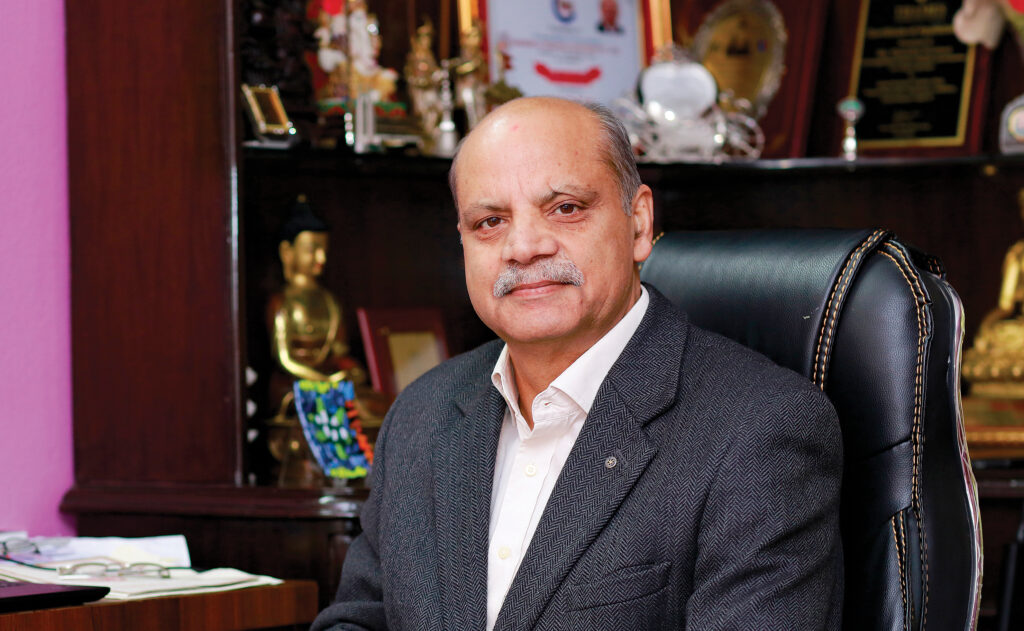
Sameer Shrestha is Chief Marketing Offi cer (CMO) at Cimex Inc. Pvt. Ltd., the authorised distributor of BYD Auto Industry Co. Ltd. in Nepal. At Cimex Inc., he leads brand strategy, market expansion, dealer ecosystem growth, and integrated marketing communications. As BYD is one of the world’s most innovative EV brands, his work focuses deeply on market creation alongside traditional marketing.
Over the years, he has gained extensive experience in developing brand perception toward premium technology leadership, expanding nationwide dealer networks, and executing high-impact sponsorship strategies with experiential marketing. His focus also encompasses industry-first, disruptive campaigns that reset automotive benchmarks, purpose-driven brand building, institutionalising CSR, and advocating for EV adoption and sustainability.
Cimex is widely credited for contributing to the country’s rapid electric vehicle adoption and green mobility shift. The HRM Nepal caught up with Shrestha to learn from his experience on EV market creation, consumer choices, service off erings, and the key factors behind becoming the country’s number one EV brand. Excerpts:
How would you assess Nepal’s EV market in particular? What are the key trends and challenges?
The EV market in Nepal has been steadily progressing toward maturity. EV adoption currently accounts for nearly 73% of new sales, up from around 67% in 2024. With annual private vehicle sales in the country hovering around 15,000 units, 52 distinct brands are now actively competing. Consequently, the market is highly competitive while simultaneously reaching a stage of structural maturity.
When Cimex first introduced BYD to Nepal, electric vehicles were still largely unfamiliar to Nepali consumers. What was the fundamental marketing challenge: selling an electric vehicle, changing consumer behaviour, or building trust in a new brand?
When we started back in 2017 by introducing the e6, EVs were generally understood as two-door cars, as people in Nepal had mostly seen models like the REVA and Mahindra EVs. A full-fledged, standard passenger electric vehicle was surprising to many. Even though people were convinced that electric vehicles matched or exceeded traditional fuel-engine vehicles in performance, efficiency, and long-term reliability, they lacked the confidence to buy them initially. Consequently, we focused primarily on B2B (business- to-business) and B2G (business-to-government) sales, with the primary aim of engaging government agencies to demonstrate the true capability and scope of EVs.
It is true that anyone has to start at the beginning. What were the motivating factors for Cimex to introduce EVs?
Back in 2017, Nepal faced an acute fuel shortage due to supply disruptions from India. Around the same time, the country was working to end rolling blackouts by securing a reliable electricity supply, with several power generation projects in their final stages of completion. Beyond increasing supply capacity, we believed this shift would create space for clean transportation. We approached the introduction of EVs primarily through the lens of sustainability and practical feasibility.
Although Nepal’s contribution to global carbon emissions is minimal, adopting clean transport helps improve the local Air Quality Index (AQI). As a country that is less industrialised, with an economy heavily reliant on agriculture and service sectors such as trade, tourism, and financial services, our core motive for introducing EVs was to reduce transport- related emissions. Having already established a business relationship with BYD through solar energy supply projects during the load-shedding era, that existing partnership directly supported us in introducing BYD EVs to Nepal.
Then Cimex started introducing new segments gradually. Which was the turning point in BYD sales in Nepal?
In the passenger vehicle segment, 2022 marked a major turning point for BYD with the introduction of the ATTO 3 in October of that year. It quickly
year. These locations provide comprehensive service across every region. Geography itself plays a major role in EV adoption here. Crossing Nepal from east to west covers roughly 1,200 km, a journey someone can complete on just one or two charges depending on the terrain. Ultimately, consumer confidence in BYD stems from a complete package: battery technology, driving range, charging infrastructure, after-sales support, safety, software, and competitive pricing.
THE ATTO 3 HAS SET A CLEAR INDUSTRY BENCHMARK AS THE HIGHEST-SELLING ELECTRIC SUV IN NEPAL.
became highly preferred by consumers, whereas prior to its launch, our sales efforts had been largely concentrated on the B2G and B2B sectors. Since then, the ATTO 3 has set a clear industry benchmark as the highest-selling electric SUV in Nepal.
BYD’s product technology is global, but brand acceptance is local. How did you decide which elements of BYD’s global brand identity should be retained and which needed to be adapted to Nepali consumers?
EV buyers in Nepal have become increasingly knowledgeable. They compare battery technology, range, charging, safety, software, resale value, after-sales service and competing brands. How has the consumer’s decision-making process changed since you entered the market?
Branding is always built for the long term. Currently, entry-level products with added features are entering the market, allowing consumers to benefit from competitive choices. However, buyers still need a deeper understanding of overall vehicle longevity and safety before making purchasing decisions. Rather than chasing short-term price competition, BYD focuses on building consumer confidence through an integrated ecosystem of service networks, spare parts availability, solid warranty terms, and strong dealer presence. This comprehensive approach is why people choose BYD with confidence, directly driving our brand’s growth.
As I lead the branding and marketing for BYD, I have focused heavily on highlighting our core technological strengths. BYD has long been an established battery manufacturer, and it naturally promoted its proprietary technology when it began producing EVs. Just as consumers were gaining confidence in electric vehicles through a better understanding of battery safety, BYD introduced its revolutionary Blade Battery. It successfully passed the “Mount Everest of battery testing”, the nail penetration test, setting an ultimate benchmark for safety evaluation and thermal runaway limits in EV batteries. By actively creating awareness around this battery technology and its safety features, we directly leveraged and driven our sales growth in Nepal.
As a highly reputed global brand, BYD continues to introduce pioneering technologies, including its ultra-fast megawatt (MW) charging in China. How can Nepal adopt this technology?
BYD is a technology-oriented company. Recently, BYD introduced Megawatt charging in China, and we are planning to launch this technology in Nepal within 2026. A fast charger can fully charge the battery in just five minutes, and even in the worst weather conditions, a full charge takes only 12 minutes. However, people need to understand vehicle compatibility, specifically, whether a vehicle is designed to handle fast charging. For instance, if your phone only accepts a 25-watt input, it will only draw that amount even if you use a 50-watt charger. The exact same principle applies to EVs. By the end of 2026, we will introduce one fast-charging infrastructure unit, followed by expanding a few more by next year.
How many vehicles Cimex has sold so far in Nepal?
We’ve so far sold more than 11,000 vehicles in Nepal.
What are the major segments Cimex has been selling in Nepal?
Currently, we’ve been selling products ranging from hatchback to SUVs. More particularly, from the entry level vehicles to premium ultra luxury plus hybrid Denza B5 and B8 SUVs.
Beyond the strength of the BYD brand and the favourable growth of the EV market, what distinctive business strategy, execution discipline and organisational capabilities have driven Cimex’s extraordinary sales performance?
Our after-sales network currently operates across 14 locations, with plans to add two to three more within 2026, bringing our total to 20-22 centres by next
How are the sales of premium luxury SUVs like Denza in Nepal?
Currently, we offer two variants: the B5 and the B8. The B5 is a five-seater, slightly smaller than the B8, which is a seven-seater. We have made these options available to cater to the diverse preferences of Nepali consumers. Both models are plug-in hybrid SUVs, allowing drivers to rely solely on battery power for city
commutes and seamlessly utilise both electric and petrol modes for long-distance travel.
higher sophistication.
Globally, BYD currently holds 42,000 registered patents and employs 133,000 research and development (R&D) engineers. BYD continues to invest heavily in R&D and innovation. As discussed earlier, BYD has recently introduced flash chargers and megawatt chargers. Furthermore, BYD unveiled trucks supported by megawatt charging, which are utilised in trade logistics and freight management. Previously, long-distance travel in an EV was considered a far-fetched dream, but in a short period, seeing freight and logistics management trucks powered by fast chargers has been remarkable.
The EV market is becoming increasingly competitive, with Chinese and other global brands entering with aggressive pricing, technology and marketing. When competitors begin offering similar features and specifications, what ultimately differentiates a brand?
When you are in business, you must be prepared to navigate all kinds of circumstances. That is a well- known reality, and there is no secret to it. We have simply been manoeuvring through those comments, criticisms, and every challenge that comes our way.
The second-generation Blade Battery (Blade Battery 2.0) is even more energy efficient. Additionally, BYD recently introduced intelligent driving technology known as “God’s Eye” (also referred to as DiPilot). Because BYD is vertically integrated, it manufactures over 70% of its components in-house, outsourcing only 30%. This unique foundation drives continuous innovation, which will be integrated into future product lines.
Nepal’s EV market has grown rapidly, but consumer demand is influenced by taxation, import policy, charging infrastructure, electricity prices, financing costs and public confidence. How much can marketing accomplish when the broader market ecosystem is not entirely within a brand’s control?
As far as I know, there should be consistency in tax policies. When we introduced EVs back in 2017, we advocated for favourable policies, especially since policymakers at the time were largely unaware of appropriate taxation for electric vehicles. Initially, the government introduced a 1% import tax, which has been continually revised over the years. Inconsistent tax policies create distortion, uncertainty, and volatility in the market. Therefore, tax policy must be designed with a longer-term scenario in mind. A predictable business environment passes benefits on to consumers, and ultimately, the government benefits from higher tax revenues through increased market sales. Predictable tax policies also give businesses the room needed to factor in changes for scalability and long-term sustainability.
Cimex has demonstrated significant social commitment, including its Rs. 7 crore contribution to the Prime Minister’s Disaster Relief Fund. What does responsible business mean to you as a branding professional?
These CSR initiatives are not merely obligations to fulfil simply for being in business. They stem genuinely from the heart. To streamline our efforts, we established the Cimex BYD Charity Foundation in 2024, through which all our corporate social responsibility activities are routed.
Our “Building Dreams and Forest” project contributes to reforestation with the support of local communities in areas affected by recent deforestation. Utilising the Miyawaki technique, we have planted 5,000 saplings across five locations so far. In the Kathmandu Valley, we have established two pocket forests in Teku, one in Jhamsikhel, and one in Chakhandol, alongside a recent plantation in Bardibas outside the valley. Plantation work is currently underway at another new site, and we will continue expanding this afforestation project.
Most importantly, prioritising EV ecosystem development is essential to driving market growth. At the moment, the government should focus on building infrastructure backed by a 24/7 electricity supply and a favourable tariffpolicy to encourage power consumption. However, the current electricity tariffstructure appears regressive. A policy where you pay higher rates the more you consume cannot effectively increase electricity consumption. On top of that, the government has levied VAT on electricity consumption for users consuming over 50 units per month.
The EV market has transformed rapidly. What can we expect in terms of technology over the next two years?
Compared to five years ago, technology is evolving rapidly. Recent advancements driven by the AI boom are pushing technologies toward even
THIS UNIQUE FOUNDATION DRIVES CONTINUOUS INNOVATION, WHICH WILL BE INTEGRATED INTO FUTURE PRODUCT LINES.
Another vital CSR initiative is “Project Dolphin”. Many people are unaware that dolphins exist in Nepal’s rivers, specifically species categorised as endangered by the IUCN (International Union for Conservation of Nature). We have been actively working along the Karnali River and plan to expand conservation efforts to other river basins.
When it comes to battery recycling, BYD has already partnered with specialist recyclers such as LOHUM in India. Furthermore, if a battery still retains usable life even when no longer suitable for powering a vehicle, it can be repurposed for energy storage in solar power plants where grid electricity is unavailable. Cimex takes full responsibility for the reuse and recycling of used batteries, ensuring it will never become a burden to vehicle owners.
Our third major project is the Mount Everest Clean-up Campaign. Last year, using heavy-lift drones, we collected 487 kg of waste between Camp 2 and Everest Base Camp. During the 2026 climbing season, in coordination with the Sagarmatha Pollution Control Committee (SPCC), we collected approximately 5,000 kg of waste. This year, in partnership with the SPCC, we also introduced the Mountain Ranger Programme to assist with medical emergencies and waste management.
Lastly, in automobile marketing, the sale is only the beginning of the customer relationship. As BYD’s customer base expands, how are you focusing on enhancing the customer experience
and building a community as key components of brand management?
We have been making consistent efforts to build a strong community from our consumer base. On the after-sales side, we have been running an “Update to Care Plus” campaign. Initially, many early vehicle owners expressed grievances over not having access to the BYD App. Now, the app has been made completely free for all owners. Beyond software, we are also planning to align the execution of our CSR initiatives through these consumer communities.
We have been making consistent efforts to build a strong community from our consumer base.
Beyond environmental conservation, the recent floods on August 26 affected us both operationally and personally. Since the beginning, BYD has utilised the Kyirong-Rasuwagadhi border for vehicle imports. Following our commercial activity through Rasuwa, local residents began exploring business opportunities, such as opening hotels in Timure. The recent flooding washed away much of that area, with which we feel a deep connection. Initially, we contributed financial support to the Prime Minister’s Disaster Relief Fund, and we are currently planning further community initiatives, given our deep sense of obligation to the region and its people.
At the moment, we see that potential buyers are well-informed about EVs, even though many people in broader society still lack a proper understanding. When an incident occurs on the road, the very first responders are traffic police and local law enforcement, which is why we have been raising awareness across every corner of the country. Due to inadequate root-cause investigations following accidents, electric vehicles are often blamed on a prima facie basis. Moving forward, developing the capacity of first responders and investigators is critical to discovering actual causes. Mechanically and structurally, vehicles share many fundamentals regardless of powertrain, making proper, evidence- based investigation essential rather than jumping to conclusions without facts.
EVs are inherently linked to sustainability. Beyond selling electric vehicles, how is Cimex addressing the sustainable management of lithium-ion batteries, particularly their reuse, recycling and end-of-life disposal?
BYD introduced its first batch of EVs in Nepal in 2017, and these vehicles have now been on the road for nine years. BYD uses Lithium Iron Phosphate (LFP) battery technology, which features an operational lifespan of 20 years or 4,000 cycles. For a vehicle with a 400 km range, this translates to roughly 1.6 million kilometres, ensuring long battery durability.