Daniela Suter, PhD Co-Founder & COO, AlpineAI (SwissGPT) | Mindfire | Founder, AiTecCare
Daniela Suter, PhD, is the Co-founder and COO of AlpineAI (SwissGPT) and Mindfire, as well as the founder of AiTecCare, which provides diverse services including generative AI workshops, consultancy, and publications for companies navigating digitalisation and AI. An AI enthusiast, Daniela is passionate about exploring how generative AI can enhance business effi ciency, reduce costs, and transform the future of work.
Based in Switzerland, she is a fast-paced, highly experienced professional with a scientific background and over 15 years of expertise in entrepreneurship and communications across the health, science, and technology sectors. Her areas of specialisation encompass Large Language Models (LLMs), business development, operational excellence, public aff airs, stakeholder management, and artificial intelligence. In this interview with the HRM Nepal, Daniela shares her insights on AI, the technological revolution, and the future of work. Edited excerpts from the interview follow:
You have worked across science, technology, business and innovation. What brought you to the intersection of these fields?
Frustration, honestly. I came from research, where I learned to be rigorous – to distinguish what we know from what we merely hope. But I also saw how much excellent work never leaves the laboratory. The gap between a valid finding and something that changes a patient’s day, or an employee’s workload, is enormous, and nobody gets a prize for closing it.
So, I moved toward the translation side:
communication, business development, and eventually building companies. What I like about the intersection is that each field corrects the others. Science keeps you honest about evidence. Business keeps you honest about whether anyone actually wants the thing. Technology keeps you honest about what is genuinely possible today rather than in a slide deck. At AlpineAI I am the operations and finance side of a company founded on a scientific idea, which means my job is mostly making sure the ambition survives contact with reality.
What do you think is the biggest misconception about artificial intelligence and its impact on society and business?
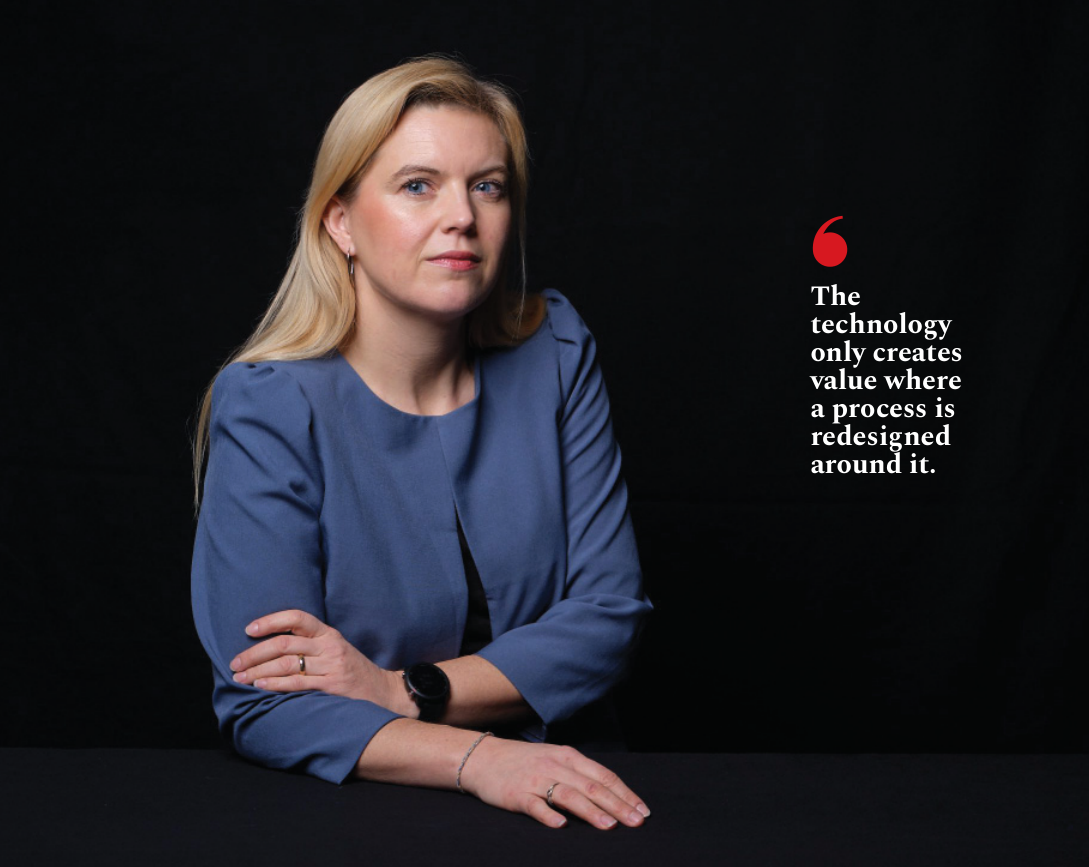
That it is a product you can buy. Organisations purchase licences, announce an AI initiative, and expect transformation to arrive with the invoice. But the technology only creates value where a process is redesigned around it, and that is organisational work, not procurement.
There is a second, paired misconception: people simultaneously overestimate and underestimate AI. They overestimate it in the short term – expecting reliable autonomous judgement from a system that is, at its core, an extremely sophisticated pattern machine that can be confidently wrong. And they underestimate it in the long term, assuming their own profession is somehow exempt. Both errors lead to bad decisions: the first to disappointment and abandoned projects, the second to a complacency that becomes very expensive around year three.
The technology only creates value where a process is redesigned around it.
Technology is advancing faster than many organisations can adapt. What should businesses do to keep pace without simply following every new technological trend?
Separate the layer that changes fast from the layer that changes slowly. Models change monthly; your data quality, your processes and your people’s skills change over years. Invest disproportionately in the slow layer. If your data is well organised and your team is genuinely fluent, you can swap the model underneath in a week. If they are not, no model will save you.
Practically, I recommend a small portfolio: the majority of effort on two or three use cases with measurable value, a smaller share on experiments, and a deliberate policy of stopping things. Most companies I meet have too many pilots and too few completed projects. And be architecturally flexible – do not build so tightly around one vendor’s interface that you cannot move. The single best defence against hype is a clear metric: how many hours did this give back, and to whom.

Nepal has a similar structural advantage: far less legacy IT to dismantle, and a young population that is already mobile-native.
For developing economies, technology can either widen or narrow the development gap. What determines which of these two outcomes occurs?
Whether the value is captured locally. If a country imports finished technology, exports its data and its best graduates, and pays for everything in foreign currency, the gap widens – even as the adoption statistics look excellent. If a country builds enough domestic capability to adapt the technology to its own problems, and keeps the resulting businesses and skills at home, the gap narrows.
Three factors decide this in practice. First, human capital: not a handful of elite researchers but broad, practical competence. Second, institutions: clear data rules, contract enforcement, functioning payment systems, because no one builds a serious company on uncertain foundations. Third, language and representation: if a population cannot use the technology well in its own language, adoption stays confined to an English-speaking urban minority and inequality inside the country grows. That last point is chronically underestimated.
How can countries with limited resources like Nepal use emerging technologies to leapfrog traditional stages of development?
Leapfrogging is real – mobile payments in East Africa are the standard example, and they worked precisely because there was no entrenched banking infrastructure to defend. Nepal has a similar structural advantage: far less legacy IT to dismantle, and a young population that is already mobile-native.
But leapfrogging has preconditions. You can skip the landline; you cannot skip electricity, connectivity, and basic digital literacy. So, the sequence matters: reliable power and internet, a functioning digital identity and payment layer, then applications. Where I would concentrate: health, extending the reach of scarce clinicians into rural districts; education, where a tutor in the student’s own language costs almost nothing to deliver; agriculture, where better forecasting has immediate economic effect; and administration, where AI can compress processes that currently take weeks. Do not try to leapfrog into building frontier models – that is not a leap, it is a different race entirely, and an expensive one to lose.
Innovation is often associated with large technology companies and substantial investment. Can smaller economies and smaller businesses build meaningful innovation ecosystems? How?
Switzerland is the obvious counter-example: small, expensive, limited natural resources,
consistently among the most innovative economies in the world. So, yes but the model is different from Silicon Valley, and copying that model is usually a mistake. I should add that being inventive and being good at turning inventions into companies are two different skills, and Switzerland is markedly better at the first than at the second.
What smaller ecosystems need is density and connection rather than scale. A handful of institutions that are genuinely excellent in one or two chosen fields, rather than mediocre in 20. Real links between universities and industry, so that research reaches a factory or a clinic. Patient capital, including public co-funding of applied projects. And an export mindset from day one, because a small domestic market forces you to compete on quality immediately, which is painful early and an advantage later.
For individual small businesses, the entry cost has collapsed. Ten years ago, you needed a research budget; today a three-person team can build a serious product on open models. The constraint is no longer capital. It is focus and skill.
What role should universities play in preparing young people for a technology-driven economy? Is the traditional education model still adequate?
Universities remain essential but what they should be selling has changed. When information was scarce, transmitting knowledge was the product. Information is now abundant and machine-generated, so the product must be judgement: how to evaluate evidence, how to know when an answer is wrong, how to work on a problem nobody has solved before.
Concretely: teach with these tools rather than policing them, because graduates will use them daily and pretending otherwise simply moves the learning off -campus. Assess through projects and defence of work rather than reproducible essays. Invest in faculty upskilling – the bottleneck is usually the teaching staff , not the students. Build real industry projects into the curriculum.
And I would say plainly: the traditional model is inadequate in one specific respect – it assumes education finishes at 25. That is over. The institutions that thrive will be the ones that also serve the 45-year-old who needs to retrain, and treat that as core business rather than a side programme.
Beyond technical skills, what human capabilities will become more valuable as automation and intelligent technologies take over routine tasks?
Critical judgement above all. These systems produce fluent, plausible, well-formatted output, including when they are wrong. The ability to
notice that something is subtly incorrect requires domain knowledge and a certain scepticism, and it is becoming the single most valuable professional trait.
Then, the ability to ask precise questions, which turns out to be a genuine skill and one most people have never been taught. Communication and trust-building, because the interfaces between people cannot be automated. Ethical reasoning, because more decisions now sit in grey zones where the rules have not been written yet. Adaptability, meaning the emotional capacity to be a beginner again at 40. And accountability – the willingness to own a decision. In healthcare especially, someone must be answerable, and “the system suggested it” will never be a sufficient answer.
Many organisations invest in technology but fail to transform the way they work. Why does digital transformation so often fail? And, AI is advancing rapidly – where is the world heading, and how quickly should countries like Nepal respond?
Transformation fails for organisational reasons, almost never technical ones. The recurring pattern: technology is bought but processes are left untouched, so the new tool is layered on top of the old workflow and everyone does double work. No single person owns the outcome. Nobody’s incentives change. Training is a one-hour webinar. And leadership announces it without using it. If the executive team does not work with these tools personally, the organisation reads that signal accurately.
On direction: we are moving from systems that answer questions to systems that carry out multi-step tasks, and from text into voice, images and eventually physical machines. That shift makes reliability, oversight and clear accountability far more important than they were with a chat window.
How fast should Nepal respond? On adoption and skills: immediately – that window is open now and costs relatively little. On infrastructure and data policy: deliberately, over the next two to three years, because those decisions are hard to reverse. On building frontier models: not at all. The mistake is not being late to the frontier; it is being late to competence.
How should leaders manage employees who are anxious about automation and the possibility of losing their jobs?
With honesty, and early. The worst approach is reassurance you cannot guarantee – people can tell, and once they conclude leadership is hiding something, cooperation ends and quiet sabotage begins. The second-worst is silence, because employees will fill that vacuum with the most frightening story available.
What works: say what you know and what you do not. Commit publicly to specific retraining investment, with a budget attached, before anyone asks. Then involve the people whose work is changing in redesigning it – they know better than any consultant which parts of their job are pure drudgery, and most people are quite happy to automate the tasks they hate. In the deployments we run at AlpineAI, the strongest advocates are usually the customer’s staffwho feared the technology at first and then discovered it removed the worst two hours of their day.
And where roles genuinely do disappear, handle it decently and visibly. Everyone still employed is watching how you treat the people who leave.
You have worked on technology and healthcare. Where do you see the greatest opportunities – and the greatest risks – in applying intelligent technologies to healthcare?
The largest and most immediate opportunity is administrative. A significant share of a clinician’s day goes to documentation, reports, correspondence and coding. That work is well suited to automation, the risk profile is comparatively low, and the benefit is felt on day one – more time with patients, and less burnout in a profession that is losing people to exhaustion. Beyond that: triage and decision support, and above all access, since a well-designed system can bring a level of guidance to a rural district that would otherwise require a specialist who is not there.
The risks are equally concrete. A confident, fluent, wrong answer in a clinical context can harm someone. Models trained largely on Western populations may perform poorly elsewhere, and that bias is easy to miss until it causes damage. Health data is the most sensitive category there is, so sovereignty is not a preference but a requirement – it is precisely why we run the AlpineAI platform on Swiss infrastructure. There is also a slower risk: deskilling, if clinicians stop practising judgement they may one day need. My rule is simple. AI draft s; the professional decides and signs.
Data has become one of the most valuable resources in the digital economy. How can countries and organisations balance data-driven innovation with privacy, security and individual rights?
accelerate innovation; it prevents the most valuable sectors from participating at all.
What that requires in practice is unglamorous. Classify data honestly, so that the 90% that is not sensitive is not slowed down protecting the 10% that is. Decide architecturally where data physically resides and which government can compel access to it – that is a design decision, not a contract clause. Limit purposes and retention. Keep audit trails. And at national level, treat health, agricultural and administrative data as strategic assets: make them usable for domestic research under clear rules, rather than either locking them away entirely or handing them over for free in exchange for a discounted licence.
You have experience with Swiss technology and innovation ecosystems. What makes an ecosystem conducive to innovation, and what can other countries learn from the Swiss experience?
Innovation, for me, begins with a personality trait rather than an institution: curiosity. The willingness to ask why something is done the way it is done, to challenge knowledge that everyone treats as settled, and to keep improving something that already works perfectly well. And it is never creation out of nothing – real innovation almost always builds on existing knowledge and pushes it one step further. So, an ecosystem is conducive to innovation when it rewards exactly that behaviour: when questioning the professor, the boss or the textbook is a career advantage rather than a career risk.
Switzerland is genuinely outstanding at that first part. We have world-class research, an education system that treats vocational and academic paths as equals, and unusually dense links between universities and industry. Where we are weak – and I think we should say so honestly – is the next step: turning knowledge into execution. We invent brilliantly and commercialise slowly. It is a bit like the Swiss Army knife: we keep adding the perfect tool for every conceivable situation, and convene a working group on whether the corkscrew belongs next to the scissors – while somebody else ships a knife with one blade and sells a billion of them.
So, there are two lessons here, not one. Build the curiosity – an education system that trains people to question rather than to memorise. And then build the execution muscle that we in Switzerland still lack: a bias toward shipping something imperfect, putting it in front of real users, and improving it in public. Nepal has an advantage there that we do not. Fewer entrenched structures are defending the status quo, and a young generation has not yet acquired the habit of waiting for permission.
How important are government policies and regulation in encouraging innovation? At what point can regulation itself become a barrier to technological progress?
Policy matters, but rarely in the way that national AI strategy papers imagine. The most effective things a government can do are unglamorous: reliable connectivity and energy, sensible rules for skilled people to come and stay, serious investment in education, and public procurement that is genuinely open to domestic providers. I can speak from experience here. AlpineAI exists today largely because Swiss hospitals, universities and public authorities were willing to buy from a small local start-up instead of defaulting to the biggest available brand. No subsidy programme would have done as much for us as those first few contracts did.
Regulation turns into a barrier at three specific points. When it regulates the technology rather than the application – an AI writing marketing copy and an AI triaging patients cannot sit under the same regime. When compliance costs are effectively fixed, because then they are trivial for a large corporation and fatal for a five-person company, and you have accidentally protected the incumbents. And when rules are written faster than anyone understands the technology, which produces requirements that cannot be met and are therefore quietly ignored, which is the worst of both worlds.
My preference is clear, simple, enforceable rules for high-risk uses, wide latitude everywhere else, and regulatory sandboxes so that supervisors learn alongside the builders.
Nepal has limited computing infrastructure, investment and technical talent compared with major AI economies. Where should Nepal realistically begin? And what does “localising AI” actually mean for a country like Nepal – Nepali-language models, local data, local applications, or something broader?
Begin with adoption and skills, not infrastructure. The fastest return available to Nepal is teaching a large number of people to use existing tools competently in their actual work – in government offices, clinics, schools and small businesses. That costs comparatively little and pays back within months. In parallel, start the slower work: Nepali- language data, a handful of strong applied research groups, and clear data rules that make it safe for institutions to participate.
On localisation, I would define it as four layers. Language: fine-tuning open models so Nepali and the country’s other languages work properly, which
is achievable without frontier budgets. Data: building domestic datasets that reflect Nepali agriculture, epidemiology, law and administration. Applications: products built for local processes rather than translated from foreign templates. And capability: the people, institutions and legal framework needed to make choices independently.
That last layer is where cooperation matters, and I would put a concrete offer on the table – at AlpineAI we operate some of the most secure infrastructure in Europe. That capacity is not fully occupied around the clock, and here the time difference turns out to be an unexpected gift : Kathmandu is nearly four hours ahead of Zurich, so Nepal’s working morning falls into the quietest hours of our Swiss night – our machines are at their emptiest exactly when Kathmandu is at its busiest. A data centre that keeps Swiss office hours is a very expensive employee. Making that capacity available to Nepali institutions during our quiet hours would give Nepal high-security compute at a fraction of what building it from scratch would cost.
The second form of cooperation is the system rather than the hardware: giving Nepali companies, hospitals and authorities an AI environment they can genuinely trust, with unambiguous rules about where data sits and who may access it – and transferring the know-how over time so that Nepal operates it itself. My motivation is not charitable. Neither Switzerland nor Nepal will outspend the very large platforms alone, and smaller countries that care about sovereignty have every reason to build together rather than each negotiating separately with the same three providers. And I am aware of the obvious objection: from a Nepali perspective, we are a foreign provider too. That is precisely why any such arrangement has to be built with an exit in mind – open models, portable data, published standards and a clear path to Nepali ownership. A partner you cannot leave is not a partner. I would also expect us to learn at least as much from Nepali use cases and constraints as Nepal would gain from our infrastructure.
What are the biggest risks for developing countries if they adopt foreign AI systems without developing their own institutional and technical capabilities?
The first risk is dependency in the ordinary commercial sense. Prices change, interfaces are deprecated, terms are rewritten, and a country that has built its public services on a foreign platform has no leverage in that conversation. The second is jurisdictional: if citizens’ health and administrative data sit under another country’s law, that data is
subject to decisions taken in a capital far away, potentially including export restrictions or sanctions that have nothing to do with you.
One practical piece of advice for founders in Nepal: do not try to build the secure infrastructure layer yourself. Partner with someone who already has it – and that is precisely the kind of arrangement we at AlpineAI are looking for – and spend your energy on the application, the local knowledge and the customer relationship, which is where the defensible value sits anyway.
Third, cultural and epistemic bias. Models encode the assumptions, languages and priorities of the societies that produced them. Used uncritically in education or healthcare, they quietly export a worldview and minority languages simply disappear from the digital future.
Fourth, and most damaging over time, is the capability trap: if a country only ever consumes, it never develops the engineers, regulators and institutions needed to evaluate what it is buying and cannot even tell whether it is being served well. The remedy is not autarky, which is unrealistic and unnecessary. It is what I would call sovereignty by design: use the best available global technology, but keep the data, the applications and the expertise at home.
Finally, if you were advising Nepal’s policymakers today, what would be your single most important message about preparing the country for the AI era?
Invest in people and in data foundations before anything else and start now, at small scale, rather than waiting for a comprehensive national strategy that will be outdated by the time it is signed.
A young workforce equipped with these tools can compete internationally on quality rather than only on cost.
If I am allowed one sentence beneath the headline: the goal is not to build the world’s most advanced AI. It is to make sure that Nepal, 10 years from now, still decides for itself how technology is used in its schools, its clinics and its public administration. That requires competent people, data the country controls, and institutions that understand what they are regulating. Those three things are achievable on a modest budget. They are also very difficult to acquire later, once dependency has become the default, which is exactly why the decisions taken in the next few years matter far more than they appear to.
What opportunities do you see for entrepreneurs in smaller markets as AI, automation and digital platforms become more accessible?
This is the most encouraging part of the whole picture. The cost of building sophisticated software has fallen dramatically. A small team can now produce, in months, something that would have required a large engineering department five years ago and can serve customers anywhere.
The opportunities I would pursue: vertical applications for specific industries, where deep understanding of one workflow beats generic tools; local-language and local-context products, which global players will not build because the market is too small for them and which are therefore genuinely defensible; services and implementation, since every organisation adopting AI needs people who can integrate it, and that demand is not going away; and global service delivery, where a young workforce equipped with these tools can compete internationally on quality rather than only on cost.
And a practical footnote: Nepal does not have to do this alone. Switzerland is a small country that decided some years ago to take digital sovereignty seriously, and we have already made most of the expensive mistakes so that somebody else does not have to. A partnership on infrastructure, training and shared standards would serve both sides and at AlpineAI we would very much like to be part of it.
One caution: build a product, not a wrapper. If your entire value is a thin layer over someone else’s model, you will be replaced by a feature release. The durable advantage is proprietary data, deep domain knowledge, and customer trust.