
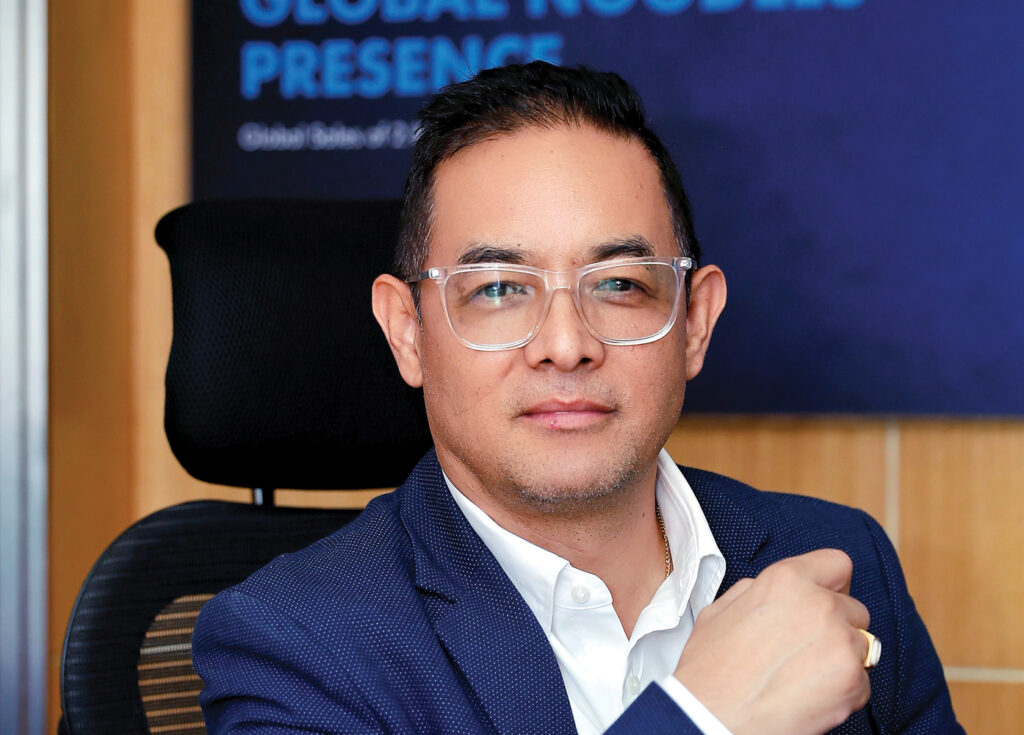
 Upendra Pradhan, Business Head, CG Foods Nepal
I began my professional career nearly three decades ago. At that time, the job market was very different from what we see today. Opportunities were fewer, information was limited, and career progression largely depended on field experience, perseverance, and consistent performance. Unlike today, there were no digital platforms or instant access to market data. Professionals had to learn directly from the market, retailers, distributors, and consumers. The environment was highly relationship-driven, and success depended on discipline, hard work, and execution excellence.
My first job taught me the fundamentals of business execution. I learned the importance of understanding consumers, building strong relationships with trade partners, and respecting frontline sales teams. It also taught me humility because the market is the greatest teacher. I learned that strategy is important, but execution is what ultimately delivers results. Those early lessons continue to guide my leadership approach today.
Career shaping
My early years in sales taught me something I continue to believe today: the market speaks through data. While experience and intuition are important, sustainable business decisions must be grounded in facts and evidence.
Working directly with retailers, distributors, and consumers helped me understand how to connect field realities with business performance indicators. Over time, I learned that data always tells a story. If we listen carefully, it reveals consumer behaviour, growth opportunities, operational inefficiencies, and emerging risks.
Those early experiences shaped my leadership philosophy of combining market understanding, data-driven decision-making, and disciplined execution.
Delving deeper in FMCG
FMCG is one of the most dynamic industries because it touches consumers’ lives every day. Every purchase decision, every retail interaction, and every innovation creates an opportunity to learn. I have always been fascinated by how brands influence consumer choices and how businesses can create value at scale. The fast pace, constant competition, and direct connection with consumers have kept me motivated throughout my career.
Nepal’s FMCG market has undergone remarkable transformation. Consumers today are more informed, quality-conscious, and value-driven than ever before. Modern trade, digital commerce, social media influence, and changing lifestyles have significantly altered purchasing behaviour.
We have also witnessed increased competition from multinational and regional brands, forcing companies to innovate continuously. At the same time, distribution networks have become more sophisticated, allowing brands to reach consumers across the country more effectively. The market today is far more competitive, data-driven, and consumer-centric than it was two decades ago.
Innovation and adaptability are critical for survival in today’s FMCG environment.
Consumer preferences evolve rapidly, competition intensifies, and technology continuously changes how businesses operate. Organisations that resist change eventually become irrelevant.
Personally, I have always believed that leaders must adapt before the market forces them to adapt. Throughout my career, I have actively embraced technology, digital transformation, and data analytics to improve business performance.
The businesses that succeed in the future will not necessarily be the largest; they will be the most agile, technology-enabled, and consumer-focused.
Understanding consumer behaviour
Understanding consumer behaviour is one of the most challenging and fascinating aspects of FMCG. Nepal itself is incredibly diverse in terms of geography, culture, purchasing power, and consumption habits.
A strategy that works in Kathmandu may not work in rural districts. Consumer needs vary based on income levels, climate conditions, local preferences, and cultural practices. This requires continuous market immersion, consumer research, and strong local execution capabilities. Successful FMCG companies are those that remain close to consumers and adapt their offerings to local realities.
Hence, while designing a new product development, or a new campaign for existing product line we have to have market research data that will help decide on the route to follow for each geographical area or culture. There is no single formula that will cater to the diverse patterns in FMCG. We could fail many times but each failure has to have a learning and way forward.
Dealing with challenges
Competition is healthy when it drives innovation and improves consumer value. However, unhealthy competition and intellectual property violations can undermine trust and discourage investment in brands.
The best response is to remain focused on quality, innovation, consumer trust, and legal compliance. Strong brands are built over years through consistent delivery of value. While companies must actively protect their intellectual property through legal and regulatory channels, they must also continue investing in differentiation and consumer engagement. Ultimately, consumers reward authenticity and quality.
Consumers at the centre
Ethics and values are the foundation of sustainable business success. Short-term gains achieved through unethical practices rarely create long-term value.
For me, keeping consumers at the centre means delivering products that are safe, reliable, fairly priced, and aligned with their needs. It also means maintaining transparency with customers, trade partners, employees, and stakeholders. Trust is one of the most valuable assets a company can build, and ethical conduct is essential to preserving that trust.
Similar trust has to be developed in the team within the company and with both the vendors and customers.
Professional values helped to attain leadership positions
Three principles have guided my career.
First is Data-driven Decision-making. I strongly believe that data tells a story. Opinions may vary, but data provides objectivity and clarity. Whether it is evaluating market opportunities, consumer trends, distribution effectiveness, or profitability, I prefer to make decisions based on facts rather than assumptions.
Second is Adaptability. Markets, consumers, and technologies are constantly changing. Leaders must continuously learn, evolve, and embrace new ways of working.
Third is Building Systems and Processes. Sustainable organisations should not depend on individuals; they should depend on strong systems. My focus has always been on creating process-driven organisations where technology creates visibility, accountability, and reliable data for decision-making. When systems are strong, businesses become scalable and sustainable.
Key turning points
One of the biggest turning points in my career was moving beyond traditional sales leadership and taking broader business responsibilities involving profitability, operations, supply chain, and organisational transformation.
At different stages of my career, whether at Amul, Dabur or CG, I had opportunities to drive GTM transformation, digital initiatives, business turnaround programmes, and process improvements. In both Amul and Dabur there were situations that had gone very bad in terms of sales revenue dropping due to certain external issues and coming back from these situations was critical and important for me personally and the company at the point of time.
These experiences reinforced my belief that long-term growth comes from building robust systems rather than relying solely on individuals. Technology-enabled processes generate reliable data, improve transparency, and allow organisations to make faster and better decisions.
Leading the turnaround of the beverage business and subsequently establishing Campa Cola operations in Nepal were examples where structured execution, data-backed decisions, and strong cross-functional collaboration delivered measurable results.
Career tips for fresh graduates interested in sales and marketing
The future of sales and marketing will be significantly more data-driven than ever before.
Historically, many decisions relied heavily on experience and intuition. While those qualities remain valuable, technology today allows us to understand consumers with much greater precision.
Artificial intelligence, predictive analytics, automation, and digital commerce will increasingly shape how companies engage consumers and allocate resources. However, technology itself is not the answer. The real value comes from converting data into actionable insights and business outcomes.
I believe future leaders in sales and marketing will need to combine analytical thinking, technological fluency, consumer understanding, and strong execution capabilities. The ability to interpret data and act decisively will become a key differentiator.
My advice is to develop both market understanding and analytical capability.
Spend time in the field because consumers and customers remain the best teachers. At the same time, learn how to use data effectively. In today’s world, successful professionals are not those who simply collect data; they are those who can interpret it and make better decisions from it.
Be adaptable, embrace technology, and continuously upgrade your skills. Most importantly, understand the importance of systems and processes. Great careers are built not only by working hard but by working smart and creating repeatable success.
The future belongs to professionals who can combine consumer understanding, technology, and data-driven decision-making.
One statement that captures my philosophy is:
“I have always believed that data tells a story. Decisions backed by data are objective, scalable, and sustainable. Combined with strong systems, technology, and capable people, data becomes the foundation of long-term business success.”

