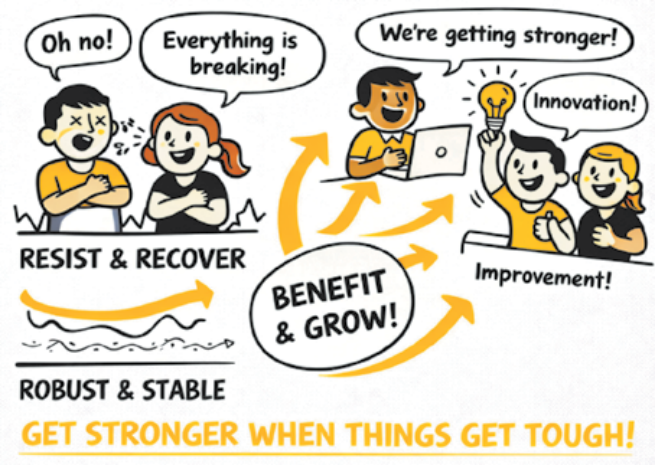
I n management, antifragility describes an organization’s ability not only to withstand disruption, but to improve because of it. The term, introduced by Nassim Nicholas Taleb, goes beyond familiar concepts like robustness and resilience. A robust organization resists shocks. A resilient one recovers and returns to normal. An antifragile organization does something more interesting: it uses volatility, stress, and uncertainty as inputs for learning and growth.
Rather than aiming for stability at all costs, antifragile systems expect disorder. They are designed to adapt, evolve, and become stronger through exposure to uncertainty. They don’t simply survive stress they move forward because of it.
KEY PRINCIPLES OF ANTIFRAGILE MANAGEMENT:
Beyond Resilience and Robustness:
The key difference lies in how systems respond to pressure. Fragile systems break under stress, such as rigid hierarchies during a crisis. Robust systems resist change but often remain inflexible. Resilient systems recover after setbacks and return to their previous state. Antifragile systems use failures and shocks to improve fundamentally.
For example, a resilient team recovers from a failed project. An antifragile team studies that failure, redesigns how it experiments and collaborates, and becomes better equipped for future success.
Decentralization and Optionality:
Highly centralized organizations are fragile because they create single points of failure. Antifragile management distributes authority and decision making, allowing teams to respond quickly to local conditions without waiting for top‑down approval.
This decentralization is paired with optionality: maintaining many small, low‑cost bets rather than a few large, irreversible commitments. Like financial options, these bets limit downside while preserving the ability to capitalize on unexpected opportunities. When change occurs, the organization has choices and choices create strengt.
Constructive Stressors and Redundancy: Antifragile organizations do not try to eliminate volatility. Instead, they
introduce controlled, non‑fatal stressors to expose weaknesses and trigger improvement. This is similar to how muscles grow through strain or how vaccines build immunity.
They also embrace redundancy. Backup systems, overlapping skills, and excess capacity are not viewed as waste, but as buffers that allow adaptation during disruptions. Redundancy prevents small failures from cascading into catastrophic ones and creates space for learning under pressure.
A Culture of Skin-in-the-Game and Evolutionary Learning: Antifragility requires that decision‑makers share in the consequences of their choices. When leaders experience downside risk directly, mistakes are contained, feedback is
immediate, and incentives align with long‑term health rather than short‑term optics.
Equally important is evolutionary learning. Experiments that fail are stopped quickly and without stigma. What works is identified, refined, and scaled. Over time, this creates a natural selection process in which better practices survive and weaker ones disappear..
EXAMPLES IN MANAGEMENT: • Venture Capital Portfolio Strategy: A Venture capital firms do not bet everything on a single “safe” company. They build antifragile portfolios by making many small investments, knowing most will fail. A few breakout successes, often amplified by market volatility, generate returns large enough to more than compensate for losses.
• DevOps and Chaos Engineering: Technology companies such as Netflix intentionally introduce failures into their systems, for example by randomly disabling servers. These controlled disruptions expose hidden vulnerabilities and force engineers to build more adaptive, self‑healing architectures. Repeated exposure makes the system stronger over time. • Modular Product Design: Organizations that design products with modular components create flexibility. When supply chain disruptions affect one part, alternatives can be swapped in. The shock becomes an opportunity to improve sourcing strategies and product architecture rather than a point of collapse.
BENEFITS OF ANTIFRAGILE MANAGEMENT: • Asymmetric Upside: The organization gains more from positive surprises than it loses from negative ones.
• Continuous Adaptation: Learning and evolution are built into daily operations, making the organization well‑suited for volatile environments. • Sustainable Innovation: Small, contained failures are expected and valued, reducing fear and encouraging experimentation. • Lasting Competitive Advantage: While competitors optimize for efficiency and stability, antifragile organizations adapt faster and turn chaos into an advantage. Antifragile management represents a shift from prediction and protection toward exposure and adaptation. It accepts that complex systems cannot be fully controlled or forecast. Instead of seeking fragile stability, it builds organizations that learn from stress, invite challenge, and evolve through disorder. The goal is not merely to survive uncertainty, but to become measurably better because of it.