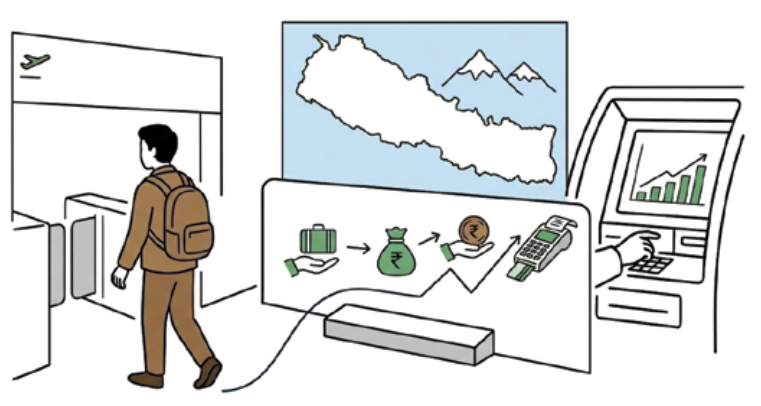

A large part of Nepal’s human resources is involved in foreign employment. Consequently, foreign employment occupies a vital place in Nepal’s economy. For the past two-and-a-half decades, remittances from foreign employment have served as Nepal’s primary source of foreign exchange and have significantly helped reduce poverty. Nepal is one of the largest recipient countries of remittances globally, ranking behind only India, Pakistan, and Bangladesh in South Asia. When the economies of destination countries are adversely affected by global economic crises or other disruptions, the impact directly ripples into Nepal’s economy through fluctuations in incoming remittances.
Southeast Asia, the Gurkhas are held in high regard as dependable protectors, even as issues regarding discrimination against them are raised from time to time.
Although exact figures are unavailable, the number of Nepalis working in India is estimated to be between 1.5 and 2.5 million.
The British, who colonised India, lauded the bravery demonstrated by the Gurkhas during the unification of Nepal’s former princely states. Subsequently, the British began enlisting Gurkhas into their army and deploying them across various colonised territories. This tradition continues today within the British Army, while Gurkhas also remain a preferred choice for military and security roles in several post-colonial Asian nations. Across
Beyond recruitment into military and security forces, ordinary Nepalis have long migrated abroad, primarily to India, for various forms of paid employment. The majority of Nepalis working in India are daily wage earners and informal sector workers across various industries.
Gradually, Nepal’s foreign employment has expanded to third countries, increasing significantly since the mid-1990s when the country formally opened up labour migration to other destinations, including the Gulf. During the Maoist insurgency, the number of
people seeking foreign employment rose sharply, and this upward trend has persisted at an increasing rate through the subsequent political transitions. Nepalis migrating to third countries for work are predominantly employed in low-skilled roles, such as construction workers, salespersons, domestic workers, and general helpers.
Managing foreign employment for Nepalis moving to third countries, as well as India, has emerged as a major challenge. Significant concerns have been raised regarding their social security and physical health. Although several policy decisions have been enacted to address these issues, the risks faced by migrant workers have not been meaningfully reduced, prompting ongoing discussion across public forums and social media platforms. Furthermore, Nepalis migrating to third countries continue to utilise informal channels in proportions comparable to formal, institutionalised routes.
Having navigated distinct political eras, the nature and extent of Nepal’s economic progress remain a subject of ongoing debate. According to historian Mahesh Chandra Regmi, the mainstay of Nepal’s post-unification economy was primarily rural agriculture, alongside trans-Himalayan transit trade between Tibet and India, small-scale domestic cottage industries, limited mining, and forest products including timber and medicinal plants. Even following the political changes of 1950, Nepal’s overarching economic structure experienced no substantial shift.
Although preliminary progress was made in modern education, physical infrastructure, and state-backed industrialisation toward the end of the Rana regime, overall systemic economic transformation remained minimal. With the advent of democracy in 1950,
political leadership committed to radically transforming the national economy, alleviating widespread poverty, and placing the country on a path toward sustainable development, a narrative subsequently echoed following the 1960 royal coup, the restoration of democracy in 1990, and the promulgation of the 2015 Constitution.
One of the major challenges of a less developed country like Nepal is low productivity. Developing nations must first cultivate skilled manpower and effectively mobilise them, but Nepal has failed to progress along this path. Much like its broader development initiatives, Nepal’s human resource mobilisation policies set ambitious targets without implementing corresponding programmes. Institutional frameworks and execution mechanisms remain weak, leaving actual achievements far below set goals.
Analysing national education policies serves as a clear illustration of this gap. While education policies claim to produce the manpower required by the country, state efforts have focused almost entirely on raising basic literacy rates. Consequently, although Nepal achieved its Millennium Development Goals for education, it failed to build the skilled workforce essential for economic growth. The nation’s educational framework educated the population but failed to produce job-ready, skilled professionals, largely because market demand and productivity requirements were never systematically evaluated.
Despite isolated interventions, outcomes have remained disappointing. For instance, while the Council for Technical Education and Vocational Training offers rigorous 18-month programmes to train skilled carpenters, non-governmental organisations simultaneously claim that one-week
workshops under various development schemes yield equivalent results. This disregard for the theoretical and practical foundations of skill development has left national human resource policies fundamentally lagging.
Compounding this issue, Nepal’s political leadership prioritises mobilising human resources for political agendas over economic productivity. Political factions rally manpower by capitalising on radical ideologies, yet fail to deliver on promises of economic opportunity, ultimately creating an environment hostile to domestic employment. While political parties naturally mobilise cadre support, the refusal of both established and emerging political leaders to shift this dynamic threatens long-term national stability.
Because of low skill levels, Nepali workers command lower wages abroad while enduring high-risk working conditions, even as the government neglects their social security. This systemic failure to mobilise human resources properly has constrained national progress, forcing Nepal to rely on foreign countries for both basic skilled labour and specialised technical expertise. This dependence raises serious questions about economic stability, particularly as foreign workers in Nepal repatriate nearly half the value of incoming national remittances.
Remittances now account for approximately 25% of Nepal’s GDP, causing national income to outpace domestic production. Recipient households spend over 50% of these funds on daily consumption while allocating less than 10% to productive investments. These figures demonstrate that while remittances elevate income and drive consumption, helping lift families above the poverty line, they fail to expand local production capacity or support sustainable, long-term economic development.