M ost acknowledge that managing people and organisations well delivers stakeholder value. To do this, organisations must combine AI and human ingenuity, create agility that responds to uncertainty and change, attend to employee mental health challenges, and establish a high- performing culture. Transformation of the HR function helps to achieve these outcomes.
out the strategy, contribution, and value- added for the HR function. Or should she focus on taking action by upgrading HR systems, practices, and people. She felt both needed improvements. Vision without action creates cynicism; action without vision creates random, unguided work.
stages to transform the HR function (item three in the fourth column of figure
With commendable colleagues, we recently posted on how to improve the HR operating model (stages 1 and 2 of figure 2) through using AI to efficiently deliver HR services, practices, and governance with an effective HR structure. And we promised further insights. In this post, we explore how to make sure that HR actions achieve
Our answer was: both. We advised her to transform the HR function (action and vision) by following the logic of the overall evolution of the HR profession. She should focus on delivering more stakeholder value through human capability as we have proposed (see figure 1). Specifically, we propose four
A newly appointed CHRO in a company undergoing significant strategic change asked us, “Where should I begin the transformation of my HR function: vision or action?” She wondered if she should focus on the vision by figuring
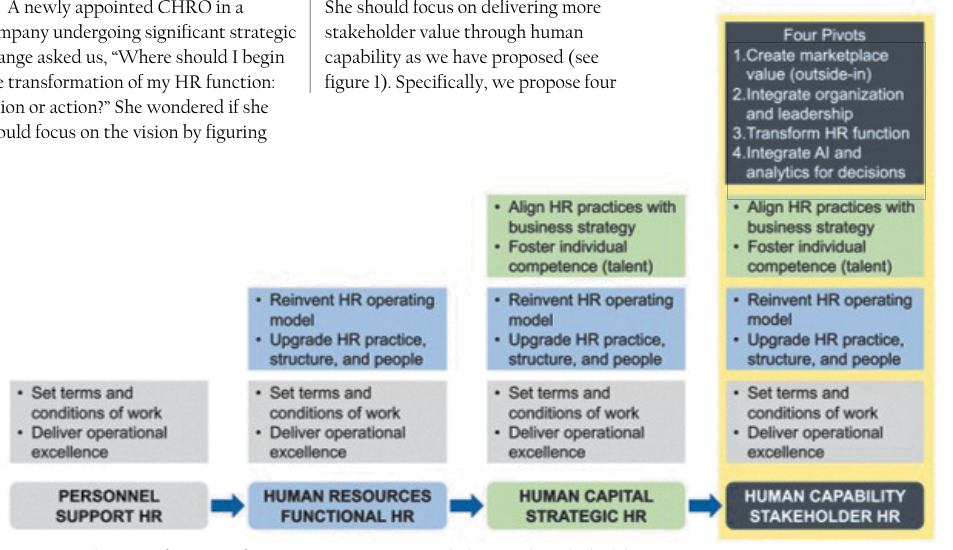
Figure 1: Evolution of HR Profession to Human Capability and Stakeholder HR
Figure 2: Four Stages of HR Function Transformation
Metaphor/Agenda Create Value By Business
Partner (identity)
Stage 4: Stakeholder HR (human capability)
Impacting customer, investor, community
Stakeholder value deliverer
Stage 3: Strategic HR (human capital)
Stage 2: Functional HR (HR operating model)
Stage 1: Support HR (operations)
Delivering business strategy
Strategic partner
Upgrading HR structure, practices, and people
Functional specialist
Efficiently administering HR work and services for employees
Admin supporter
HR Professionals
(competence)
Anticipate and create future
Partner by collaborating with business leaders
Expertly deliver practices
Transact to get things done
HR Analytics
Primary AI Use
(measures of success/value)
(application)
Demonstrate increased customer revenue and investor value
Deliver impact to all stakeholders though HI * AI
Intervene for strategy execution through predictive analytics
Benchmark for comparison of activity of HR work
Lower costs and increase efficiency for HR services
Guide to prioritize though AI analytics
Inform and assist through agenticAI
Access information through genAI
the vision of strategic HR (stage 3) and deliver stakeholder HR (stage 4).
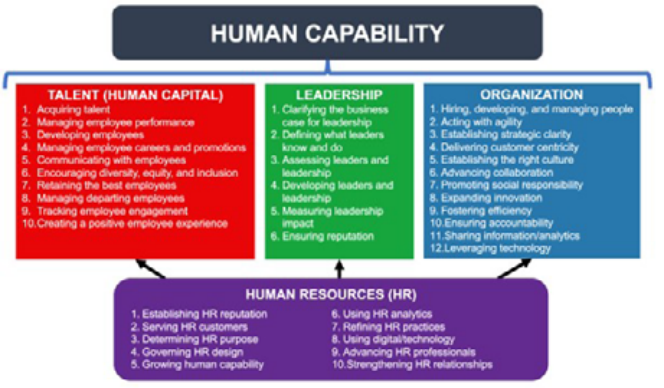
Going Beyond Strategic HR (Stage 3) As the HR profession has evolved through the four phases in figure 1 and the HR function transforms each of the four stages in figure 2, many focus primarily on creating “strategic HR” (stage 3). Strategic HR certainly helps deliver and execute business strategy, acting as a mirror to shape HR priorities. However, stakeholder HR (stage 4) goes beyond strategy to anticipate and create the future by engaging with customers and investors. Think more of looking through a window to engage with external stakeholders instead of at a reflective mirror at oneself. Stakeholder HR relies on the human capability taxonomy of talent + leadership + organisation + HR function to organise and integrate the myriad of HR initiatives. Figure 3 shows the four domains of human capability and 38 possible investment initiatives. Delivering Stakeholder HR (Stage 4)
Based on our work with clients, we have identified seven steps to stakeholder HR to turn the aspiration to reality.
Step 1: Communicate and contract
with business leaders and HR professionals that HR transformation will focus on stakeholder HR (stage 4) as an agenda that builds on the previous three stages in figure 2. The mindset, skillset, and settings for stakeholder HR set expectations for all involved. The most crucial aspect of this step is clearly communicating your goals and intentions. Outcome: Buy in for delivering
stakeholder HR.
Step 2: Form a team of business
and HR leaders to implement stakeholder HR. Charge the team to create a stakeholder HR plan with actions, required resources, measurable results, and clear accountabilities. With this intention, the HR leadership team (HRLT), HR business partners, and COE experts should invest in professional development so that they have a shared language and tools to diagnose and deliver value to all stakeholders.
Figure 3: Four Human Capability Domains and 38 Initiatives
Outcome: Clarity around a plan and
improved competencies to make stakeholder HR happen. Step 3: Identify and interview key
stakeholders, both inside and outside. As we have said, the “human” in human resource represents all stakeholders who engage with the organisation, including employees and executives inside and customers, investors, and communities outside. Learn what each stakeholder wants and needs from their engagement with the business by asking them: a. How much do you currently engage
with the organisation (e.g., customers purchase, investors invest, community participates)? b. What would you expect (want and
need) in order to engage more with the organisation?
c. What is your current view of the
organisation’s human capability? What would you like to see more/ less of in each area of talent (quality of people in the organisation), culture (brand promises, values, actions, norms of the organisation), and leadership (leadership brand and competencies). d. If we were to improve human
capability, how would it impact your engagement with us? Outcome: Discover stakeholder views of
current state and desired outcomes.
Step 4: Summarise these interviews
into an overall assessment of human capability for stakeholder value. Figure 4 gives a template the teams can use to summarise interviews. Note that we have also used this template (or similar version) to
collect data from stakeholders to identify what human capability investments could be made to increase their engagement. We have found that AI can be a valuable tool to analyse either interview data or other public data sources on stakeholder assessments. Outcome: Synthesise stakeholder data
into a report on stakeholder views.
Step 5. Prioritise targeted human
capability practices that deliver the most stakeholder value and measure the impact. Using the analytics in step 3 and 4, identify which human capability initiatives merit more investment. In our work, we prioritise based on impact on stakeholder value and ease of implementation. We determine this by placing each initiative in the four
Figure 4: Template for Stakeholder Value Through Human Capability
STAKEHOLDER VALUE THROUGH HUMAN CAPABILITY
Do We: Inside: Strategic HR
Outside: Stakeholder HR
Customer Investor Community
Talent
Have the right talent to deliver our strategy?
Have talent that delights customers?
Have talent who give investors confidence in our future success?
Have talent who demonstrate our commitment to social citizenship?
Leadership
Organization
Human Resources
Low 1 2 3 4 5 High Low 1 2 3 4 5 High Low 1 2 3 4 5 High Low 1 2 3 4 5 High
Define behaviours of an effective leader based on past performance?
Align leadership behaviours with customer brand promises?
Create more value with investors because of their confidence in our leaders?
Have leaders who model social citizenship by their words and deeds?
Low 1 2 3 4 5 High Low 1 2 3 4 5 High Low 1 2 3 4 5 High Low 1 2 3 4 5 High
Define our organisation as a set of capabilities and governance that deliver on our goals?
Create a culture that resonates with customers every time we interact with them?
Demonstrate to investors that our culture differentiates our business in a positive way that sustains value?
Commit to and act with social responsibility in our communities?
Low 1 2 3 4 5 High Low 1 2 3 4 5 High Low 1 2 3 4 5 High Low 1 2 3 4 5 High
Ensure that our HR work (practices, policies, analytics, and people) reflect business strategy?
Align and focus our HR work to deliver value to customers?
Encourage, communicate, and track the intangible value of our HR work with investors (e.g., increase Tobin’s Q or P/E ratio)?
Improve our social citizenship through our HR work?
Low 1 2 3 4 5 High Low 1 2 3 4 5 High Low 1 2 3 4 5 High Low 1 2 3 4 5 High
Figure 5: Prioritisation Grid for Human Capability Initiatives
disciplines of making change happen to ensure intentions become actions. Outcome: Deliver on high- impact human capability priorities. Step 7: Communicate to and engage all stakeholders. Stakeholder HR begins and ends with stakeholders engaging with the organisation. Stakeholder engagement generally includes stakeholders being actively involved in HR work. For example, stakeholders can recommend and interview potential hires or promotions; co-design, present, or attend training and development experiences; participate in reward processes; and join project or task teams. Our research and experience consistently show that when stakeholders engage in key HR practices, they become more committed to the organisation.
Impact on Stakeholder
High 3 Be patient; find simple
4 Prioritise
Value
steps
Low 1 Avoid
2 Get started now;
move quickly
Hard Easy
Ease of Implementation
cells of figure 5 and then picking the top two or three priorities in cell 4 to focus on. Outcome: Determine which human
capability initiatives to focus on.
Step 6: Implement action plan for the
highest priorities. Once the human capability priorities for stakeholder value are identified, the team can prepare an action plan for making them happen. This plan includes the
Outcome: Increased stakeholder
commitment. Stakeholder HR: Not just a future prediction, but a present practice.
To our CHRO friend, as well as others committed to upgrading the HR profession and elevating its contribution, transforming an HR function has many dimensions. It requires improving the HR operating model through AI to make sure that “HR actions” are delivered efficiently; it also requires “HR vision” by discovering how stakeholder value comes from human capability investments. By applying the seven steps for stakeholder HR, HR professionals become business partners who deliver value to all stakeholders by anticipating and creating the future and effectively implementing AI tools to build efficiency and augmentation at each step (see Figure 5 for summary).
(Ulrich is Rensis Likert Professor Emeritus at University of Michigan and Partner in The RBL Group. He can be reached at dou@umich.edu)
Figure 6: Steps and Outcomes for Stakeholder HR
Step 1: Communicate and contract with business leaders
and HR professionals.
Buy in for delivering stakeholder HR
Step 2: Form a team of business and HR leaders to
implement stakeholder HR.
Clarity around a plan and improved competencies to
make stakeholder HR happen.
Step 3: Identify and interview key stakeholders, both inside
and outside.
Step 4: Summarise these interviews into an overall
assessment of human capability.
Step 5: Prioritise targeted human capability practices that
deliver the most stakeholder value.
Discover stakeholder views of current state and
desired outcomes,
Synthesise stakeholder data into a report on
stakeholder views.
Determine which human capability initiatives to
focus on.
Step 6: Implement action plan for the highest priorities.
Deliver on high-impact human capability priorities.
Step 7: Communicate to and engage all stakeholders
Increased stakeholder commitment.