NEPAL’S UNTAPPED COMPETITIVE ADVANTAGE

T he landscape has changed tremendously! While digital transformation, AI, and global competition have been discussed widely, challenging topics like economic uncertainty, labour migration, and changing employee expectations have also been in the limelight. Digital transformations have taken a large space,
knowingly and unknowingly. Somehow, we appear to be evolving towards this trajectory. I will not debate whether this is good for us or not. Maybe I will do that another time. For now, one thing is for sure – this is Nepal’s new business reality… blending into global requirements.
organisational success is People.
Human resources in several organisations (even today) are widely associated with recruitment, payroll, leave management, policies, and compliance. While these may be important, they are definitely not sufficient. The organisations that will now thrive in Nepal’s increasingly competitive environment will be those
Amid all these changes, one factor that remains at the heart of
that recognise people strategy as a core business strategy and not simply an HR responsibility.
Technology has become increasingly accessible. Competitors can acquire similar software, systems, and infrastructure. Products and business models can be replicated. However, an organisation’s culture, leadership capability, collective knowledge and most importantly, the commitment of its people, is surely not replicable!
People have become a strategic asset! They can become a competitive advantage for an organisation.
Highly engaged employees understand the organisation’s purpose and support in creating better customer experience. A capable manager can turn a struggling team into a high-performing one. I have seen these transformations in organisations I worked with. A workplace where people feel respected and valued is more likely to attract and retain talent.
An organisation that is focused on “How many people do we need?” is outdated! The question should be “What capabilities do we need now? And in the future? What is our leadership capability? What kind of leaders do we need now? How can we develop them? How do we create an environment where talented people can perform their best?”
Nepal’s changing talent landscape is one of the most significant challenges being faced by organisations. The younger generation have convenient access to international education, employment, and remote working opportunities. Salary, though important, no longer remains the only consideration. People look for opportunities to learn meaningful work, career progression, flexibility, supportive leadership, psychological safety, and an organisational culture aligned with their own values. I believe this to be a challenge but also a huge opportunity for organisations in the country.
While we do discuss talent migration as a challenge, I believe we should also start asking “What can we do to encourage more talented individuals to choose to build their careers here, in this country?” and I also strongly believe that the answer lies partly in creating
workplaces that can compete not only financially, but also culturally and professionally.
Having worked in both the corporate and development sectors for over three decades, I conclude that few things I have listed below could be prioritised to support in creating an organisation for the future:
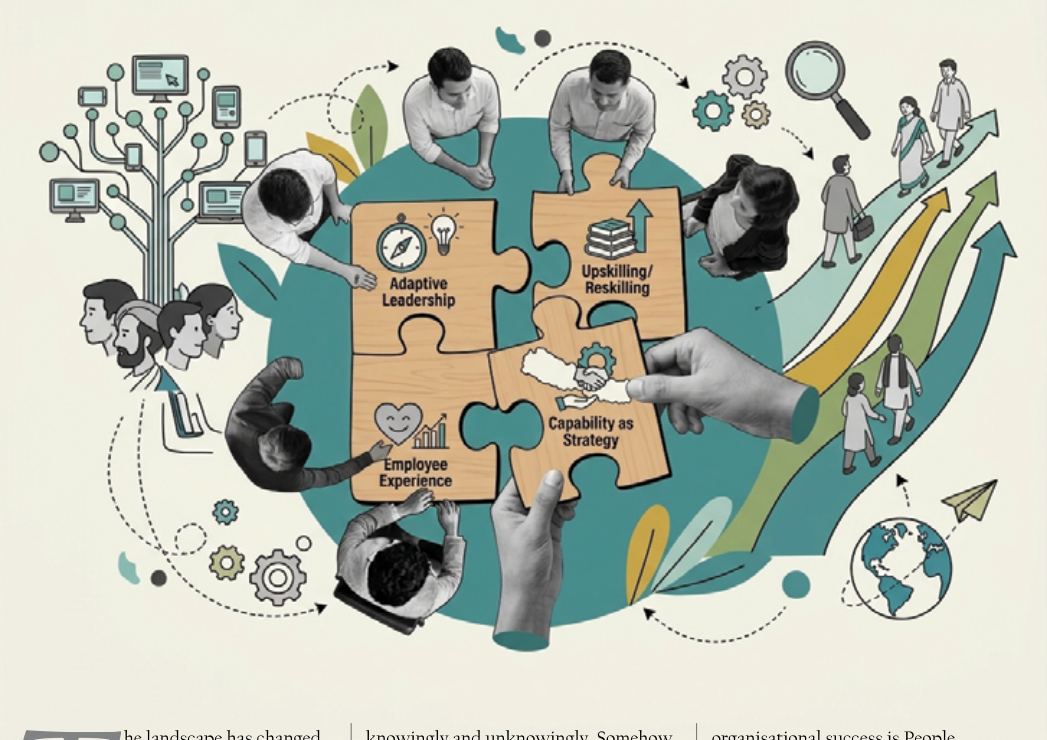
1. Building adaptive leadership in the organisation. Leadership in an organisation today is expected to navigate uncertainty, communicate with empathy, manage diverse teams, and inspire people through change. Emotional intelligence, coaching skills, adaptability, and the ability to build trust are becoming as important as technical expertise. However, leadership development should not be limited to senior executives but at every level across the organisation.
2. Since technology and business practices are evolving continuously, organisations cannot depend only on what employees already know. Upskilling and reskilling need to become part of an organisational culture. The real objective of trainings provided should be to create a learning environment where people are encouraged to ask questions, share knowledge, be open to receiving/give feedback and continuously improve.
3. There is a direct connection between employee experience and organisational performance. Organisations have always made considerable investment in creating customer experience. Yet, the experience of the employee who delivers that customer experience is sometimes overlooked. Do employees feel heard? Do they trust their managers? Do they understand why their work matters? Are good contributions recognised? Can they speak up without fear? Do they see a future within the organisation? These may sound like ‘soft’ HR questions, but they have ‘hard’ business consequences.
4. Culture in an organisation is not only described by the value statements. It is experienced through everyday behaviour and built in the same manner. It is reflected in how a manager responds when an employee makes a mistake, how disagreements are handled, whether
people feel safe to express an opinion and whether respect is extended equally across levels and functions. A strong culture does not avoid difficult conversations, but rather has them fairly, respectfully, and transparently.
5. While AI and automation do influence business and ways of working, communication, and delivery of services, organisations cannot assume that technology can replace human judgement too. The future belongs to organisations that combine technology with human capabilities like critical thinking, creativity, empathy, relationship building, ethical judgement, leadership.
A new role of HR emerges with the changing environment. HR leaders need a strong understanding of finance, operations, customers, technology, and strategy. They need to sit at the business table and ask questions about having the right talent to deliver the strategy, and capabilities needed in the future. They need to be aware of what is preventing the people from performing their best and if the leadership in the organisation is supporting the culture that is aspired.
Our country stands at an interesting point in its economic and organisational journey. We have a generation of young professionals who are ambitious, digitally connected, and globally aware. We also have experienced professionals whose knowledge can be transferred to the next generation. The challenge is to connect these strengths! The future of Nepali business cannot be built solely on technology, infrastructure or financial investment, but through investment in human capability.
People are not merely a resource to be managed; they are the capability through which strategy comes alive.
Nepal’s greatest competitive advantage may therefore not be something we need to import, build, or buy. It may already be here, in our people. The only question is whether we are prepared to invest in them, trust them, develop them and create organisations where they can thrive.