

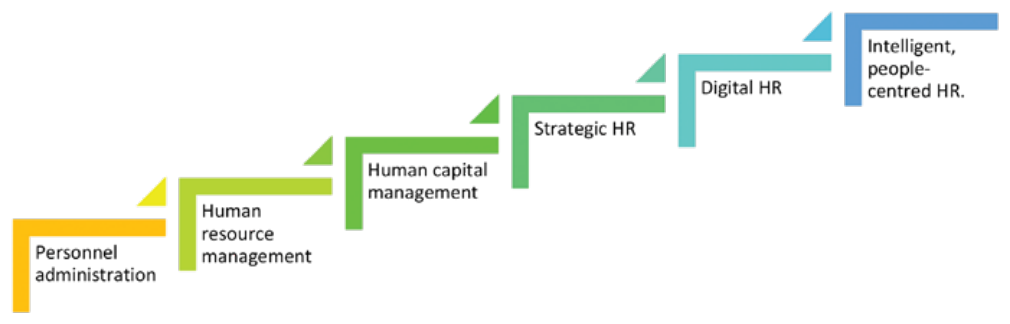
H aving observed and worked alongside Human Resources professionals over the years, I have witnessed a remarkable transformation in the HR function. Over the last three decades, HR has evolved from a primarily administrative role to an operational function, then to a strategic business partner, and today, increasingly, to a business transformation leader.
When I look back to the early days, HR was commonly referred to as Personnel Management and was largely viewed as a support function. Its primary responsibility was ensuring compliance and maintaining employee records. Most activities were paper- based, highly process-oriented, and involved minimal use of technology. HR professionals spent much of their time maintaining employee files, processing onboarding documents, managing attendance and leave records, issuing employment letters, updating employee information, handling payroll inputs, administering benefits, and maintaining personnel records. At that time, HR was often perceived as an administrative service provider rather than a contributor to organisational success.
As organisations gradually began to recognise that their people were valuable assets rather than simply resources, the role of HR expanded. This marked the transition
from Personnel Management to Human Resource Management. HR became increasingly involved in recruitment and selection, onboarding, performance management, learning and development, employee relations, grievance management, and disciplinary processes. During this period, HR moved beyond administration and started playing an operational role that influenced employee performance.
The next significant shift came when organisations realised that effective people management was critical to achieving business objectives. HR began to gain recognition as a strategic function capable of influencing organisational performance and transformation. The concept of HR as a Business Partner emerged, and HR professionals started working closely with leadership teams to shape organisational strategy and people agendas.
In this strategic phase, HR became actively involved in workforce planning, identifying critical competencies and future skill requirements, developing talent management strategies, and promoting diversity and inclusion. It contributed to organisational design, retention strategies, succession planning, leadership development, and capability building. HR also played a critical role in managing organisational change, supporting restructuring efforts,
SULAKSHENA TAMRAKAR HR, Safeguarding and IT Director Save the Children
facilitating cultural transformation, and fostering resilience among employees.
At the same time, employee wellbeing, engagement, and psychological safety became increasingly important considerations. HR was expected not only to ensure legal and policy compliance but also to create productive, healthy, and inclusive workplaces. This represented a major shift from transactional HR practices to value-driven HR. The human resource strategies became directly aligned with organisational missions, goals, and long- term priorities.
Another notable development was the emergence of people’s data analysis. Organisations increasingly relied on workforce data to make informed decisions regarding talent management, retention, productivity, and organisational effectiveness. HR evolved from being largely intuition- driven to becoming more evidence- based and data-informed.
The COVID-19 pandemic accelerated many of these changes. In my view, few events have transformed the HR profession as dramatically as the pandemic. Almost overnight, organisations had to adapt to remote and hybrid work models, and HR was at the centre of this transition. Digitalisation rapidly expanded across HR processes, while technology, automation, and artificial intelligence became integral to workforce
employee commitment. The pandemic therefore produced an apparent paradox: technology became more important, but so did the human side of HR.
Employees began placing greater value on flexibility, work-life balance, meaningful work, well-being, career
development, and organisational culture. This shift has continued into the post- pandemic workplace.
2020s: from digital HR to intelligent HR
HR is now entering another phase.
Artificial intelligence, generative AI, automation, predictive analytics, and digital learning are beginning to reshape recruitment, workforce planning, learning, performance management, and employee services.
The question is no longer whether
management.
Today, HR is moving beyond traditional administrative responsibilities and increasingly focuses on business transformation. As automation and AI continue to take over routine administrative tasks, HR professionals are expected to provide strategic advice, lead organisational change initiatives, and help organisations navigate uncertainty and complexity. Modern HR is becoming more agile, people-centric, and future-focused. Employee wellbeing, organisational resilience, continuous learning, reskilling, and upskilling have become key priorities. HR is no longer simply managing people; it is shaping the future of work.
What Gaps Still Remain? Despite significant progress, several challenges continue to hinder the full realisation of HR’s strategic potential.
One of the most significant challenges is the persistence of traditional mindsets regarding the role of HR. While organisations increasingly acknowledge the importance of people management, many still view HR primarily as a support function rather than a strategic contributor. This mindset often limits HR’s ability to influence critical business decisions.
In many Nepali organisations, for example, HR remains largely operational. Strategic decisions related to workforce planning, organisational transformation, succession planning, change management, and culture building are often led exclusively by senior leadership, with limited involvement from HR professionals. As a result, HR frequently lacks a seat at the decision-making table where long-
technology will enter HR. It already has.
The more important question at this moment is, what should HR automate, what should it augment, and what should remain fundamentally human?
“Being tech-enabled gives us the insight and agility to drive meaningful
term business strategies are formulated.
Another area that requires attention is the gap between organisational commitments to Diversity, Equity, and Inclusion (DEI) and actual practice. Although many organisations discuss inclusiveness, genuine inclusion often remains limited. Formal DEI goals and accountability mechanisms are frequently absent, while unconscious biases continue to affect opportunities and workplace experiences for marginalised groups.
Similarly, while organisations collect employee data, there is often insufficient use of people analytics to drive evidence-based decision-making. Many employee related decisions continue to rely more on assumptions than on data-driven insights.
The employee readiness gap is another critical concern. Today’s workplace requires employees to be agile, digitally competent, and adaptable to technological change. However, many organisations have not invested sufficiently in developing future-ready talent. Consequently, gaps in digital skills, leadership capability, and change management capacity remain significant barriers to organisational transformation.
Employee wellbeing has gained substantial attention in recent years, particularly concerning mental health. However, psychological safety and psychological first aid are areas that remain underdeveloped in many organisations. While legal employment contracts define formal obligations between employees and employers, the psychological contract, built on trust, mutual respect, and commitment, often receives far less attention.
Ultimately, high-performing organisations depend on highly engaged employees. Yet, in many workplaces, employee engagement remains process- driven rather than people-centred. Organisations may conduct engagement surveys and wellness initiatives but often fail to address the underlying issues affecting employee experience. This disconnect can contribute to grievances, dissatisfaction, declining morale, and increased turnover.
What should be done by organisations or HR professionals to achieve the desired goals in HRM?
Throughout my career, the lesson I have learnt is that organisations do not achieve success through systems and process; they achieve success through people. The organisation and HR professional must change how they view people management. It needs to create an environment where people can perform, grow and contribute meaningfully to the organisation’s success.
HR must position itself as strategic partners by influencing and being involved in strategic decision- making, related workforce planning, restructuring, succession planning, risk management and cultural transformation. For this, the HR personnel need to develop business acumen and understand organisational priorities, and financial and operational challenges. Secondly, organisations should invest in upskilling and reskilling of their employees. Informed decisions should be made based on data analysis and mitigation measures must be developed for predicted challenges. Lastly, creating a culture of belonging is the need of the day.
change, while staying people-driven ensures every decision strengthens trust, connection with our people, and growth for the organisation. The future belongs to organisations that can balance both tech and people,” as per Sudeep Patro, Head of HR at Asian Paints Nepal.
This balance will be particularly important as organisations begin using AI in recruitment and performance management. Technology can improve efficiency and generate insights, but poorly designed systems can also reproduce bias, compromise privacy, or
make workplace decisions excessively mechanical.
The rise of employee experience
Another important evolution is the movement from employee management toward employee experience. Employees are increasingly evaluating organisations through the totality of their workplace experience: recruitment, onboarding, leadership, rewards, learning, flexibility, career progression, workplace culture, and exit.
Hemhari Shrestha, HR Manager at Sun Nepal Life Insurance, emphasised that technology can support HR through data-driven workforce planning, digital recruitment, performance reviews, and online learning platforms. However, technology is not the sole solution. HR will always have to maintain the human aspect as well.
He underscores employee engagement, work-life balance, equal opportunities, career growth, and quality of work as central to contemporary HR.
This represents an important conceptual shift. An employee is no longer viewed simply as a resource to be managed, but as a stakeholder whose experience directly impacts productivity, retention, and organisational reputation.
Nepal’s distinctive HR challenge: talent migration
Nepal’s HR evolution cannot be discussed without considering the country’s labour market realities. Large numbers of Nepalis seek employment abroad. This creates a distinctive
challenge for domestic employers. Organisations are not competing only with other Nepali employers for talent, they are competing with international labour markets.
Retention has therefore become a strategic issue. For organisations, the challenge is not simply about how to recruit good people. They must delve into why a capable person would choose to build a career in Nepal.
This brings compensation, career progression, organisational culture, leadership quality, learning opportunities, and employee experience into the centre of HR strategy.
Skills mismatch and productivity
Another unfinished aspect of Nepal’s HR transformation is the relationship between skills and productivity. Academic qualifications do not automatically translate into workplace competencies. Organisations continue to report difficulties in finding employees with the technical, managerial, digital, and interpersonal skills they require.
This creates an important role for HR in workforce planning and continuous learning. The future HR function therefore needs to move beyond periodic training programmes toward continuous capability development.
The larger lesson goes beyond the HR Meet itself: Nepal needs stronger mechanisms for transferring knowledge between organisations, educational institutions, and HR practitioners.
Nepal is now deeply connected to the global business environment.
Information, ideas, research, technology, and professional practices travel much faster, allowing Nepali organisations to catch up with emerging HR practices far more quickly than they could in the past, as per Sanjeev Shrestha, Director of HR at COTIVITI Nepal.
HR and organisational culture
As HR has become more strategic, organisational culture has also become a central concern. Culture influences how employees behave when managers are not watching. It affects innovation, customer service, collaboration, ethics, and employee retention. Consequently, HR increasingly bears responsibility for issues that cannot be resolved through policies alone.
Organisational culture influences these outcomes in many ways, such as rewarding positive behaviours, fostering acceptance of leadership, enabling horizontal and vertical communication, and driving merit- and competency- based promotions alongside recognition of contributions and achievements. This proves particularly rewarding when HR’s strategic objectives and human dimensions intersect, according to experts.
The changing role of the HR professional
The HR professional of the future will need a substantially broader competency set than the traditional personnel officer.
The emerging HR leader needs inter- holistic knowledge and skills, including business acumen, people expertise, data literacy, technology awareness, leadership capability, and ethical judgement, among others.
The HR professional must understand both quantitative evidence and human behaviour. Technology can identify patterns, but HR professionals must interpret them. Analytics can identify high turnover, but HR must understand its causes. AI can shortlist candidates, but HR must ensure fairness and organisational fit. A digital performance system can generate scores, but HR must ensure that the underlying objectives and evaluation processes are credible.
This is why technological transformation does not make HR less important. Properly used, it can make good HR more consequential.
The institutionalisation of the HR profession
The evolution of HR has also been supported by the emergence of professional platforms, consultancies, academic programmes, conferences,
and practitioner networks. Growth Sellers’ annual HR Meet, launched in 2008, is one example of this wider professionalisation. Its successive themes, from HR Today and Tomorrow in 2008 to HR: Partner in Business Transformation in 2025 and Tech- Enabled, People-Driven HR in 2026, reflect changing conversations within the profession.
But HR Meet is only one platform among many. The broader evolution has been driven by the combined influence of organisations, HR professionals, universities, consultants, employers’ associations, policymakers, technology providers, and changing labour-market conditions.
Its significance lies in providing a space where these different actors can exchange experiences and debate emerging practices.
The road ahead
The next decade could be the most consequential period in the evolution of HR in Nepal. Experts have said that AI will automate some traditional HR activities. Analytics will improve workforce decisions. Digital platforms
will change recruitment and learning. Skills requirements will evolve faster. Employees will become more demanding about flexibility and workplace quality.
Yet, the fundamental purpose of HR will remain unchanged: enabling organisations to create value through people in the changing world of work.
The challenge is to prevent technological sophistication from becoming an end in itself. A technologically advanced HR department with poor leadership, weak organisational culture, unfair performance management, and low employee trust cannot create sustainable organisational performance.
Each stage has added a new responsibility rather than completely eliminating the previous one. HR still has to administer. It still has to comply. It still has to recruit and maintain records. But it is now also expected to build capabilities, shape culture, develop leaders, improve productivity, retain talent, use data, manage technological change, and contribute to business strategy.

