
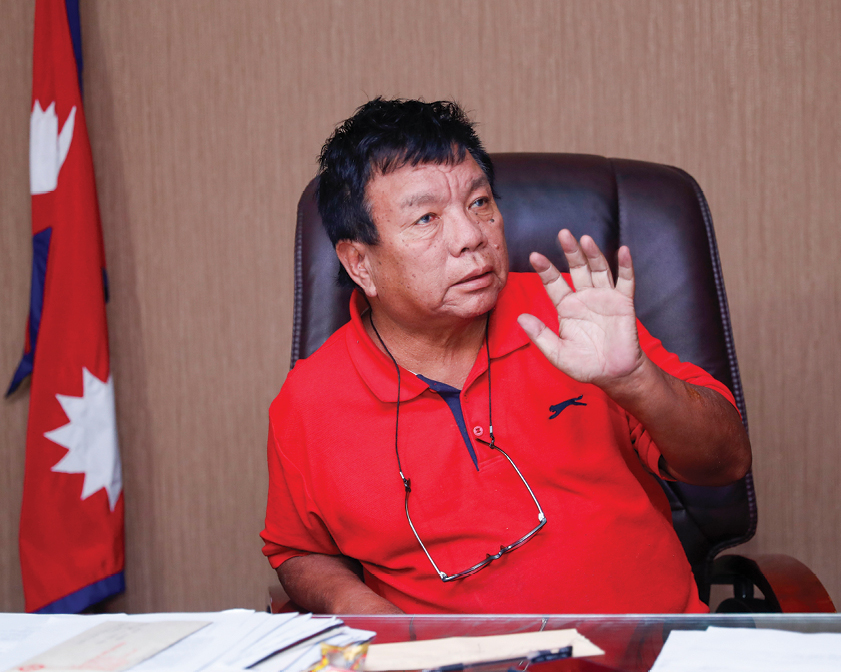
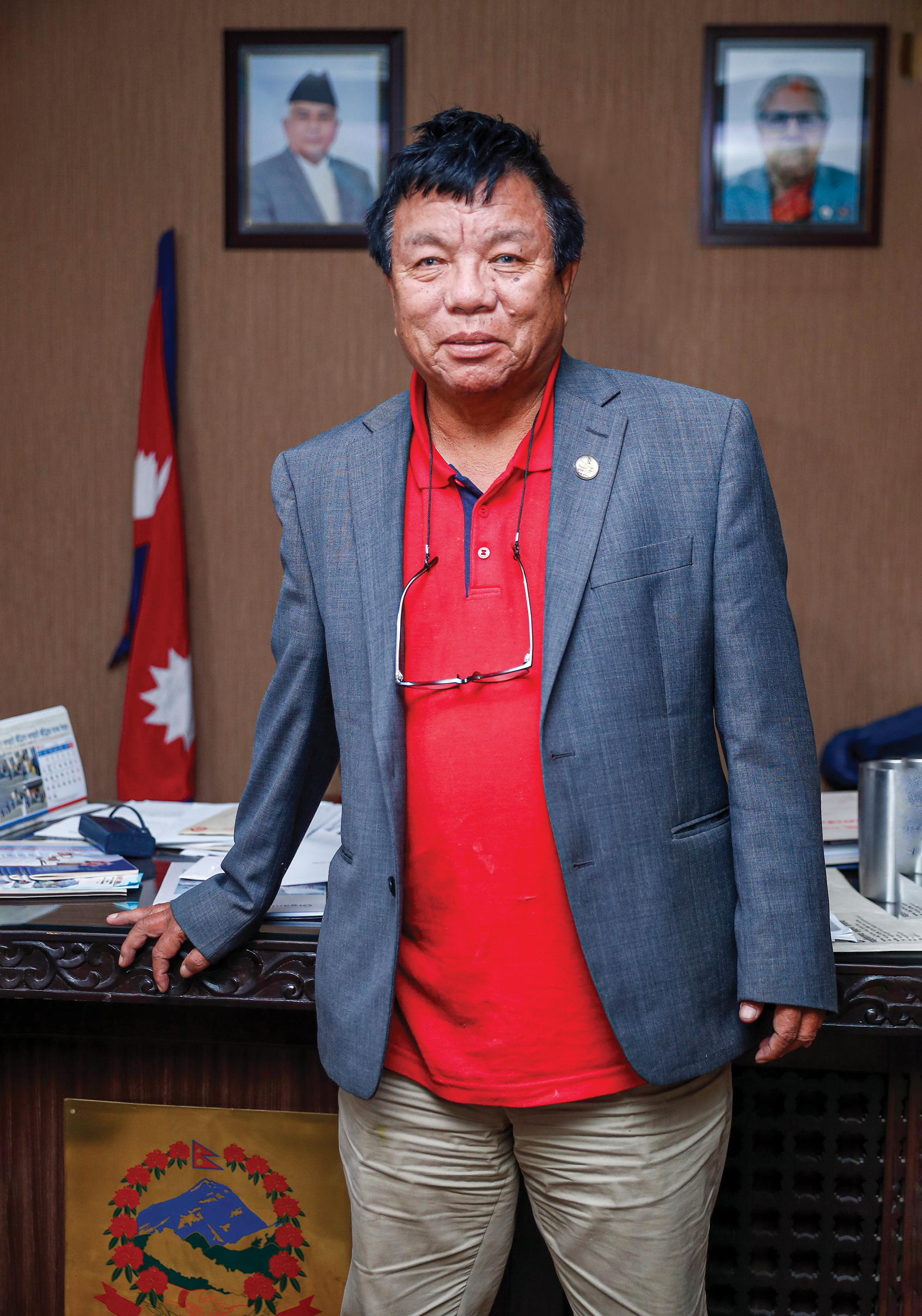
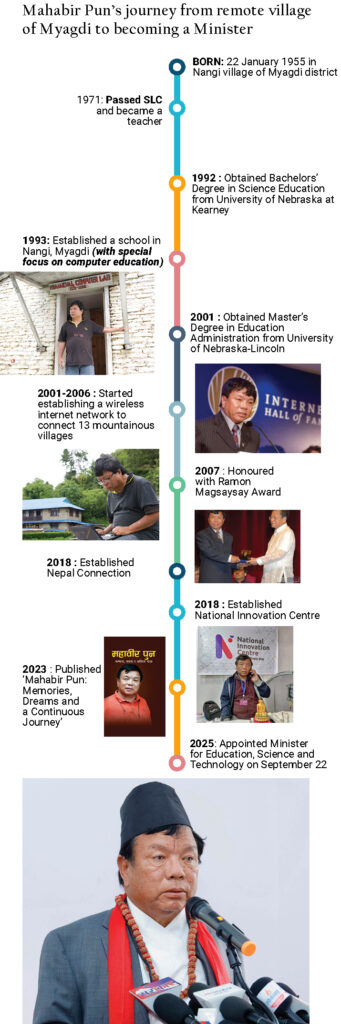
 Mahabir Pun is the Minister for Education, Science and Technology in the incumbent interim government. He is an innovator, researcher, teacher, social entrepreneur, and author. Pun is well-known for his pioneering work in installing wireless technologies in Nepal’s rugged mountain villages, a contribution for which he was honoured with the Ramon Magsaysay Award.
Born in Nangi village of Myagdi district, Pun was raised in Chitwan. He graduated from the University of Nebraska at Kearney, United States, in 1992 with a Bachelor’s Degree in Science. Upon returning to Nepal, he established a school in Nangi village, focusing specifically on computer education and other income-generating programmes. He later returned to the United States to pursue a Master’s degree in Educational Administration from the University of Nebraska-Lincoln, completing it in 2001.
In 2001, Pun initiated a project to build a local communications network using wireless technology. This project connected people in remote Himalayan communities with each other and with the outside world. By 2006, Pun had successfully established a wi-fi network through the project, connecting 13 mountainous villages to the internet. The project has since expanded to include over 175 remote villages across 15 districts of Nepal. In 2012, he founded the National Innovation Centre to foster research and development for the country’s economic growth. His book, ‘Mahabir Pun: Memories, Dreams and a Continuous Journey’, was published in 2023. He actively sold his book to raise funds for the operation of an ‘agriculture inputs factory’.
During a conversation with the HRM Nepal, Pun stated that he plans to return to the National Innovation Centre and resume operating the agri inputs factory once his tenure as minister is complete. Excerpts from the interview are provided below:
Q: In light of the Gen Z uprising of September 8–9, 2025, which demanded control of corruption and governance reform, what specific measures is the interim government implementing to address these calls for accountability and change?
A: The primary mandate of this interim government, formed following the Gen Z movement, is to conduct a general election to establish a new parliament and government with a fresh electoral mandate. Consequently, the government has prioritised ensuring a fair and timely election. Although its six-month tenure limits its scope, the government can establish certain values aimed at minimising corruption and reforming governance. However, the existing legal barriers pose a significant challenge to implementing comprehensive reforms and improving governance. Despite this, the government is making its best efforts. We cannot expect to eradicate all entrenched ill practices that have rampantly prevailed in the system overnight. The main challenge is the inability to introduce new legislation. To curb corruption and disorder, the government is making its best efforts based strictly on the existing laws, rules, and regulations. Nevertheless, the incumbent government has inherent limitations in fully eliminating corruption and scandals.
Q: Considering your short tenure and legal limitations, what specific, impactful initiatives in education and technology do you intend to launch that will constitute your lasting legacy or ‘footprint’ within the Ministry of Education, Science and Technology?
A: My current priority is minimising political interference in academic institutions, which has been paralysing educational entities, including universities, schools, and technical and vocational education programmes. The level of political interference is extensive; political leaders frequently appoint their supporters as executives of these institutions, meaning politics is deeply rooted in our educational/academic structures. We are actively trying to minimise this interference and create a sound environment that improves the quality of education and produces empowered human resources. I have been frank in stating that we cannot achieve a great deal in this very short timeframe, given the constraints I mentioned earlier. Other activities and day-to-day businesses are being handled by the bureaucracy and the assigned authorities. Nevertheless, I have been diligently overseeing these processes to ensure prudence and result-based delivery.
 Q: Will minimising political interference be considered your most significant achievement or ‘major footprint’ within the ministry?
A: In addition to minimising political interference, I have also been working specifically toward the restructuring of existing institutions as much as possible. For example, to enhance the technical and vocational programmes managed by the CTEVT (Council for Technical Education and Vocational Training), I’ve formed a committee tasked with devising a plan for restructuring the TVET programmes in Nepal. A separate team of experts is currently working on the restructuring of universities and concurrently focusing on minimising political interference within them. Regarding school-level education, the Constitution delegates that mandate to the local governments. We acknowledge that numerous challenges exist in improving the quality of education in public schools. I advise the local governments to be proactive in the quality improvement of these public schools, as this will be recognised as their landmark contribution to the landscape of basic education.
Q: Given that school-level education is the foundation for future talent and national development, and considering the disparity between human resources produced by private versus public schools (excluding a few exceptional public institutions), what is the single most effective strategy the government can implement to bring about crucial reforms and significantly improve the quality of education in public schools?
A: We shouldn’t interpret it that way. There are capable individuals in local governments who are performing very well, and their good practices should be replicated. Conversely, in areas where local leaders are corrupt, the schools are not performing effectively. In light of this, the people themselves and school management committees must be aware and actively create pressure on local leaders to improve the quality of education at the local level. It is fundamentally the responsibility of the local government to build the future of the students enrolled in public schools. The role of the federal government is limited to developing the curriculum and textbooks, and ensuring their distribution to schools across the nation.
Q: Will your directive instructing school teachers to cease political activities and suppress political affiliations while on school premises during duty hours effectively contribute to improving the quality of education?
A: I must say, this will help improve the quality of education to some extent. School hours typically run from 10 am to 4/5 pm, six days a week. The directive instructs teachers not to engage in any political activities during these specific school hours. Beyond that time frame and outside of school premises, we will not encroach upon their political rights. If a teacher is found absent from school due to their engagement in political activities, we can take disciplinary action, which may include issuing a memo or employing moral suasion.
Q: Given your background in technology and innovation and your vision for promoting TVET (Technical Education and Vocational Training) in Nepal, what is the single most effective policy measure you envision to successfully integrate TVET programmes with the high school level education system?
A: A Technical and Vocational Education and Training (TVET) programme is already included in the high-school level curriculum, spanning Grade IX to XII, though it is not being run effectively. The TVET programmes administered by CTEVT (Council for Technical Education and Vocational Training) are quite different, as their objective is to produce skilled human resources based on job market demand. CTEVT-run programmes are less focused on academic subjects compared to the high-school level TVET programmes. At the high-school level, the programmes are designed to meet academic rigour, allowing graduates to choose either academic programmes at the Bachelor level or technical and vocational education in higher education. My assessment is that the CTEVT-run vocational training programmes are unable to fulfil their desired objectives. Crucially, these programmes are not effectively aligned with apprenticeship opportunities in relevant industries. As a result, students are often deprived of job opportunities after completing the courses offered by CTEVT.
Q: Considering the ongoing talent drain, and recognising that Nepal needs to focus on STEM and TVET to cultivate the human resources required for national development, what specific educational policy is necessary to ensure the country produces talent aligned with its domestic demand?
A: The primary reason for the outflow of students from Nepal is not solely the pursuit of better education. In fact, they are chasing better opportunities. Since we haven’t been able to provide them with adequate job opportunities or an enabling environment for embracing entrepreneurship, the out-migration of students should be viewed in a positive light, with the hope that they will return with skills and capital if we succeed in creating a conducive environment in Nepal.
We cannot prevent them from going abroad; they will only be retained in the country if we foster an atmosphere conducive to investments and jobs. Migration is a common global phenomenon. In terms of the human resources required for our country’s development, we currently have scientists, engineers, technicians, and other talented people available and ready to contribute to the nation. The only thing lacking here is the opportunities. Nonetheless, we must prioritise STEM (Science, Technology, Engineering, and Mathematics) and TVET education. Undeniably, highly talented, innovative, and creative people should be absorbed/retained in the country. This retention depends entirely on the investment climate and the development of industries. We have a limited number of industries utilising cutting-edge technology to employ youth talent, skills, and innovation, which is why many of them are migrating abroad.
Q: A key consideration for Nepal’s labour policy is whether Nepal should shift its focus from exporting low-skilled and semi-skilled migrant workers to investing in and promoting the export of higher-skilled labour to improve wages and economic returns, given the poor compensation currently received by lower-skilled workers in major destination markets like the Gulf countries and Malaysia?
A: The intended goal of the TVET programme is to produce highly skilled labourers who can command better payment in both the domestic and international job markets. This is currently not being achieved due to political interference in CTEVT and other training institutes. The performance of these institutions was largely overlooked because their executives were protected by their political masters who were running the government. This political intervention in the educational institutes has paralysed their effective functioning, performance, and desirable outputs and outcomes. Consequently, we are largely unable to produce competent and high-skilled human resources. It is necessary that we must provide relevant skills to those aspiring to enter both the domestic and international job markets.
On the brighter side, the nursing programme run by CTEVT has been successful to some extent. Nurses produced from CTEVT-affiliated programmes have been migrating to developed and developing countries for job opportunities and are performing quite well there. Except for a few programmes like nursing, most programmes run by the CTEVT require revamping with a focus on performance improvement. A similar situation exists in universities. Apart from medical and engineering programmes, the rest are not performing well. Furthermore, the quality of engineering education has also deteriorated in recent years, largely due to a lack of practical experiences and apprenticeships for engineering students within the country.
Q: What specific actions is the Ministry of Education, Science and Technology undertaking to promote technology and its utilisation to enhance Nepal’s national productive capacity?
A: My immediate capacity for action is constrained by the short timeframe. From a policy perspective, my current focus is establishing a dedicated system centred on applied research and innovation. I am consulting with science and technology officials and collaborating with university professors and academia to design this framework.
Establishing a dedicated fund for this endeavour is currently a significant challenge, as the government’s primary focus and resources are dedicated to successfully conducting the upcoming election. Additionally, another critical priority is the reconstruction of public buildings that were damaged and vandalised during the Gen Z uprising of September 8-9. Despite these constraints, I have engaged with diaspora scientists, encouraging them to participate in our applied research and innovation initiatives, and have received initial emails from them expressing their interest in collaborating.
Q: Considering your unexpected transition into a ministerial role, how has your experience been working in government. Do you find the work mundane or interesting, are you enjoying it, and do you believe the government has the capacity to implement meaningful change?
A: I had never anticipated becoming a minister. It was an unexpected occurrence, devoid of any prior ambition or expectation. Throughout my career, I’ve consistently embraced whatever challenges have arisen. Assuming the role of minister arrived as a challenge during a particularly difficult political situation but I had a firm conviction that I could succeed. Accepting these challenges has resulted in both failures and successes over time.
I’ve always accepted unexpected developments in my life, even those I hadn’t dreamed of, and striven to perform and deliver my best. In this instance, the nation’s political situation was heading in the wrong direction, marked by chaos. I took on this responsibility with the mindset that if my contribution could be useful to the government, I shouldn’t refuse. Although I lacked experience leading a ministry, I have been learning and performing to the best of my ability with a sincere purpose.
Q: What is your assessment of the bureaucracy’s cooperativeness and competence, and what specific skill and competency gaps have you identified within the system?
A: Cooperation is inherently mutual. If a leader demonstrates cooperation toward their subordinates, they reciprocate. My life’s lesson is the necessity of being cooperative with both subordinates and superiors. In terms of competence, the bureaucracy is sufficiently experienced and capable, yet this capacity may not always be utilised effectively. To achieve perfection, they require systematic training, reskilling, and upskilling; improving their abilities is the fundamental basis for enhancing overall performance.
Q: What kind of political landscape do you anticipate emerging after the upcoming election?
A: I cannot offer a prediction but it is certain that we will not remain in the status quo. Whatever outcome emerges after the election, we will have no choice but to accept it. Nevertheless, as far as the government’s efforts are concerned, we are fully committed to doing our utmost to conduct the election in a timely manner and ensure a fair environment.
Q: Considering your advice to Gen Z delegations to pursue change through the electoral process, fighting elections or supporting candidates to form a government, what is your key message for young people who are striving for political and social change?
A: The Gen Z delegations approach me expecting magical changes, which is simply not feasible under the existing political structure and the government’s limited mandate. Their desired changes and aspirations can only be realised through the upcoming election. This is why I strongly advise them to participate in the election instead of wasting time in Kathmandu, repeatedly visiting ministries, and submitting memorandums to ministers and bureaucrats. If they mobilise within their respective constituencies and actively campaign, they can help elect young leaders who possess the vision to carry their aspirations forward.
Subsequently, the resulting Parliament will form a government capable of addressing those aspirations. The incoming Parliament will carry the people’s mandate and will have the power to enact laws and make significant decisions. This interim government only holds limited authorities, primarily restricted to conducting the election. Therefore, Gen Z must learn how to effectively engage in politics, support youth representatives in getting elected, and involve themselves in political innovation.
Q: What are your plans following the conclusion of your tenure as minister?
A: I plan to resume selling my books to generate the necessary funds to operate the agriculture inputs factory in Birgunj. To date, I have sold 245,000 books nationwide, successfully accumulating Rs. 12 crores. We currently possess sufficient capital to run the factory for the next five to six months but further funding will be required thereafter. Upon concluding my tenure here, I will dedicate myself to generating funds through book sales. I am not anticipating a miraculous or external source of funds, as I have no alternative means of raising the money needed to operate the factory.

