
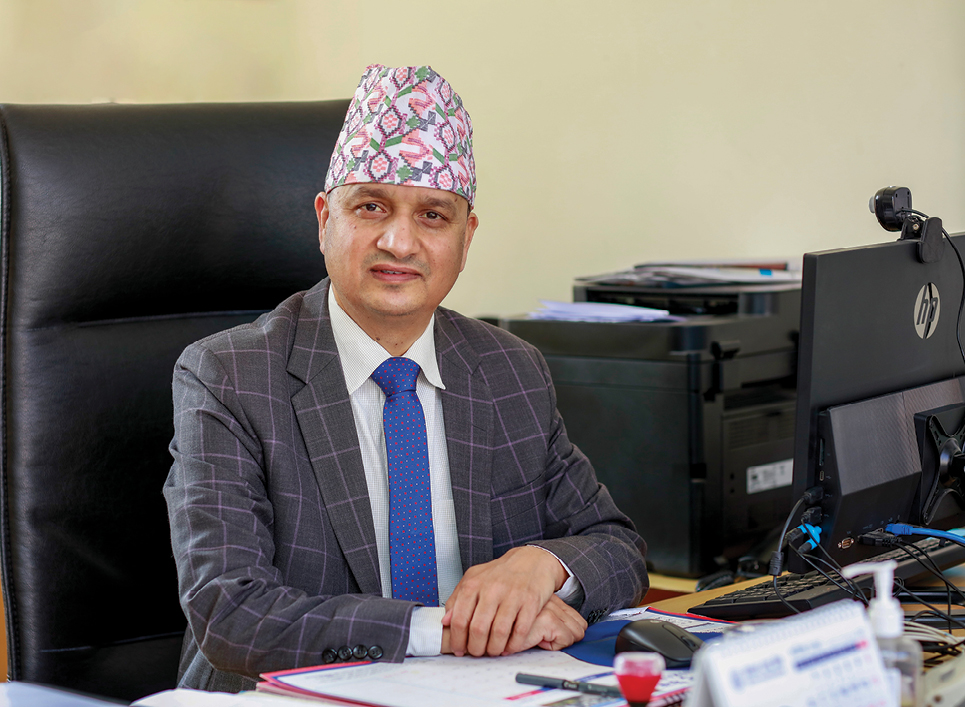
Dr. Gunakar Bhatta is the Vice Chairperson of the National Planning Commission (NPC), the apex planning body of the government. Previously, he served at Nepal Rastra Bank (NRB) for two-and-a-half decades, retiring last year from the position of the Executive Director as a special class officer. He possesses extensive experience in economics, finance, and regulation/supervision, and is an architect of various monetary and regulatory policies issued by the central bank.
He served in several departments of the central bank, including the Research Department, which is widely regarded as the institution’s intellectual core. Equally recognised for his academic excellence, he has also taught at various universities. He earned his Master’s Degree in Economics from Williams College in Williamstown, Massachusetts, and holds a PhD in Economics from Wayne State University in the United States.
As the Vice Chairperson of the NPC, he is a central figure in the policy-making and budget formulation processes. The HRM Nepal recently spoke with Dr. Bhatta regarding the priorities of the new budget, the challenges and opportunities within the economy, and various issues across the development landscape. Excerpts:
 Q: The newly formed government, backed by a popular mandate, is poised to introduce its inaugural budget. Government leaders and authorities are reportedly crafting a fiscal plan centred on a comprehensive reform package. What specific elements are expected to be included in this upcoming package?
A: Considering the current economic climate and the Government’s recently unveiled National Commitment, the 100-point governance reform action plan and the 16th Periodic Plan, which focuses on social justice, inclusion, and sustainable growth, serve as the primary guiding frameworks for upcoming policies.
Regarding the priorities of the Fiscal Year 2026/27 budget, we must address public aspirations while balancing them against available resources, as every policy and project requires funding for execution. We face a constrained fiscal space. Recurrent expenditure is approximately Rs. 1,300 billion, while revenue collection hovers around Rs. 1,200 billion, which is insufficient even to cover operating costs. Consequently, the government relies heavily on domestic and foreign debt, as well as external grants. We must remain cautious with borrowing. Excessive internal debt can trigger a ‘crowding out’ effect, where government demand for domestic financing reduces the capital available to the private sector. Furthermore, foreign assistance is dwindling, and we are limited by our future repayment capacity.
Against this backdrop, the government is formulating the fiscal budget based on these guiding documents with a higher growth target exceeding 7%. While the 16th Plan envisions an average 7% growth rate throughout its term, the relatively low growth of the past two fiscal years necessitates accelerated performance in the remaining period to compensate for those gaps. The government has pledged to expand the economy to $100 billion within the next five to seven years. In this regard, the budget must strike a delicate balance between ensuring fiscal sustainability and pursuing a high-growth trajectory.
Q: It is often said that the success of the government’s fiscal policy depends on allocative efficiency, implementation capacity, and accountability. While accountability may be enhanced through governance reforms, how do you plan to address the remaining two pillars?
A: Allocative efficiency depends on the prioritisation of projects based on rigorous cost-benefit analysis. In the past, instead of providing adequate resources and necessary facilitation to ensure completion within stipulated timeframes, the practice of inserting new, piecemeal projects without clear rationale or resource guarantees escalated the government’s long-term liabilities. We are firmly committed to eliminating such practices.
As per its mandate, the National Planning Commission (NPC) urges line ministries to enter their projects into the project bank while abiding by specified standards and benchmarks. Simultaneously, the NPC verifies the eligibility of these projects, allowing the Ministry of Finance to allocate the requested resources based on the budget ceilings provided to the concerned ministries.
In this spectrum, the government will focus on the completion of ongoing projects that are in their final stages and poised to create multiplier benefits. By providing adequate funding and necessary facilitation, these completed projects will spur revenue growth by creating opportunities for economic activity, improving public service delivery, and lowering government liability. In a nutshell, infrastructure projects with significant multiplier effects remain the government’s priority.
Q: The ruling party, the Rastriya Swatantra Party, envisioned the implementation of at least 10 signature projects over the next five years in its election manifesto. Will the government announce at least one or two of these projects for study or implementation in the upcoming budget?
A: We have been in constant discussion with the concerned ministries. Following initial consultations between the ministries and the NPC, the Ministry of Finance has been actively coordinating to finalise the crucial projects and programmes to be incorporated into the budget. These initial discussions between the NPC and the ministries were concluded just before my team assumed office. As far as I am aware, the line ministries have proposed several projects, which will be finalised through ongoing discussions with the Ministry of Finance.
A number of sectors of the economy are currently expanding at a slow pace and accelerated growth will not be possible without a fresh injection of investment. Investment presently accounts for merely 24% of the Gross Domestic Product (GDP), down from 30% three years ago. This declining investment is clearly reflected in the current GDP growth rate. It is projected that an investment level of around 35% of the GDP is essential to achieve a 7% economic growth rate, given the current capital-output ratio.
Q: What specific measures has the government taken to bridge the investment gap necessary to achieve its desired growth targets?
A: Obviously, we are in close coordination with our multilateral and bilateral development partners to properly utilise the resources they have offered. There have been clear constraints regarding the government’s implementation capacity. However, we are now addressing the inefficiencies of implementing and executing agencies identified in the past, such as the frequent turnover of project heads and key staff, government instability, weak monitoring, and a lack of necessary facilitation.
I believe we will be able to enhance our implementation capacity, improve the efficiency of executing agencies, and effectively mobilise the foreign assistance, both loans and grants, pledged by our development partners. Despite our internal resource pressure, we remain capable of mobilising funding for large-scale infrastructure projects from multilateral development partners. The interest rates and repayment conditions for debt offered by these partners remain favourable to us.
Q: As banks and financial institutions are currently flushed with liquidity due to a lack of borrowing appetite in the private sector, why is the government reluctant to issue project-specific bonds, which would allow BFIs to invest a significant portion of their funds in government securities?
A: While discussing the surplus of liquidity, we must analyse the situation rationally by considering the ongoing tensions in West Asia. These conflicts could disrupt remittance inflows and significantly increase our import bill as fuel and other commodities become more expensive. Consequently, such shocks could pose challenge to the sufficiency of our foreign exchange reserves.
Q: The Public Debt Management Act (PDMA) 2022 suggests remaining below the threshold of 33% of GDP when mobilising foreign debt. Given that Nepal has already mobilised 24% of its GDP, do you believe the country might exceed the threshold prescribed by the PDMA?
A: We should not limit our mobilisation of foreign assistance, both debt and grants, provided we have lucrative projects that yield high returns. Mobilising investment is fundamental to leapfrogging from the current period of slow growth. In some years in the 1990s, the debt-to-GDP ratio was approximately 67%, however, we managed to minimise that debt through economic and governance reforms, private sector development, and infrastructure projects. That effort has paid off in the long term, which is why we should not be reluctant to mobilise debt for projects with high returns that eventually pay for themselves. Nonetheless, we must pay close attention to three specific aspects: whether the project aligns with national priorities, the return on investment (including the social rate of return), and our implementation capacity.
Q: As you mentioned multiplier benefits, there are many ‘low-hanging fruit’ projects available. How do you plan to expedite their implementation and completion, and ensure they are operated optimally?
A: Various studies suggest that infrastructure not only boosts production but also enhances productivity, creating vital backward and forward linkages. The government is placing particular emphasis on completing and operating projects in their final stages, such as the Kathmandu-Terai Fast Track. To achieve optimal gains without delay, we are considering operating two lanes if feasible while continuing to upgrade the remaining lanes.
Furthermore, other projects like the north-south corridors and roads linking district headquarters are being given high priority. Already completed projects, including the Pokhara and Gautam Buddha International Airports, will be brought into full operation as soon as possible. Robust connectivity minimises fuel consumption, increases commuter movement, promotes tourism, and opens market opportunities for agricultural and livestock projects.
Q: As you are leading the resource estimation committee for the budget formulation, how have you been mapping the available resources?
A: We have limited resources, and the budget ceilings were already assigned to ministries prior to our appointment at the NPC. These have already been submitted to the Ministry of Finance in accordance with legal provisions. As discussions between the line ministries and the Ministry of Finance continue, we can make further adjustments based on the availability and requirement of additional resources.
Since the context has changed, the priorities of the new government, namely governance reform and quality infrastructure development, will likely shape resource requirements. In this situation, we must make readjustments and secure additional resources to implement the government’s key priorities, meeting the aspirations of the people within this evolving landscape.
Q: As the government’s primary think tank and a seasoned economist, what possible consequences do you foresee resulting from the prolonged tensions in the Middle East?
A: If the war and tensions persist for another four to five months, inflation will surge and economic growth will decelerate. Examining sectoral impacts, adverse effects will be felt directly on wholesale and retail trade, transportation, and tourism. An inadequate supply of chemical fertilisers could hinder agricultural production, while rising fuel prices and shortages of construction materials may dampen the construction sector.
Fortunately, the supply of fuel and other commodities remains steady despite rising costs. The government has activated an automatic pricing mechanism for retail fuel based on import bills. This follows past reforms at the Nepal Oil Corporation (NOC) to move away from subsidised pricing. Furthermore, although their contribution to the GDP is not as significant, mining, quarrying, and related activities could also be affected by the ongoing Middle East tensions.
Q: Can we estimate the extent to which these shocks might impact the GDP growth figures?
A: It is difficult to estimate the exact figure. The energy crisis has created difficulty in attaining the targeted growth for the current Fiscal Year 2025/26. This situation has once again exposed our vulnerability, highlighting why we must strengthen our capacity to ensure energy and food security.
Countries worldwide are currently revisiting their industrial policies. Even multilateral agencies that once advocated for purely pro-market and liberal policies are introducing new perspectives. Industrial policy now extends beyond manufacturing commodities like consumer goods, footwear, or electronics. It can encompass the use of Artificial Intelligence, the development of Large Language Models, and facilitating an energy mix to ensure security by integrating wind, solar, and hydrogen power. It also involves capitalising on the optimal potential of the ICT sector.
Moreover, internal migration is increasing significantly. Production in the hills and high hills often lacks market access, leading people to leave these areas. Consequently, we must find ways to promote commercial farming through the collective efforts of local governments, the private sector, and non-governmental agencies. By leveraging the high potential of high-value crops, cash crops, and medicinal plants, we can revive farming while ensuring market access. International shocks repeatedly signal that Nepal’s industrial policy must align with energy and food security. For instance, fuel price or supply shocks are fostering debates on clean cooking solutions, sustainable transport, and creating an enabling environment through nationwide electrification.
Q: The government has focused largely on punitive actions within its governance reform agenda. However, the public perceives that economic reforms, legal, procedural, and administrative, for investment, employment, and production, as well as improvements in public service delivery, have been overshadowed. How does the government intend to balance these punitive measures with delivery-driven reforms?
A: As far as I know, the government has primarily been advancing macro-level reforms within the policy and legal regime, such as digital governance, which could support the formalisation of informal trade. Another key aspect is the restoration of ‘good governance’, which has garnered massive public support.
In the past, state agencies were controlled and captured by certain cronies or oligarchs who consolidated undue power through their nexus with political leadership. They were powerful enough to frame and bend policies or even form and topple governments. However, the actions taken by the current government have sent a clear message that no one is above the law, regardless of how prominent those tycoons may be.
Q: If you were asked to think outside the box, how would you identify the specific anchors that could spur economic growth?
A: The anchors are visible and already identified. They include infrastructure development, digitalisation, and minimising the potential consequences of climate change with a focus on mitigation and adaptation. We must also rethink industrial policy in line with food and energy security to strengthen our sovereignty. For example, we should maintain at least a three-month reserve of petroleum products.
Moreover, digitalisation helps minimise the informal economy, including ride-hailing and food delivery services. We can bring these into formal channels and integrate them into the social security net. Digitalisation enhances transparency, which in turn builds trust in the state. Therefore, these elements can directly impact revenue collection and control tax evasion. We must advance macro-level reforms and governance improvements simultaneously. Policy reform combined with state investment in essential infrastructure will create an enabling environment for achieving a higher growth trajectory. Given the alarmingly high number of informal enterprises, we are thinking of realigning our policies to provide incentives and social security to encourage formalisation, helping us achieve a $100 billion economy in the next few years.
Q: The names of the National Planning Commission and developmental thinker Harka Gurung were once almost synonymous, as he envisioned the concept of decentralisation featuring growth poles in each of the five development regions. We can adapt this concept of growth poles within the federal system as well. What steps should be taken to develop growth poles in each of the seven provinces to ensure equitable growth?
A: To begin, we must move forward with restructuring the NPC to establish it as a crucial economic and development advisor to the government. We will enhance its policy research capacity and align scattered data with national development priorities while bringing all relevant agencies under the NPC umbrella. Furthermore, we will work effectively on the monitoring and evaluation of projects. Regarding balanced development, the government must ensure that districts, provinces, or local bodies with high poverty rates or low Human Development Index (HDI) scores are offered flagship programmes, such as entrepreneurship development, infrastructure projects, and educational or medical hubs, among others.
Q: Finally, you have placed a strong emphasis on public-private partnerships in the execution of industrial policy.
A: It is certain that the government alone cannot achieve everything, nor would it be efficient. The government is willing to leverage PPPs based on its established priorities. The government and private sector can join hands to meet national objectives through clearly specified covenants for sharing risks and benefits. Globally, recurring crises, the 2008 financial crisis, the supply disruptions of 2015/16, and the COVID-19 pandemic, suggest that the state must be self-reliant in key areas; the industrial policy must prioritise energy and food security as well as other essential commodities.

