
Navigating a Significant Mandate and Ambitious Goals
 The upcoming Fiscal Year 2026/27 is poised to redefine the nation’s political-economic landscape through the inaugural policies, programmes, and budget of the Balen Shah administration, established upon a massive popular mandate. This government has reaffirmed its commitment to good governance and anti-corruption measures, the central pillars of last year’s Gen Z movement. To transform these public aspirations into tangible results, the administration is meticulously crafting a comprehensive reform package designed to address ‘weak state syndrome’, characterised by mass outmigration, rising insecurity and unemployment, through legal, procedural, administrative, regulatory and institutional overhauls.
Simultaneously, the government must navigate inherited systemic challenges while fulfilling its own pledges to create decent jobs, provide affordable healthcare and education, and strengthen public institutions for efficient service delivery. However, constitutional ambiguities and overlapping concurrent powers between federal, provincial and local levels continue to complicate these efforts. Improving agency efficiency remains difficult without a clear functional delineation. While the local level should ideally handle service delivery, provinces manage coordination and the federal government sets policy standards, in practice, the federal centre remains excessively preoccupied with direct service implementation.
Furthermore, the government must redefine concepts of diversity, inclusiveness, inequality, disparity, and spatial balance as inherited through the Constitution. Another constitutional paradox lies in the juxtaposition of a highly advanced political system, the ‘Federal Democratic Republic’, with a ‘socialist’ economic framework, which inherently opposes liberal economic thought.
Against this backdrop, the government is attempting to advance economic reforms within a liberal order. While the liberal economic policies introduced in the 1990s established the foundation of the modern economy, the 2015 Constitution undermined the progress achieved through those policies.
“Given this legacy of the past, delivering results in a short time will be difficult if the leadership follows established processes and systems for institution building. The politics of nostalgia might prevail, leading to reform fatigue and backlashes,” according to Bimal Koirala, former Chief Secretary.
The government’s initial actions appear driven by a ‘hit and trial’ approach that does not fully abide by formal processes and seems desperate for immediate results. This is evidenced by a series of arrests made without proper evidence and the rushed demolition of squatter settlements without new arrangements for their resettlement.
“Results are important but the process matters. The state must adhere to the due process of law,” stated Gagan Thapa, President of the Nepali Congress, the main opposition in parliament. “This ‘hit and trial’ governance will lead to adverse consequences.”
Structural Reforms and Governance for Economic Transformation
The government is preparing to present the 2026/27 fiscal budget featuring a comprehensive reform package, guided by the 100-point governance reform programme, national commitments, the High-Level Economic Reform Advisory Commission Report, and the 16th Plan, among others.
Enhancing the ease of doing business and improving service delivery will be high priorities, according to Finance Minister Dr. Swarnim Wagle. In a recently unveiled economic status paper, the government identified that while macroeconomic indicators and basic infrastructure remain in good shape, reforming specific constraining factors is essential for progress.
 Within the scope of legal, procedural, administrative, regulatory, and institutional reforms, the government has incorporated the repeal of decades-old, antiquated laws and the restructuring of government agencies that currently constrain private sector activities.
Technological advancement, rapid digitalisation, and structural reforms are expected to leverage the country’s growth potential. However, limited institutional capacity could hinder effective implementation. “Fixing governance and advancing digitalisation could unleash growth sprouts,” the Finance Minister stated. “The formalisation of informal enterprises, entrepreneurship development, and the expansion of small and micro enterprises will receive due attention to sustain a high-growth trajectory.”
Furthermore, institutional efficiency has been identified as a top priority, with micro-level reforms focusing on providing faceless and paperless services to the public, according to officials. “Prime Minister Balen Shah has issued instructions to eliminate queues at public offices and end the practice of bribing officials to obtain services. He has called for the relentless enforcement of laws to take action against corruption.”
Compliance requirements and cumbersome bureaucratic processes are considered major bottlenecks for entrepreneurship development in the country. Unless institutional capacity is developed to implement the announced reforms, they cannot take root or deliver their intended impacts, according to Dr. Resham Thapa, Associate Professor at the Central Department of Economics, Tribhuvan University.
“The reforms announced by the government are expected to be as extensive as the major reforms of the 1990s, requiring institutional deepening to achieve the intended results and establish a solid foundation for the country’s long-term macroeconomic development.”
Key Drivers of Nepal’s Accelerated Economic Growth Strategy
The government’s recently unveiled status paper identifies key economic drivers, including the energy sector, agricultural modernisation and allied activities, quality tourism and infrastructure, the digital economy, and information technology.
Nepal’s energy sector reforms of the 1990s delivered visible changes by mobilising significant private sector resources and foreign direct investment. Former Finance Minister Rameshore Prasad Khanal underscored that energy policies were effectively executed, primarily through market assurances via Power Purchase Agreements (PPAs), which incentivised private and foreign investors in a way rarely seen in other sectors. In contrast, even the provisions of the Industrial Enterprises Act often went unimplemented due to contradictory clauses in the annual finance bills presented with the budget.
Undoubtedly, the power sector has made significant strides through market predictability and the consistent execution of government policies. Reportedly, there are over 347 hydroelectric projects totalling 7,251 megawatts – 2,948 MW currently operational and 4,303 MW under construction – and the government recently unveiled an Energy Development Roadmap envisioning 28,500 MW by 2035.
 The government aims to expand installed generation capacity to 15,000 MW within the next five years, aligning with the country’s aspirations to become a clean energy hub for South Asia. National pride projects are expected to be completed and commissioned within two years, while several other large-scale storage projects have been prioritised for implementation.
Secondly, agriculture remains stagnant in terms of production despite a large number of people relying on it for subsistence. Agriculture modernisation and commercialisation have long been debated. However, the sector remains traditional and subsistence-based, with its contribution to the Gross Domestic Product (GDP) stagnating due to slower growth compared to the non-agricultural sector. The incumbent government envisions modernising, commercialising, and integrating agriculture into the value chain to enhance productivity and create employment in allied activities.
The third driver of growth identified by the government is quality tourism and infrastructure, aimed at developing Nepal into one of the most attractive destinations for tourists. This goal is supported by providing sufficient amenities and infrastructure to deliver high-quality services.
Lastly, the fourth major driver of accelerated economic growth consists of digitalisation, artificial intelligence, and the use of robotics across all sectors to unleash growth and employment potential. A sovereign Large Language Model (LLM) has been envisioned to establish the country’s own AI infrastructure, ensuring data security and privacy while saving foreign currency that would otherwise be paid to international AI companies.
Strategic Foundations for Nepal’s Target of a Hundred Billion Dollar Economy
The government has envisioned 7% growth and a $100 billion economy within five to seven years. To achieve this ambitious target, it requires the mobilisation of significant capital stocks from both the public and private sectors, alongside improvements in labour productivity and Total Factor Productivity (TFP) driven by technological adoption and reform. Former Chief Secretary Baikuntha Aryal analyses this through the lens of production factors: scaling up opportunities through investment and market access, skilling and upskilling labour to address low productivity relative to wages, and enhancing efficiency through technology and the execution of major policy reforms.
The government has previously overlooked the efficiency of state institutions regarding service delivery. An inefficient government creates negative multiplier impacts, including hindering the efficiency of the private sector. Aryal noted that governance reform should focus on improving the efficiency of public institutions, which will ultimately enhance TFP and support the augmentation of national growth.
Breaking the country’s vicious cycle of inefficiency remains a herculean task. Fundamentally, digitalisation, meritocracy, competence, and fair performance management are essential for improving efficiency across both the public and private sectors. Nepal’s Incremental Capital-Output Ratio (ICOR) stands at 4.77, meaning 4.77 units of additional capital investment are required to produce one additional unit of GDP growth, a figure significantly higher than the ratios below 2 in India and China. By improving efficiency, Nepal can achieve high growth through increased returns on capital investment, which is a prerequisite for attracting investment and minimising deadweight loss in the economy.
Nepal remains a laggard in growth, with an average growth rate over the last three decades falling below 4%, primarily due to low productivity, high unemployment, and low investment. Because of a significant imbalance between the expansion of the agricultural and non-agricultural sectors, Nepal is witnessing lopsided growth. Driven by the rapid expansion of the non-agricultural sector, mainly services, and sluggish agricultural growth, the share of agriculture in the country’s GDP currently stands at a mere 22%.
Fiscal Ambitions and Resource Challenges for the Upcoming Budget
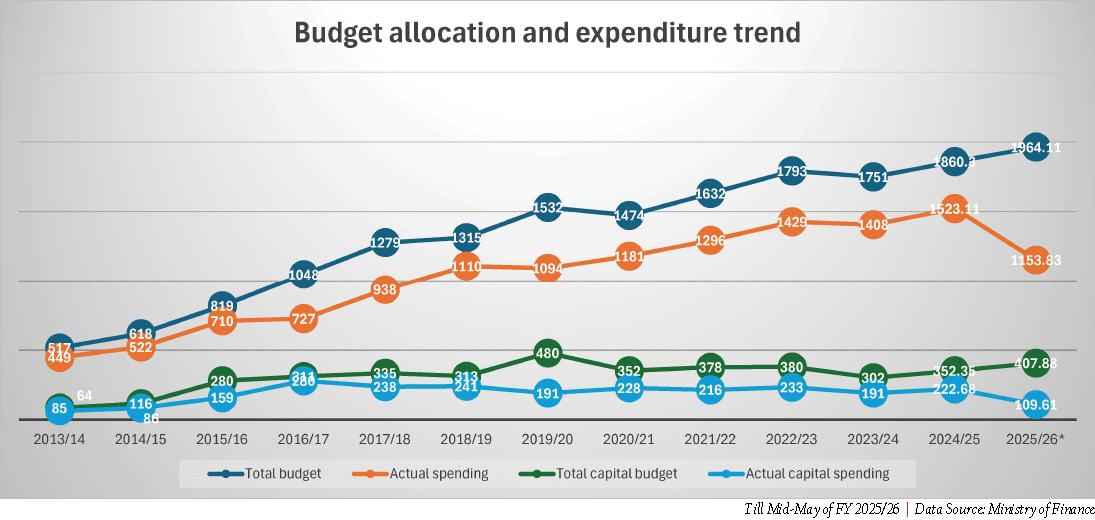
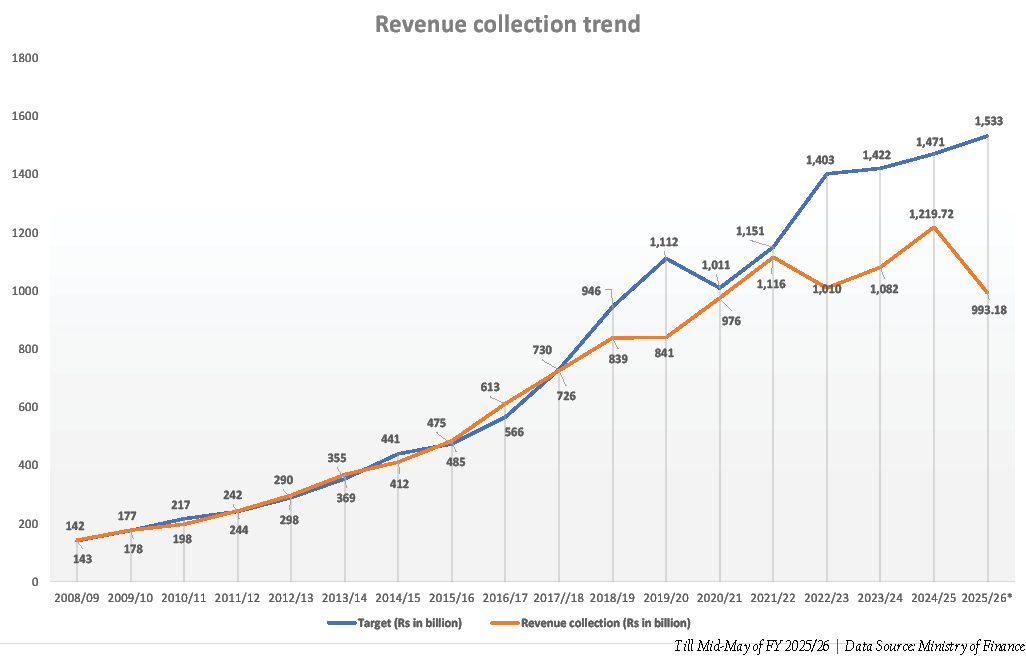
As the government prepares the budget amidst lofty aspirations, its ambitions remain constrained by limited resources. Total revenue collection is grossly insufficient to cover recurrent expenditure. While revenue is expected to hover around Rs. 1,180 billion, recurrent expenditure allocations exceed Rs. 1,300 billion. Consequently, the government must mobilise internal and foreign debt, along with foreign grants, to bridge the gap.
The National Planning Commission has set a ceiling of Rs. 1,900 billion, and ministries have proposed their expenditure requirements accordingly. Sources at the Finance Ministry privy to the formulation process suggest the government may finalise a budget of approximately Rs. 2,000 billion for FY 2026/27, factoring in sluggish revenue mobilisation and a lack of foreign aid absorption capacity caused by the weak implementation of development projects.
However, experts argue that the government should not confine itself to the narrow rhetoric of resource constraints. “It is evident that the government must enhance its implementation capacity through governance reform and by addressing existing capacity gaps,” said Sudarshan Raj Pandey, former President of the Institute of Chartered Accountants of Nepal (ICAN).
“The government must take bold steps to execute game-changing projects and expedite ongoing national pride projects by providing the resources necessary for early completion. Funding can be secured by divesting shares in state-owned enterprises (SOEs), issuing project-specific bonds, especially as banks and financial institutions are flushed with liquidity, and utilising the overdraft facility from Nepal Rastra Bank, which allows for 5% of the previous year’s revenue. If the government demonstrates sufficient will, multiple windows exist for channelling resources,” he added.
Pandey further stated that if the government delivers merely a conventional budget, the country will lose its current momentum, and it will take years for the nation to achieve a significant leap forward.
Economic Traps and Structural Constraints Hindering Nepal’s Growth Potential
The economy is currently facing three major traps: an unsustainable private sector debt trap, an inferior assets trap, and a public sector burdened by an unbearable social security trap, according to Gunakar Bhatta, Vice Chairperson of the National Planning Commission. Debt from banks and financial Institutions (BFIs) to the private sector hovers around 92% of GDP. If loans mobilised from non-banking financial institutions, such as the Employees Provident Fund, Citizen Investment Trust, and Social Security Fund (SSF), are included, this figure reaches 110% of GDP. Furthermore, the deteriorating quality of bank assets remains a significant concern for future improvement.
Additionally, Nepal’s increasing committed liability to social security requires a serious review to escape the trap of unsustainable social security expenditures.
Nepal faces various constraining factors from a political economy perspective: its production, security, financial, and knowledge and technology structures. The country’s production potential is highly underutilised due to gaps in skills and technology, poor value chain integration and market access, and a lack of standardisation, particularly in agricultural and industrial products.
The country has yet to prioritise energy and food security, which are fundamental for any nation to survive international volatilities. The absence of capital account convertibility hinders the flow of foreign funds into the domestic market, leaving Nepal with the weakest FDI inflows in South Asia. Although Nepal has allowed borrowing from foreign financial institutions with Nepal Rastra Bank’s permission and completed its sovereign credit rating, it has not yet created lucrative investment opportunities for foreign investors.
Moreover, Nepal remains a laggard in knowledge and technology due to insignificant investment in research and development (R&D), failure to nurture talent, and slow adoption of cutting-edge technologies.
Private Sector Optimism and the Need for a Collaborative Investment Climate
The private sector remains optimistic about the government’s budget and its reform initiatives aimed at accelerating growth, particularly after suffering significantly from the backlashes of corruption and unethical practices under previous administrations. “The private sector has always collaborated with the government to achieve national prosperity goals,” stated Birendra Raj Pandey, President of the Confederation of Nepalese Industries (CNI). “CNI has envisioned a 100-billion-dollar economy, which requires an effective economic development roadmap to foster a favourable investment climate.”
Despite this, private sector umbrella bodies remain somewhat sceptical of the government’s perspective and have expressed displeasure regarding recent actions taken against business leaders. However, the government and the ruling party chair have clarified that these measures are specifically targeting criminal acts rather than legitimate business activities.
Chandra Prasad Dhakal, former President of the Federation of Nepalese Chambers of Commerce and Industry (FNCCI), underscored that complementarity and an environment of trust between the government and the private sector are essential for achieving desired results. He further urged the government to implement the Private Sector Protection and Promotion Plan to boost morale and create an enabling investment climate by safeguarding investments.
Government Pledges Tax Rate Revisions to Foster Entrepreneurship and Industrialisation
For the first time in decades, the government has pledged to lower tax rates, citing that oppressive taxation is hindering entrepreneurship and industrialisation. Despite a slowdown in tax collection, the administration is prepared to take the bold step of revising rates to a more amicable level. “Some of our tax rates are oppressive and were set under the influence of major trading firms,” noted Finance Minister Wagle. “The government believes in expanding the tax net to broaden the base rather than increasing rates. We plan to provide tax rate predictability for at least a decade, in line with our investment promotion strategy.”
The government is emphasising the expansion of small and medium enterprises. Focusing on entrepreneurship development and scaling up opportunities is a priority to strengthen broad-based growth and expand business activity across the country.
The effective income tax rate in Nepal is 39%, which is exorbitant in the national context. Similarly, excise duties are imposed rampantly. Paradoxically, tariffs of 60-70% are levied at customs even on intermediate goods, which is higher than the rates for finished products.
Citing the Laffer Curve, a theoretical model illustrating the relationship between tax rates and government revenue, Wagle stated that rational tax rates help maximise revenue by encouraging broader participation and discouraging evasion among existing taxpayers.
 Rajendra Khetan
Chairperson, Khetan Group
Equipped with a popular mandate, the government must initiate landmark reforms to propel the economy beyond its current stagnation. As the administration has pledged to lower tax rates, income tax should be reduced to 20% and Value Added tax (VAT) to 10%. A board of regulators should be established to streamline regulatory policies and provide a seamless route for investments, including diaspora capital and FDI. If the government is truly committed to significant reforms in the foreign investment regime, capital account convertibility must be introduced. Most importantly, allowing outward investment, particularly for specialised products and services, will grant domestic firms the opportunity to expand into the global marketplace.
Salt Trading Ltd. and National Trading Ltd. should be encouraged to operate fair price shops and procure local agricultural and industrial commodities from municipalities and rural municipalities nationwide. Finally, Damodar Kunda in Upper Mustang should be opened for tourism, and robust connectivity must be ensured across the Lumbini-Pokhara-Kathmandu-Janakpur corridor.
 Darshana Shrestha
President, Federation of Woman Entrepreneurs’ Associations of Nepal (FWEAN)
The fiscal budget should prioritise entrepreneurship development through incubation support, subsidised funding, value chain integration, and market access. Nepal’s niche-market products produced by women entrepreneurs can be exported to various destinations with government support for branding, marketing, and trademark registration. Most importantly, we have been urging the government to utilise ‘Made in Nepal’ products. At the very least, the government should prioritise these goods even if they are up to 10% more expensive than imported commodities. This initiative will encourage women’s entrepreneurship and help sustain their enterprises. Furthermore, the 2026/27 fiscal budget must reduce compliance burdens and tax rates for micro, small and medium enterprises (MSMEs).
 Urmila Shrestha
CEO, Salt Trading Ltd.
It is an opportune moment for Nepal to focus on transformative sectors to achieve accelerated growth and sustain it over the medium term. The government must move beyond a mentality of short-term popularity, as a distributive approach to allocation cannot provide the necessary momentum for the economy. Furthermore, a conventional budget lacking the ambition for high growth and transformative change would likely result in a linear growth path, with significant consequences for an aspirational society. The budget must unleash high-potential sectors, augment production, and create more jobs by attracting private sector investment. In doing so, the country can achieve prosperity and its sustainable development goals.
 Deepak Shrestha
Chairperson, Nepatop Organisation
The 2026/27 fiscal budget should focus on facilitating investment, reducing administrative hassles, and providing opportunities for businesses to thrive. Without a strong private sector, the country cannot achieve a path to prosperity. The government’s initiatives to end cumbersome bureaucratic processes and eliminate corruption are praiseworthy. The upcoming budget should introduce policies to boost the private sector, streamline regulatory requirements through prudent practices, and improve the investment climate.
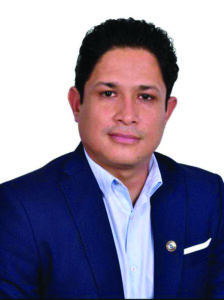 Deshbandhu Basnet
Chairperson, Tourism & Air Transport Committee
I believe Nepal’s upcoming budget must prioritise tourism as a key economic driver. Policy stability, enhanced air connectivity, and destination-focused infrastructure are essential. Strong public-private collaboration will be crucial to unlocking Nepal’s full tourism potential.

