

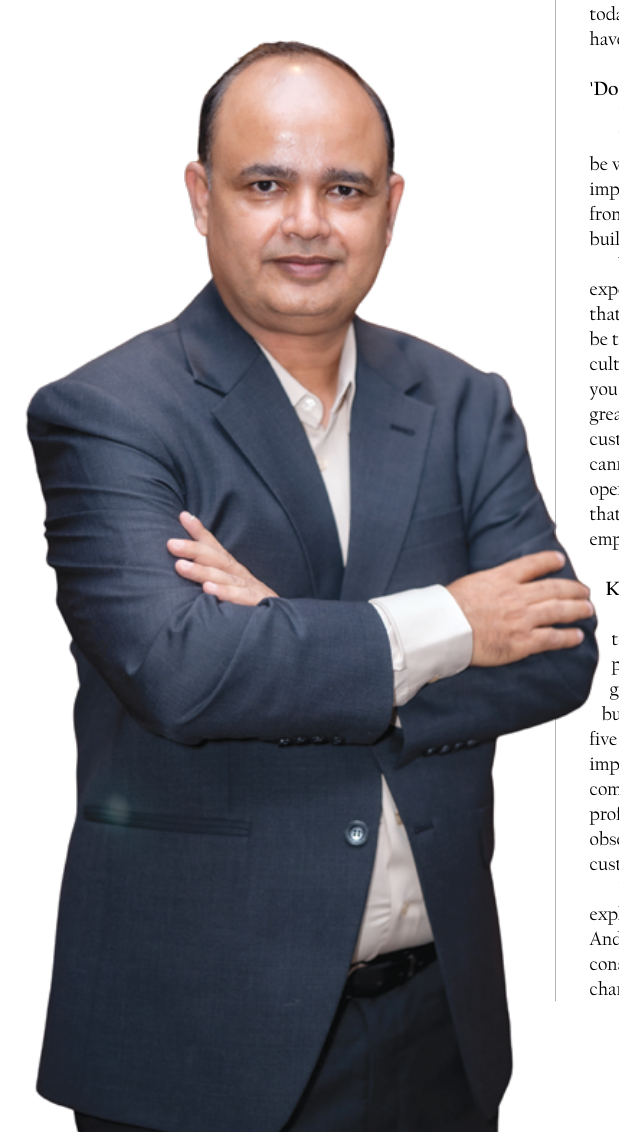
VIJAY SHARMA | Country Manager, Devyani International Nepal Pvt. Ltd.
I started my professional journey in November 2000 with McDonald’s as a Team Member.
When I look back, the job market was very different from what young people experience today. There were fewer opportunities, less access to information, and certainly nothing like LinkedIn or the digital ecosystem we have today. Career paths were also not as clearly defined.
But I think that environment taught me something very important: you had to earn your opportunity through your performance.
I didn’t start with a big designation or a management title. I started at the frontline. And that experience has remained one of the biggest strengths of my career because I understand what it feels like to be the person standing behind the counter, serving a customer, handling pressure and learning the business one shift at a time.
For me, that first job was not just a job. It was the foundation of my career.
At that stage, I was simply looking for an opportunity to work, learn and build a career. I don’t think I had a grand five-year career plan at that point.
What attracted me was the professionalism of the organisation and the opportunity to learn through actual work.
I started by doing the basics – serving customers, maintaining standards, learning food safety, working as part of a team and understanding restaurant operations.
What I learned very quickly was that there is dignity in every role. Whether you are a Team Member or the Country Manager, every role contributes to the customer experience.
That belief has stayed with me throughout my career.
Learnings and skills
My first job taught me three things: discipline, customer focus and respect for people.
When you are on the restaurant floor, the customer doesn’t care about your designation. They care about whether you are serving them correctly, whether the food is right, whether the restaurant is clean and whether you treat them with respect.
That experience taught me to focus on execution. It also taught me that leaders should never become disconnected from the frontline.
Even today, I believe that if you want to understand your business, go to the restaurant, talk to the team and listen to the customer. Numbers will tell you what is happening. But people on the frontline will often tell you why it is happening. That is something I have carried with me throughout my career.
Turning point
and Pizza Hut as part of Devyani International Nepal. What changed at every stage was not just my designation – it was my level of accountability. I gradually moved from asking, “How do I run this shift?” to “How do I build a team?”, then “How do I grow a business?” and eventually, “How do I build an organisation that can grow sustainably?”
There have been several turning points, but I would describe my journey in stages. The first was learning the fundamentals of restaurant operations at McDonald’s. I spent almost a decade growing through the organisation, eventually taking on Restaurant Manager responsibilities.
The second turning point was moving from managing a restaurant to managing people and multiple business dimensions – sales, profitability, customer experience, people development and operations. The third was my transition into the Yum! ecosystem and eventually taking on broader responsibilities with KFC.
That progression has been the most rewarding part of my journey. I strongly believe that you cannot learn restaurant leadership completely from a classroom. You have to experience the rush hour. You have to deal with an unhappy customer. You have to motivate a team member who is having a difficult day. You have to understand food safety, inventory, labour productivity, sales and profitability. Those experiences build judgement. My frontline experience also gives me empathy. When I ask a team to deliver something today, I understand what that means operationally because I have done the job myself. That creates credibility.
And the biggest turning point was coming to Nepal and getting the opportunity to contribute to the growth of KFC
‘Do yourself’ philosophy
My philosophy is simple: Never ask your team to do something you would not be willing to do yourself. I think that is one of the most important lessons I have learned from starting at the frontline. One of the biggest lessons is that great brands are built through consistency.
Whether it is McDonald’s, KFC or Pizza Hut, customers expect the same core experience every time. Training creates that consistency. I have also learned that training should not be treated as a one-time activity. It has to become part of the culture. You train people, you coach them, you observe them, you give feedback and you give them opportunities to take greater responsibility. The other important lesson is that customer service and operational excellence go together. You cannot create a great customer experience without strong operations behind it. The best organisations create systems that allow people to perform consistently, but they also empower people to care.
Keep learning, don’t be stationary
The biggest shift was learning to move from doing to enabling. When you manage a restaurant, you can personally influence many things. As your responsibility grows, you cannot do everything yourself. You have to build capable people and trust them. So, I would identify five skills: First, people leadership. Building teams is more important than building individual performance. Second, commercial understanding. You need to understand sales, profitability, productivity and cost. Third, customer obsession. Ultimately, everything comes back to the customer.
Fourth, problem-solving. Don’t spend too much time explaining the problem. Focus on finding the solution. And fifth, learning agility. The restaurant industry changes constantly. Consumer behaviour changes, technology changes and competition changes. A leader has to keep
learning. Yes, the biggest opportunity was the opportunity to take on responsibilities beyond individual restaurant operations and eventually move into broader business leadership. But if I look deeper, I would say that the most important decision was actually saying yes to opportunities that stretched me.
There were moments when I could have stayed comfortable with what I already knew. Instead, I chose to take on new responsibilities, new markets, new teams and new challenges. Coming to Nepal was one such opportunity.
It gave me the chance not only to operate a business but to contribute to building and growing brands in a different market. So, my advice to young professionals is: don’t always choose the opportunity that feels easiest. Sometimes choose the one that will make you grow the most.
New orders in the job market
The biggest change is the speed of change. When I started in 2000, access to information was limited. Today, young people have incredible access to knowledge, technology and global best practices. But with opportunity comes responsibility.
Employers today don’t only look for qualifications. They look for attitude, adaptability, communication, problem- solving and the ability to learn quickly. Technology has also changed the workplace. Today, someone entering the restaurant industry needs to be comfortable with digital platforms, data, mobile technology and increasingly AI.
But I would add one important point: Technology can give you information, but attitude determines what you do with that information. So, I would encourage young people to build both – digital capability and human capability.
I understand why young people want fast growth. But my own journey is proof that sustainable growth takes time. I started as a Team Member in November 2000. Today, I am in a country-level leadership role. There was no shortcut between those two points. There were years of learning, mistakes, coaching, hard work and taking on progressively larger responsibilities.
My message to young people is: don’t chase the designation; chase the learning. If you become really good at what you do, take responsibility, build relationships, learn from mistakes and consistently deliver results, growth will follow. Patience doesn’t mean waiting passively. Patience means staying committed while continuously improving yourself.
Communication, attitude and teamwork
I would say three things are particularly important. Communication, attitude and teamwork. You don’t need to know everything when you join your first job. We can train you on products, processes and systems. But we cannot easily train someone to genuinely care about the customer or respect their colleagues. In our business, every interaction matters.
if I look deeper, I would say that the most important decision was actually saying yes to opportunities that stretched me.
A customer may forget the exact product they ordered, but they will remember how the team made them feel.
So, I look for people who are positive, willing to learn, comfortable working with others and genuinely interested in serving customers.
Technical skills can be developed. The right attitude is the starting point. Young people should develop the ability to communicate, listen, work in teams and handle pressure.
Quick Service Restaurant (QSR) is a very dynamic environment. During peak hours, you may have hundreds of customer interactions happening within a short period.
You need to stay calm, follow processes and still deliver a warm customer experience.
I would also encourage young people to develop basic business understanding.
Understand what sales means. Understand customer satisfaction. Understand productivity.
Because when you understand the business, you stop thinking only about your individual task and start thinking like an owner.
That mindset can accelerate your career significantly.
Career progression mantra
I believe career progression happens when three things come together: Opportunity + capability + performance. Our industry has a unique advantage – we can provide people with real responsibility relatively early in their careers.
Someone can join as a Team Member, become a Shift Manager, then a Restaurant Manager and eventually take on larger leadership responsibilities. But the organisation has to create the environment for this.
That means structured training, coaching, recognition and – most importantly – giving people opportunities to demonstrate their capability. We have seen many examples of people growing within our organisation. And that is something I personally find very satisfying.
Because as a leader, your success should not only be measured by what you achieve. It should also be measured by how many people become better leaders because they worked with you.
Equal opportunities
The first thing is to create equal opportunity – not just equal statements. You need to ensure that people have access to recruitment, training, career progression and leadership
opportunities based on capability and performance. At Devyani International Nepal, women represent more than 90% of our workforce, and women are present in leadership roles across many of our KFC and Pizza Hut stores.
We have also taken steps toward inclusion of specially- abled colleagues. For example, KFC Nepal has created specially-abled outlets and has seen specially-abled colleagues progress into leadership roles. But inclusion is not just about hiring. It is about creating an environment where people feel that their background will not limit their potential. My belief is very simple:
Give people an opportunity, give them the right training, and then let their performance speak.
New skills in the era of technological advancement
The future will require a combination of digital skills and human skills. AI and data will help us understand customers better, forecast demand, improve productivity, personalise offers and make faster decisions.
Young professionals therefore need to become comfortable with data. They should know how to interpret information, identify trends and use technology to solve business problems. But I don’t believe technology will eliminate the importance of people. In a restaurant, technology can help us take an order faster.
But a human being still creates the emotional connection
with the customer. So, I would tell young people: learn AI, learn data, learn digital – but don’t forget communication, empathy, leadership and customer service. The winners will be those who can combine technology with humanity.
Career tips for new entrants in job market
I would give them five pieces of advice. First – start somewhere. Don’t be obsessed with getting the perfect first job. Second – respect every job. Your first job may not define your career, but the way you perform in it will define your reputation.
Third – learn more than you earn. Especially in the early years, focus on building capability. Fourth – be patient but ambitious. Wanting growth is good, but don’t expect a shortcut. And finally, take care of people.
Throughout my career, I have realised that businesses are ultimately built by people. I started my career as a Team Member in November 2000. More than two decades later, I am leading a business at the country level. If there is one message I would like young people to take away from my journey, it is this:
Your starting point does not determine your destination. Your attitude, discipline, willingness to learn and ability to create value for others determine how far you can go. So don’t be afraid to start from the ground. Start small. Learn fast. Stay humble. Take responsibility. And keep moving forward.


