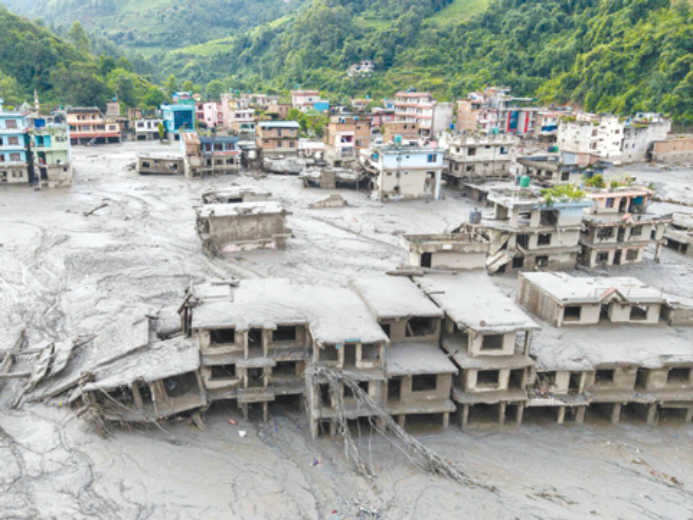
AT A TIME WHEN COMMUNITIES ACROSS NEPAL ARE AGAIN FACING FLOODS AND LANDSLIDES, ECONOMIC POLICY CAN FEEL FAR REMOVED FROM IMMEDIATE HUMAN LOSS. IT IS NOT.

A disaster does not end when the water recedes or the road reopens. Behind the visible damage are lost crops, closed shops, damaged factories and hydropower assets, interrupted incomes, displaced families and years of investment.
These moments reveal what economic resilience actually means. A strong private sector is not simply a source of taxes and growth in normal times. It is part of the country’s capacity to endure and recover: keeping essential goods moving, preserving jobs and supply chains, financing repairs, rebuilding assets and helping communities return to work. Where productive capacity is thin, every shock lasts longer and recovery rests more heavily on already- stretched public resources.
Nepal’s next economy must therefore do more than grow. It must be strong enough to absorb shocks, broad enough to reach people across the country and confident enough to keep investing in the future. That is the promise behind Nepal@100BN.
For much of our economic history, the conversation between government and the private sector has centred on a familiar
question: what should the government do for business?
It remains an important question. Businesses need predictable policies, workable laws, efficient public services, infrastructure and an environment in which investment can take place with confidence.
But Nepal has reached a point where we must ask a larger question as well: What can the government and the private sector build together for the country?
I believe one of the most important evolutions of the Confederation of Nepalese Industries has been in this direction.
For 23 years, CNI has represented Nepal’s productive and service industries. Representing the legitimate interests of the private sector remains at the heart of our mandate. But representation today cannot mean advocacy alone.
Increasingly, our responsibility is also to become a reliable partner of the government in building the economy – bringing evidence to policy discussions, identifying constraints faced by businesses, supporting reforms that work, proposing practical solutions where they do not, and helping carry good ideas through to implementation.
Partnership does not mean silence or automatic agreement.
A credible private-sector institution must be able to say when a policy is hurting investment, when a law no longer serves its purpose, when implementation is failing and also when businesses themselves need to raise their standards.
The government and business will not agree on every issue. Nor should they.
But beneath those differences, our larger objectives are remarvkably similar: more investment, more production, better jobs, stronger exports, higher productivity, rising incomes and a more capable country.
That common ground should allow us to work much more ambitiously together.
Policy improvement must translate into real economic activity
Nepal’s economic debate is often dominated by large indicators – reserves, liquidity, interest rates, revenue, inflation and annual GDP growth.
These numbers matter. But for an entrepreneur deciding whether to expand a factory, hire another worker or make a new investment, the economy is experienced much more directly: Are orders coming in? Are firms operating near capacity? Is capital moving into productive activity? Are people confident enough to invest?
One of Nepal’s challenges today is
Nepal cannot transform by managing the present alone. We need to choose the economy we want to build, Nepal@100BN.
precisely this disconnect.
Money can be available in the financial system without becoming investment. Interest rates can fall without immediately creating new demand. Stronger external buffers do not automatically translate into factories expanding, businesses borrowing or new jobs being created.
The government has set an ambitious economic growth target of around 7%. Achieving that kind of growth requires more than favourable macroeconomic conditions. It requires activity in the real economy. • Capital must move. • Projects must move. • Businesses must invest. • Consumers and investors must regain confidence.
The real test of economic policy is whether stability is converted into
production, investment and jobs.
That is where the private sector and government have to work together much more closely. From policy advocacy to policy delivery
CNI has always engaged the government on taxation, industrial policy, investment and regulation. What we increasingly want to strengthen is the next part of the chain: implementation.
There are encouraging examples. The current budget includes customs reductions on 273 items used in productive industries and the removal of excise duties on 360 items. It also contains measures related to VAT refunds, disputed tax cases, business succession and restructuring, investment approvals, repatriation and alternative financing instruments.
Many of these respond to issues raised repeatedly by industry.
That is welcome. But a provision written into a budget is only the beginning.
A reform has value only when a firm can actually use it.
This is why initiatives such as CNI Budget Watch matter. The objective is not simply to judge a budget after it is announced, but to follow whether important commitments are actually implemented, identify the agencies where execution is getting stuck, and keep those issues alive beyond the annual budget
cycle.
The same principle guides our research work.
CNI’s Research Cell now produces the CNI Industry Status Report on a quarterly basis and CNI Nepal Economy Insights monthly. Our intention is simple: policy advocacy should increasingly be grounded in evidence rather than anecdote.
Government is more likely to respond when the private sector can explain not only what it wants, but why a change matters for investment, productivity, jobs and the wider economy.
Nepal has to make producing worthwhile again
Nepal cannot build a strong economy without expanding what it produces.
This is the deeper purpose behind Make in Nepal–Swadeshi, which CNI has pursued in partnership with the Government of Nepal.
The initiative now has a collective trademark, but its ambition is much larger than a logo or a promotional campaign. • It is about building confidence in Nepali production. • It is about making domestic firms more competitive. • It is about creating an environment in which producing in Nepal makes economic sense. • And ultimately it is about changing the structure of an economy that imports a great deal, consumes a great deal and still produces far below its potential.
Industrialisation requires practical conditions: competitive energy, suitable industrial land, finance, logistics, predictable taxation, quality infrastructure, reasonable regulation and easier access to markets.
This is why CNI has continued to raise questions around industrial areas such as

MAKE IN NEPAL-SWADESHI
Joint initiative of the Government of Nepal and CNI
Shaktikhor and Motipur, the use of land and structures within industrial areas and SEZs, electricity charges and the practical barriers that prevent productive assets from being financed and used efficiently.
But industrial policy must also remain honest. Protecting inefficiency indefinitely cannot be Nepal’s industrial strategy.
The objective must be to help Nepali firms become productive and competitive enough to win, first in our own market, and increasingly abroad.
Production matters not simply because it substitutes imports. It creates capabilities. It creates jobs. It deepens supply chains. It gives young people skills. It creates exports and revenues. And it gives an economy greater resilience.
Skills have to connect to actual work
The same logic applies to human capital.
Nepal regularly hears two complaints at the same time: employers cannot find the workers they need, while young people cannot find the opportunities they want.
That is a failure of connection. CNI has therefore tried to move the skills discussion closer to the workplace.
Through our cooperation with Kathmandu University, a Job and Internship Fair connected more than 25 companies with over 100 employment and internship opportunities.
With CTEVT, we have worked on functional analysis in sectors including cable and conductor and footwear, including the development of national occupational standards up to Level 4 in footwear.
We are also developing a Labour Market Information System to better understand current workforce demand and the occupations and skills industries expect to need over the coming two years.
And together with other private sector associations, CNI has supported the development of the TVET Industry Council, so that employers can have a more organised role in occupational standards, curricula, apprenticeships, work-based learning and skills policy.
This may sound technical. It is not. It goes to the heart of Nepal’s economic challenge.
If we want young Nepalis to see a future at home, we need an economy
capable of offering productive work and a skills system capable of preparing people for that work.
At the same time, productivity cannot be separated from the quality of employment.
CNI remains committed to decent work, inclusion and workers’ rights, and our engagement with the Social Security Fund reflects this.
A productive economy must also be one in which businesses and workers can build a relationship based on capability, dignity and security.
Growth must widen participation
Nepal’s next economy also cannot remain concentrated in Kathmandu or within the same networks of people.
CNI’s provincial and district structures matter because enterprise exists across the country, and the constraints faced by a small or medium industry outside the capital can be very different from those of a larger firm in Kathmandu.
The same applies to women’s economic participation.
Following the 2026 Women Leadership Summit in Biratnagar, the CNI Women Leadership Forum presented 16 recommendations to the Koshi Province Government focused on women’s entrepreneurship and the policy conditions needed to encourage more women to build businesses.
That work should not be treated as separate from the economic-growth agenda. Nepal cannot significantly raise productivity, enterprise and labour participation if economic opportunity remains limited by geography, gender or access to networks. A larger economy must also be a wider economy.
Rules matter as much as incentives
Investor confidence is shaped not only by taxes, interest rates or incentives. It is also shaped by how the state behaves.
Businesses need clear rules, predictable administration and confidence that legitimate commercial activity will be treated fairly.
This is why CNI has supported legal and regulatory reform alongside fiscal
reform.
• Maintenance systems that prevent small failures from becoming disasters • Early-warning and business- continuity systems • Wider disaster insurance and risk-financing instruments • Rapid recovery finance that can keep a damaged but viable firm alive
Many laws governing investment and enterprise were written for a different period of Nepal’s development. Some need amendment. Some procedures need simplification. In some cases, laws that have outlived their purpose may need to disappear altogether.
The same principle applies when businesses are accused of wrongdoing.
The principle is simple: mobilise new capital, but protect it too. There is little value in celebrating billions of rupees of investment if one avoidable shock can erase years of it.
Economic offences must be investigated seriously. No responsible private sector institution should argue otherwise.
But there is an important distinction between deliberate misconduct and commercial error, and between investigation and punishment.
Resilience is what allows investment to keep its promise.
Infrastructure with purpose
Infrastructure brings many of these questions together.
The private sector does not ask for immunity.
Investment. Productivity. Government expenditure. Private capital. Land. Procurement. Finance. Regulation. Project preparation. Climate resilience. Institutional coordination.
It asks for due process. Detaining people or destroying reputations before facts are established has consequences far beyond one company or individual. It affects risk-taking, investment decisions and the wider confidence on which a modern economy depends.
projects are damaged. Farms lose crops and livestock. Hotels and shops close. Inventories disappear. Electricity, transport and supply chains are interrupted. Firms far from the disaster can lose inputs, orders and customers.
Since CNI established the Nepal Infrastructure Summit in 2014, it has provided a national platform bringing government, business, investors, development partners and experts together around these issues.
Much of that loss sits directly on the balance sheets of businesses and households, often with little or no insurance. The state then faces a double burden: financing reconstruction while revenues, jobs and local economic activity fall.
A country that wants entrepreneurs to take legitimate commercial risk must also develop institutions capable of distinguishing legitimate risk from wrongdoing.
But for the next phase, we want the question to become much sharper:
What infrastructure does the economy we want to build actually require?
A strong private sector would not replace the state in a disaster. It would make the whole country more capable of responding and rebounding. Local producers keep essential goods available. Transport and logistics firms reconnect markets. Banks and insurers help viable businesses survive. Contractors rebuild. Employers preserve jobs and incomes. The deeper and more capable this productive base is, the faster recovery can begin.
Protecting the capital we already have
Climate and disaster resilience cannot sit at the margins of economic policy, as if it were an environmental qualification added after investment decisions are made. It determines whether roads remain open, power keeps flowing, supply chains continue and investment survives long enough to create returns. Nepal cannot focus only on attracting new capital. We must become much better at protecting the businesses, livelihoods and productive assets already built.
Infrastructure should not be judged simply by how much money is spent or how many kilometres are built. • A road matters because it can connect producers to markets. • A transmission line matters because it can unlock electricity generation and industrial demand. • An airport matters when it improves connectivity, tourism and trade. • Urban infrastructure matters because cities are centres of productivity. • Digital infrastructure increasingly matters because economic opportunity itself is becoming digital. • Industrial parks, logistics, water, sanitation, energy and transport all
For CNI, therefore, climate resilience is an investment and competitiveness agenda as much as an environmental one. Nepal needs: • Climate-risk screening inside every major project appraisal • Infrastructure standards based on the conditions we now face
When floods, landslides and other disasters strike, damaged roads and bridges are the most visible losses. The wider economic destruction is quieter.
Factories stop. Hydropower
influence the economics of doing business.
This is what we mean by Infrastructure with Purpose.
There is also a second problem. Nepal does not suffer only from a shortage of infrastructure projects on paper. We suffer from too few projects that are sufficiently prepared to be financed and implemented. A project is not investor-ready simply because it appears on a list.
• Its demand must be understood. • Land and approvals must be considered. • The legal authority has to be clear. • The allocation of risk must make sense. • The financing and payment mechanism must be credible.
Climate and disaster risk must also be identified, priced, allocated and insured. If that work is left until after financing, the project is not ready; it is merely exposed.
This is why CNI increasingly wants the Nepal Infrastructure Summit to evolve from a discussion platform into a conversion platform:
priority→project→preparation →reform→finance→investor engagement→implementation.
Government resources will remain essential, but the scale of Nepal’s infrastructure requirement means public budgets cannot do everything.
Nepal will need stronger PPP frameworks, better project preparation, domestic institutional capital, foreign investment, development finance, blended finance, infrastructure and green bonds, and other mechanisms capable of bringing long-term capital into productive assets.
Choosing a destination
All these initiatives eventually lead us to a larger question.
If Nepal improves its policies, produces more, invests more, builds better infrastructure, develops skills and strengthens institutions – what are we actually trying to become?
Nepal today is an economy of roughly USD 45 billion.
CNI’s Nepal@100BN – USD 100 Billion Economy Initiative began by asking what
it would take to more than double that economic base.
Not as a slogan. Not as a forecast to be celebrated if one number is crossed in one particular year.
But as a way of forcing ourselves to think seriously about the scale of change required.
The macroeconomic work behind the initiative estimates Nepal’s long-run business-as-usual real growth at roughly 4.26% a year. Under a stronger reform scenario, sustained growth of around 6% is possible.
That difference, roughly 1.74 percentage points of additional growth, is what we call the reform premium.
It comes from things that are tangible. • Higher productivity. • More investment. • Greater labour-force participation. • Better infrastructure. • Stronger institutions. The modelling envisages investment rising from around 24.3% to 30% of GDP, alongside substantial improvement in productivity.
Under that trajectory, Nepal could reach approximately USD 100 billion in nominal terms around 2033.
The precise year is less important than the discipline behind the exercise.
The number gives us a destination. The real work is building the economy behind it.
This is also why Nepal@100BN does not stop with a macroeconomic model.
CNI has developed 100 Growth Pathways across energy, manufacturing, tourism, agriculture, information technology, infrastructure, exports, finance, skills and institutional reform.
The purpose is to connect a national ambition to practical action. • Some pathways require investment. • Some require laws to change. • Some require institutions to work differently. • Some require government agencies to coordinate better. • And some require the private sector itself to invest more, innovate and raise its standards.
Vision without pathways becomes aspiration. Pathways without
implementation become reports.
Nepal has produced enough good reports.
The next challenge is delivery.
A new compact between government and business
The government and the private sector have different responsibilities. The government must provide policy stability, workable laws, effective regulation, infrastructure and institutions capable of implementation.
It must also remove unnecessary barriers to investment and create confidence that legitimate businesses can operate, grow and compete fairly.
The private sector, in turn, cannot ask only for concessions and protection. • We must invest. • We must innovate. • We must create jobs. • We must strengthen corporate governance. • We must develop our workers. • We must compete internationally. • And we must meet our responsibilities to society.
The private sector must also treat resilience as part of responsible investment, not as a compliance exercise. That means safer sites, stronger standards, insured assets, diversified supply chains, continuity plans and a willingness to help local economies recover when crises strike.
Development partners and international institutions also have an important role – bringing finance, technology, international experience and institutional knowledge.
But ultimately Nepal’s transformation cannot be outsourced.
We have to build it ourselves. That requires a relationship between government and business that is more mature than either confrontation or accommodation.
It requires partnership built around results.