A Changing Corporate NEPAL’S CORPORATE landscape is no longer what it was a decade ago. The shift is subtle and quiet, yet undeniable. Business houses are growing, organisations are expanding beyond the capital, and structured practices are taking shape.
From well-designed office spaces to expanding branch networks, the external face of
corporate Nepal looks impressive. But infrastructure alone does not build a genuine corporate culture. Systems, discipline, and, most importantly, people do.
Nepal’s private corporate sector is not only expanding in visibility, but has also firmly established itself as the backbone of the national economy. As of FY 2025-26, the private sector contributes an estimated 80%
to 85% of the country’s Gross Domestic Product (GDP). With total GDP projected to reach approximately Rs. 5.5 to 6 trillion, the private sector alone accounts for nearly Rs. 4.5 to 5 trillion in economic output, underscoring its vital role in driving growth, employment, and investment across the country.
This contribution spans multiple sectors, including banking and financial services, trade and commerce, manufacturing, hydropower and energy, construction, tourism, transport, insurance, education, and health services.
With such a dominant presence, corporate responsibility extends beyond financial growth to encompass how people are treated and how workplace culture is cultivated.
What Does “Corporate” Really Mean?
The term “corporate” is often misunderstood. It is not defined by glass cabins or modern furniture.
At its core, being corporate means operating in a structured, ethical, and accountable manner. It involves robust human resource policies, financial discipline, compliance with government regulations, and a clear focus on employee well-being.
Simply put, it defines an organised way of doing business. Yet, even when all these elements are present, something vital is often missing.
health is often overlooked. It is not as visible as targets or results, yet it directly affects how people work.
When employees operate under constant fear or pressure, their confidence erodes. They hesitate to speak up and avoid taking responsibility. Over time, this undermines both individual performance and team outcomes.
The Missing Piece: Psychological Safety
In many organisations, psychological safety is rarely discussed. It does not appear in reports, nor is it measured in numbers. Yet, it shapes everyday behaviour.
In a healthy environment, the opposite occurs. Employees become more open, take initiative, and actively contribute ideas. They focus on solving problems rather than avoiding them.
A new employee entering an organisation carries uncertainty. In many ways, they are like fresh clay. The environment shapes them, and leadership influences them. Systems either build their confidence or quietly break it.
Psychological health is not separate from performance. It is one of its most powerful drivers.
When a culture is driven by fear and pressure, employees learn to stay silent, avoid risks, and limit their potential.
Performance Is Not Just About Targets
Every company is focused on results. Targets must be achieved. Performance must improve.
In a supportive environment, however, something fundamental shifts. People begin to think freely, speak openly, and contribute meaningfully. And that changes everything.
But there is a difference between working under pressure and working with purpose.
An employee who feels mentally safe:
• communicates clearly • takes ownership • solves problems instead of hiding them
Employee Psychological Health Matters
Employee psychological
This is not theory. It is practical reality.
Psychological safety is not a “soft ” concept. It is directly linked to performance and productivity.
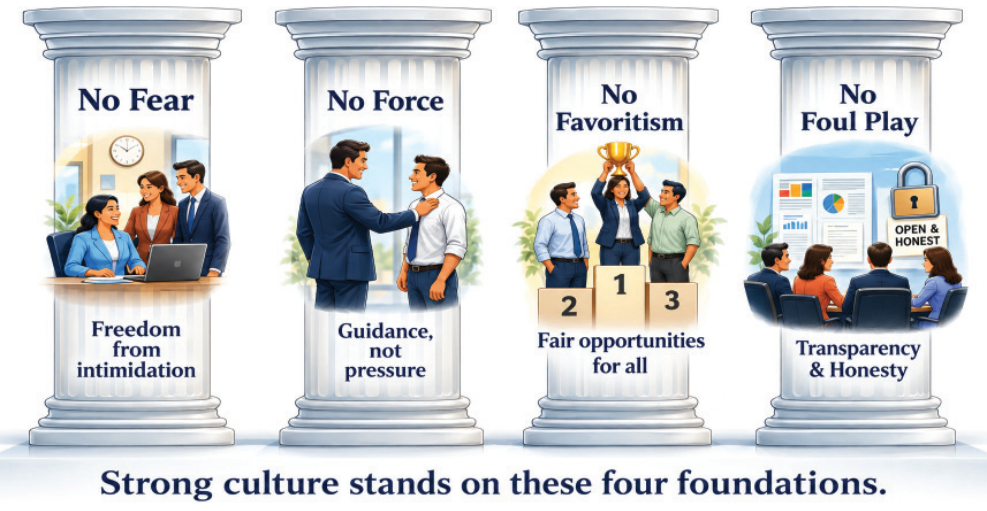
The Four “F’s”: A Simple but Powerful Framework
A healthy corporate culture does not need complicated theories. Sometimes, clarity comes from simplicity.
The foundation can be understood through four principles:
No Fear. No Force. No Favouritism. No Foul Play.
Each one addresses a common workplace issue.
No Fear Employees should not feel intimidated by work, by deadlines, or by seniors. Respect must exist, but without fear. Confidence grows only in a safe environment.
No Force Pressure may deliver short-term results, but it damages long-term potential. Employees should be guided, not pushed into unrealistic or unethical situations.
No Favouritism Fairness builds trust. When recognition and opportunities are based on merit, employees

stay motivated. Bias, on the other hand, quietly destroys morale.
No Foul Play Transparency matters. No hidden agendas. No internal manipulation. Clean systems create strong organisations.
Beyond Politics: Returning to Work Culture
Corporate politics often becomes part of the system, accepted, normalised, even expected. But it comes at a cost.
When politics dominates: • communication becomes indirect • energy is wasted • focus shifts away from work Remove politics, and the environment changes.
Work becomes central again. Communication becomes clear. Teams function better. There is discipline, but also openness. And slowly, performance improves.
Maximum Output, Minimum Friction
Every organisation wants better results.
But results do not come from pressure alone. They come from:
• clarity • transparency
• aligned systems • and mentally healthy employees When people are not distracted by fear or confusion, their energy flows in one direction, toward their work. That is where real efficiency lies.
Leadership: The Real Culture Builders
No system works without the right people behind it.
HR Head – the observer and protector of culture. Policies must not just exist, they must be practiced fairly and consistently.
CEO – the tone setter. Quick decisions, clear communication, and visible accountability define leadership strength.
Upper Management – the bridge between strategy and execution. They ensure that values are not lost in translation.
HODs and Line Managers – the daily influence. Employees experience the organisation through them. Their behaviour defines the real culture.
Conclusion: The Future of Corporate Nepal
Nepal’s corporate world is growing. That is clear. But growth
in size is not the same as growth in culture.
Real progress will be seen when organisations start giving equal importance to people, culture, and psychological safety. Expansion and infrastructure matter, but they are not enough on their own.
In the end, companies succeed because people perform. And people perform best when they feel safe, respected, and heard.
This responsibility does not belong to organisations alone. Stakeholders also play a role in shaping how people enter and experience the workplace.
A strong corporate culture is built when there is no fear, no force, no favouritism, and no foul play. If that foundation is right, performance will follow naturally.
Baral is a PhD scholar in Management. He is also the CEO of the Commercial Vehicles division at MAW Vriddhi, one of the largest automobile conglomerates in Nepal.