

Reforms in fiscal governance at the central stage
The state treasury’s limited resources have intensified discussions regarding the urgent need for reforms in fiscal governance, particularly concerning the efficacy of public expenditure.
Speaking at the Pre-Budget Discussions for Fiscal Year 2025/26, organised by the Management Association of Nepal (MAN) on May 3, Deputy Prime Minister and Finance Minister Bishnu Prasad Paudel emphasised that the upcoming fiscal budget will establish a significant precedent for enacting tangible transformations in fiscal governance.
“Rectifying the management of resources and expenditures is imperative,” asserted Paudel. “We must exercise discipline in handling public funds and will implement concrete reforms in governance.”
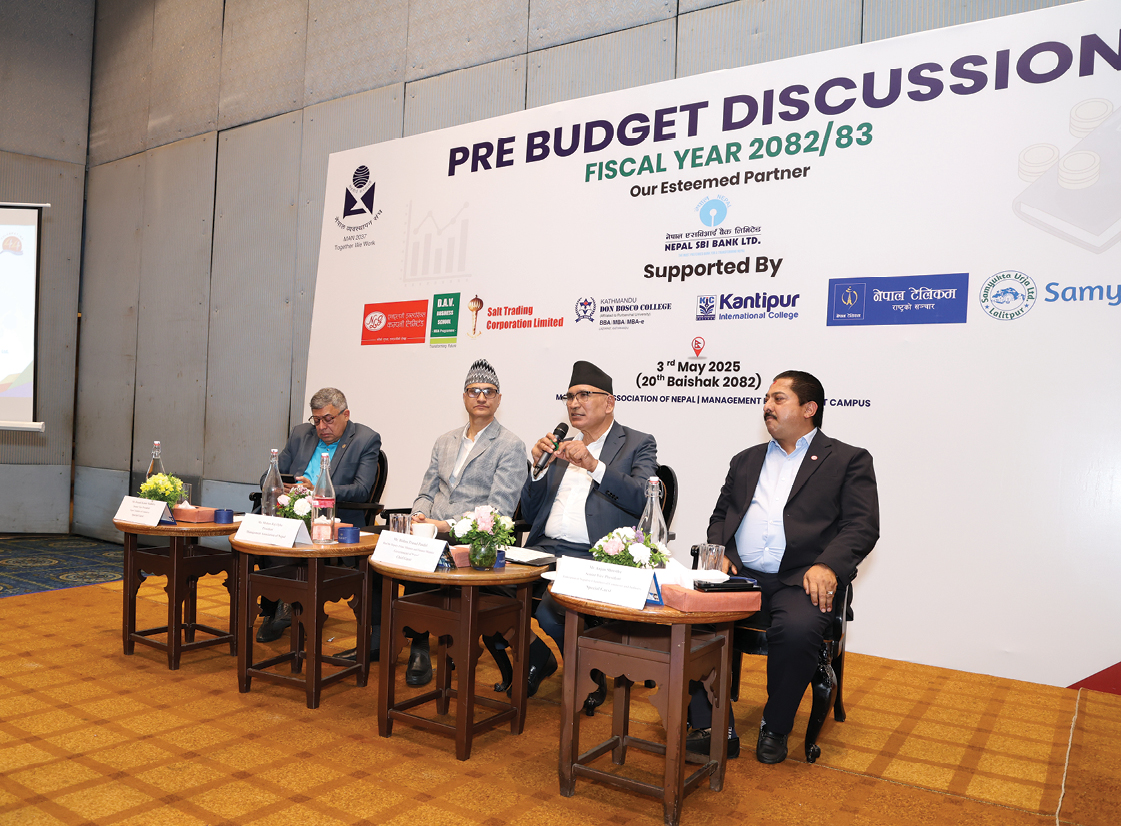 He further stated, “The government’s priorities include harnessing the advantages of ICT by integrating digitalisation across all economic sectors, developing human capital, establishing robust forward and backward linkages within the production sector, incentivising and fostering innovation in exports, reducing logistics costs, and accelerating infrastructure development.”
Reforming the investment climate to attract both foreign and domestic private investment is also a key priority. As part of these efforts, the government aims to be removed from the Financial Action Task Force (FATF) grey list.
Deputy Prime Minister and Finance Minister Paudel also highlighted the commitment to implementing the recommendations put forth by the High-Level Commission for Economic Reforms, led by Former Finance Secretary Rameshore Khanal and comprising representatives from the private sector.
“Given the evident contraction of our revenue streams, we must explore alternative financing mechanisms to realise our development objectives. Public-private partnerships (PPPs) have been a key focus of our efforts,” stated Deputy Prime Minister Paudel. “The government has recently formulated and introduced a Bill entitled the ‘Alternative Development Finance Fund’ in Parliament, which will facilitate the mobilisation of funds for development projects beyond the confines of the state treasury.” He expressed confidence that the government would establish a conducive environment to secure sufficient resources to bridge infrastructure deficits.
The Pre-Budget Discussion stands as a prominent event organised by MAN, convening representatives from diverse sectoral business and professional associations, alongside experts and academics, to solicit their insights and recommendations for the forthcoming fiscal year’s budget. Over 35 such associations were in attendance, in addition to various experts and academics. Deputy Prime Minister and Finance Minister Paudel acknowledged the highly productive, engaging, and thought-provoking discussions that preceded his address.
The programme was structured into three segments: inauguration, discussion and closing. In his opening remarks at the inauguration of the Pre-Budget Discussion, President of the Management Association of Nepal, Mohan Raj Ojha, extended a welcome to the guests and participants. He emphasised that the upcoming budget should tackle prevailing economic challenges through effective public spending, the provision of legal and regulatory facilitations for enterprises, and the creation of a favourable investment climate.
To frame the discussions, First Vice President of MAN, Suman Pokharel, delivered a presentation encompassing a broad spectrum of issues. He commenced by noting the current encouraging economic outlook, indicating a growing momentum in the present fiscal year, supported by political stability, legal reforms, and procedural simplifications aimed at reducing the cost of doing business. “Subdued public spending has amplified various adverse economic consequences, and the private sector remains hesitant to mobilise capital from the financial sector. Their inclination to seek loans appears to be waning, and banks and financial institutions are characterised by surplus liquidity,” observed Pokharel. “Consequently, the entire economy is experiencing a dearth of investment, leading to setbacks in infrastructure development, production and job creation.”
The presentation urged the government to accelerate economic reforms in response to sluggish credit growth, a weak real estate sector, crises in cooperatives and microfinance institutions, increasing non-performing loans, inefficient public spending, declining resources (revenue, foreign aid), and escalating public debt, among other issues. Moreover, it emphasised challenges in public finance management (PFM), including inefficient allocation, ineffective and delayed spending, inadequate intergovernmental coordination, poor infrastructure quality, political instability and frequent transfers of civil servants, resource misuse, capacity and planning deficits, and time and cost overruns in projects.
The ensuing floor discussion yielded valuable feedback, insights and recommendations. Speaking at the event, Shova Gyawali, President of the Federation of Women Entrepreneurs Associations of Nepal (FWEAN), advocated for enhanced access to finance and investment, women-centric business support, digital transformation and e-commerce initiatives, tax relief and incentives, improved market access and export promotion, greater government procurement inclusion, strengthened provincial and local-level coordination, and enhanced social protection and entrepreneur welfare, among other measures aimed at fostering women’s entrepreneurship nationwide.
Similarly, Dr. Rewat Bahadur Karki, Former Chairperson of the Securities Board of Nepal (SEBON), highlighted the growing recurrent expenditure that remains inadequately covered by revenue. He noted that the budget allocated for servicing the principal and interest on debt now exceeds capital expenditure. “Allocative efficiency is questionable, and the budget lacks credibility,” Karki stated.
Contributing insights for the upcoming fiscal budget, Nara Bahadur Thapa, Former Executive Director of Nepal Rastra Bank, implored the government to expedite the implementation of national pride projects with sufficient resource allocation. “Simultaneously, it would be prudent to curtail uneconomical expenditures,” Thapa mentioned. “Nepal has received a BB- country credit rating, which is commendable. However, this non-investment grade rating hinders the attraction of foreign direct investment. To elevate our rating to investment grade and attract both foreign and domestic private sector investment, we must prioritise improving the investment climate.”
Thapa further called upon the government to take decisive actions to exit the FATF grey list. According to Thapa, the government is under pressure to secure sufficient resources and must reconsider reducing non-essential expenditures to present a credible and feasible budget.
Automobile traders, the Land and Housing Development Association, and various other sectoral and professional associations also presented their feedback for the upcoming budget. Private sector umbrella organisations delivered their consolidated remarks, incorporating the inputs gathered from the floor discussions.
In his address, Deepak Malhotra, Vice President of Nepal Chamber of Commerce, stated that the economy is gradually recovering and expressed optimism that the budget for Fiscal Year 2025/26 would provide the necessary impetus for further momentum. “The private sector stands ready to collaborate with the government to accelerate economic growth through investments, production, and job creation. We urge the government to implement a prudent tax system characterised by utmost transparency and recommend raising the income tax threshold,” said Malhotra.
“Currently, Nepali producers are concerned that the excise duty on domestic production hinders their competitiveness in exports. The government’s announced policy of providing tariff exemptions to households up to a certain unit is a misguided approach driven by populism,” he added.
Malhotra pointed out the prevalence of unethical practices in land registration. “Given the already substantial 5% land registration tax and widespread undervaluation in land and housing transactions, lowering the tax rate could significantly improve compliance. If the rate were reduced to 1% or 1.5%, people would be more inclined to declare the actual transaction value,” Malhotra suggested. He also advocated for waiving land ceiling regulations for real estate companies to facilitate the development of housing and apartments, permitting foreign investors to purchase apartments, and allowing them to invest in Nepal’s capital market.
Finally, Malhotra urged the government to enforce the Mobile Device Management System (MDMS) to curb the grey market for mobile phones, estimating that effective implementation of MDMS could generate over Rs. 10 billion in annual revenue from mobile phone imports.
Addressing the Pre-Budget discussions, Anjan Shrestha, Senior Vice President of the Federation of Nepalese Chambers of Commerce and Industry (FNCCI), emphasised the necessity of a conducive investment climate to attract both domestic and foreign private sector investments. He further stated that the private sector in Nepal consistently champions a liberal and open economy that also guarantees social justice.
“It aspires to advance second-generation economic reforms, foster private sector growth, improve governance, and enhance the efficiency of public spending,” Shrestha remarked. “Looking forward, government spending must be impact-oriented, particularly in critical areas such as infrastructure development, reducing the cost of doing business, lowering trade logistics costs, and implementing transformative multipurpose projects.”
Shrestha further conveyed the private sector’s desire to deepen its collaboration with the government in the future to steer the economy towards a higher growth path through legal and procedural reforms, enhanced effectiveness of public spending, and the establishment of a favourable environment for both domestic and foreign private sector investments.

