



extreme events were framed as a grave warning to humanity.
When Prime Minister Balendra Shah walked to the podium at the 81st UNGA, he opened his address by highlighting the recent climate- induced, massive devastation in Nepal.
“I come before you from Nepal, a distant country in the Himalayas, carrying a close warning for humanity,” Shah told the Assembly.
His message was framed around the catastrophic flash floods that recently swept through Nepal’s mountain communities, causing loss of life, destroying infrastructure, and disrupting livelihoods. However, his speech went beyond the tragedy itself. Shah used the disaster to make a broader argument that the Himalayan crisis is no longer solely Nepal’s problem, and the international response to climate change must transition from mere pledges and procedures toward active preparedness, financing, and accountability.

FOLLOWING THE DEVASTATING transboundary flash flood of August 26 this year, which caused massive casualties and a colossal loss of infrastructure and private property across Rasuwa, Nuwakot, and Dhading districts, Nepal has been drawing global attention to climate justice, asserting that the country pays a heavy price despite its negligible contribution to global carbon emissions.
reconstruction and recovery cost at approximately $4,774.99 million. Indeed, the loss and damages caused by the Gyirong-Rasuwa flash flood equal roughly 15% of the nation’s GDP.
Scientific studies, including those published in Seismica, highlight that this cascading multi- event disaster, comprising an ice- rock collapse, mudslide, and glacial lake outburst, generated a massive flood surging downstream at speeds up to 165 km/h. This deluge washed away entire settlements, vital infrastructure (roads, ports, bridges, telecommunication towers, and power networks), schools, hospitals, public buildings, commercial enterprises, heritage sites, livestock, and agricultural lands.
The Prime Minister described the Bhotekoshi-Trishuli disaster as a wake-up call to the world and questioned whether that warning had truly been heard.
Despite maintaining 46% forest coverage and contributing a mere 0.1% to global carbon emissions, Nepal faces severe threats from accelerated glacial melt, erratic snowfall patterns, and permafrost thawing triggered by rising global temperatures. In recent years, the frequency and intensity of climate- induced disasters have escalated, dealing severe blows to the country. The Rapid Damage and Needs Assessment (RDNA) of the Rasuwa Bhotekoshi flood, conducted by the National Disaster Risk Reduction and Management Authority (NDRRMA), estimated the total
For Nepal, this represented a significant shift in emphasis. Climate vulnerability was presented not merely as an environmental concern but as a critical issue of development, finance, international cooperation, and justice.
Serious threat towards humanity
In the aftermath of the disaster, Nepal’s Prime Minister, Balendra Shah, addressed the 81st General Assembly of the United Nations, reinforcing the need for urgent action to minimise the severe impacts of climate change. These
A disaster without borders
One of the most striking elements of Shah’s address was his emphasis on the transboundary nature of Himalayan disasters. Himalayas and glaciers in Tibet
Some facts about Rasuwa-Bhotekoshi flash flood
HUMAN IMPACT AND RELIEF
1,455
Human casualties
13,795
Total rescued
17
Holding centres
1,085
People in holding centres
INFRASTRUCTURE DAMAGE
5,285 Missing/ unaccounted
636 Foreigners
Rs. 135 million Government cash transfer (as relief)
for 15 aff ected municipalities/rural municipalities
69 km Roads
443 km Drinking water pipeline
13 Hydropower
plants
4,800 Business enterprises
68 Suspension
bridges
7,570 Private houses
37 Motorable
bridges
48 Public buildings
18 Schools
7 Healthcare institutions
1,086 ha Cropping area
(irrigated agricultural land: 697.05 hectares included)
17 Bank and
financial institution
branches
INFRASTRUCTURE DAMAGE
Transmission line and substations • Trishuli 3B 220 kV Substation • Matatirtha-Chilime hub 220 kV • Trishuli 3B Hub 132 kV • Chilime-Matatirtha 66 kV • Switchyards of Chilime Powerhouse • Upper Trishuli 3A Powerhouse and Devighat Powerhouse
LOSS, DAMAGES AND RECONSTRUCTION NEEDS
Rs. 723.21 billion Reconstruction and recovery needs Rs. 274.48 billion (Physical Damages) Rs. 133.80 billion (Economic Loss)
Rs. 408 billion Total loss and damages
6.69% Total loss and damage share in national GDP 11.84% share in national GDP
As of October 3, 2026 Source: National Disaster Risk Reduction and Management Authority and Independent Power Producers Association)
and Nepal pose severe threats to downstream areas in Nepal and India. The recent flash flood originated in Tibet after a glacial lake burst, triggered by a massive ice-rock collapse and heavy mudslide near Mt. Langtang along the Nepal-Tibet border.
The disaster clearly demonstrated how hazards originating in high mountain regions can cross political boundaries and impact downstream communities. Shah argued that climate change, glaciers, and floods do not recognise national borders.
“Glaciers and floods do not travel with a visa stamped on passports,” he said.
The metaphor captured a central challenge facing the Hindu Kush Himalaya. While environmental systems operate across borders, governance remains largely confined within them.
Shah therefore proposed a trilateral Himalayan Climate Resilience Mechanism involving Nepal, India, and China. The proposed mechanism would facilitate the sharing of satellite data and technical expertise, the monitoring of dangerous glacial lakes, the establishment of stronger joint early-warning systems, and a coordinated disaster response.
If pursued, the proposal could represent a practical dimension of Nepal’s climate diplomacy. Rather than addressing Himalayan climate risks exclusively through global climate negotiations, it would place greater emphasis on regional cooperation among nations sharing the mountain ecosystem and its river systems.
The Prime Minister’s proposition was clear. The Himalayas should become a laboratory of international cooperation, rather than a frontier of fragmented information.
From climate vulnerability to development emergency
Nepal’s argument at the UN was also deeply rooted in the developmental consequences of climate disasters. Prime Minister Shah noted that while Nepal contributes less than 0.1% of global carbon emissions, its glaciers are retreating, its mountain slopes are becoming increasingly unstable, and its river systems are growing less predictable.
For a country still struggling to build basic infrastructure and expand productive employment, a major disaster carries consequences that extend far beyond immediate humanitarian relief.
Roads, bridges, schools, homes, farms, and businesses can be wiped out within hours. Hydropower plants and other vital infrastructure can also be severely damaged precisely when Nepal needs greater investment to accelerate its economic transformation.
This creates what Shah described as a development emergency. Every major climate- related disaster risk reversing years of hard-won progress. A country operating with limited fiscal space may then be forced to borrow funds to rebuild infrastructure destroyed by a crisis to which it contributed virtually nothing. That
argument lies at the very heart of Nepal’s demand for climate justice.
Six ‘R’, the world should acknowledge
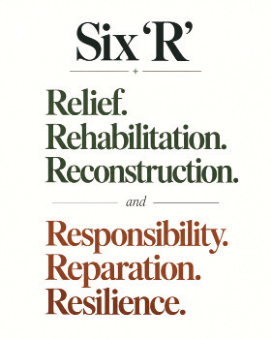
Perhaps the most memorable formulation in the speech came when Shah reduced Nepal’s demands to six words:
Relief. Rehabilitation. Reconstruction.
and Responsibility. Reparation. Resilience.
The first three, he explained, are what countries require after a disaster. The latter three are necessary to prevent disasters from becoming a permanent condition.
This formulation moves the discussion beyond emergency relief. Nepal has traditionally approached disasters primarily through humanitarian assistance, reconstruction grants and development finance. Shah’s UN address sought to place the issue within the broader architecture of loss and damage, climate finance and historical responsibility.
He argued that a climate- related disaster in a poor country should not result simply in another large loan or a collection of fragmented grants. Nepal wants greater access to grant- based international support and argues that existing mechanisms, including the Loss and Damage Fund and other climate-finance instruments, remain inadequate relative to the scale of vulnerability.
His criticism was directed not only at the volume of finance but also at the way climate finance is delivered.
“When the house is burning, we do not ask the family to complete 50 forms. We act,” he said.
That line distilled a longstanding concern among climate-vulnerable developing countries: accessing international
climate finance can involve complex procedures, institutional requirements and long approval processes, while climate disasters require immediate action.
Climate justice is more than fund
Shah also broadened the meaning of climate justice. He described it as distributive justice – who bears the costs; procedural justice – who has a voice; and intergenerational justice – whether future generations count equally. This is an important conceptual expansion. For Nepal, the climate debate is not simply about receiving financial compensation. It is also about whether countries with limited economic and political power have sufficient influence in decisions that affect their future.
The Hindu Kush Himalaya provides water, ecosystems, agriculture and livelihoods to nearly two billion people, according to the Prime Minister’s address. The consequences of changes in the region therefore extend far beyond Nepal’s borders.
This gives Kathmandu an opportunity to reposition Himalayan issues within the international climate agenda, not simply as a matter of national vulnerability but as a regional and global public-interest issue.
The geopolitical dimension
The speech also moved beyond climate change into a critique of the wider international order. Shah argued that the multilateral system is under strain and that military and economic power too often determines whose voice is heard. His criticism became particularly pointed when he contrasted global military logistics with the movement of basic necessities.
“Inter-continental missiles arrive on time. Rifles and ammunition cross borders, clear
every bottleneck, meet every deadline. But a peasant in Nepal cannot procure his fertiliser or fuel at market price at a time of need,” he said.
His broader argument was that the international system has developed highly efficient mechanisms for moving military hardware while remaining less effective in ensuring food, energy and other essential supplies reach vulnerable populations.
The Prime Minister linked this problem to Nepal and other South Asian countries, arguing that countries in the region are simultaneously confronting climate impacts and the consequences of conflicts and disruptions in global supply chains.
The underlying message was one of human security.
Security, in this formulation, is not simply about territory, military capability or geopolitical influence. It is also about food, energy, livelihoods, climate resilience and the ability of ordinary people to live with dignity.
Nepal’s diplomatic balancing act
The speech therefore carried a diplomatic message beyond climate negotiations. Nepal has traditionally had to navigate a difficult geopolitical environment between two major neighbours, India and China, while maintaining relations with major powers and multilateral institutions.
Shah was careful not to frame climate action as a confrontation between developed and developing countries. He explicitly said Nepal was not there to blame any country or continent or turn climate change into another geopolitical battlefield.
Instead, he invoked the principle of common but differentiated responsibilities and respective capabilities, already embedded in the international climate regime.
The diplomatic challenge is to convert that principle into practical cooperation.
The proposed Himalayan Climate Resilience Mechanism could become one such avenue if it develops beyond a diplomatic
CLIMATE RISKS DO NOT STOP AT NATIONAL BORDERS, MAKING REGIONAL COOPERATION ESSENTIAL FOR RESILIENCE, EARLY WARNING AND DISASTER RESPONSE.
proposal into a functioning platform for data sharing, early warning, scientific cooperation and disaster response.
For Nepal, cooperation among the three Himalayan powers could be particularly significant because climate risks do not stop at national borders. But the political and institutional complexity of such cooperation should not be underestimated.
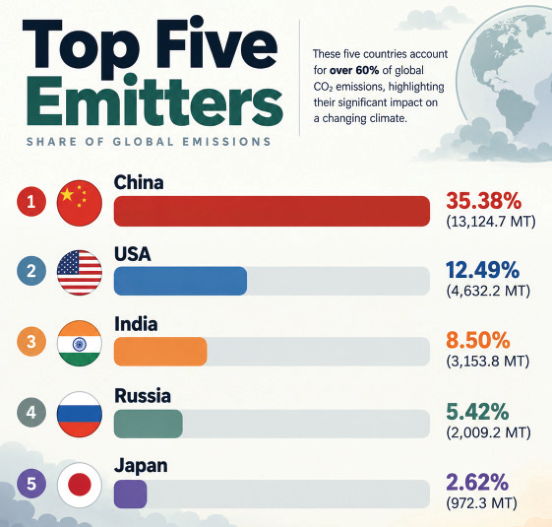
Top five emitters
China: 35.38% (13,124.7 MT) USA: 12.49% (4,632.2 MT) India: 8.50% (3,153.8 MT) Russia: 5.42% (2009.2 MT) Japan: 2.62% (972.3 MT)
Nepal’s own climate responsibility
Shah also used the speech to underline that Nepal is not asking the international community to act while doing nothing itself. He highlighted forest restoration, hydropower development, electric mobility and local-level climate adaptation as areas where Nepal is already taking action.
This is important for Nepal’s diplomatic credibility. The argument for climate justice becomes stronger when vulnerability is accompanied by demonstrable domestic efforts to reduce emissions, protect ecosystems and build resilience.
Yet, Nepal’s challenge is considerable. Its development needs are rising, its infrastructure remains vulnerable to extreme weather, and its fiscal capacity to absorb repeated disasters is limited.
Climate policy therefore has to be integrated into infrastructure planning, urban development, hydropower, agriculture, insurance, disaster risk management and public finance, rather than treated as a separate environmental agenda.
From response to preparedness
Perhaps the most practical message from the speech was the call to move from ad-hoc disaster response towards a culture of preparedness.
Nepal has repeatedly experienced the cost of inadequate preparedness, from earthquakes and floods to landslides, glacial lake outburst floods and other hazards.
The Prime Minister called for investment in insurance and innovation, stronger infrastructure and institutions, reduced fossil-fuel dependence, and systems capable of warning and saving lives.
This is where international climate diplomacy must eventually connect with domestic policy.
A Himalayan resilience mechanism can provide data. International climate finance can provide resources. Regional cooperation can improve early warning. But communities still need functioning institutions, evacuation protocols, resilient infrastructure, insurance coverage and reliable communication systems.
The ultimate test of climate policy is therefore not the number of international declarations but whether people receive a warning early enough to move to safety.
A new generation and a new global agenda
Shah also connected Nepal’s climate message with the aspirations of a younger generation.
He referred to the new government’s democratic mandate and the demand among young people for integrity, accountability, decent employment and opportunities at home.
The connection is significant. Climate change and employment are often discussed separately, but for Nepal they are increasingly intertwined.
Climate disasters can destroy livelihoods, infrastructure and
productive assets. At the same time, investment in renewable energy, resilient infrastructure, environmental services, technology and adaptation can create new economic opportunities.
The future of Nepal’s climate strategy therefore cannot be limited to adaptation expenditure. It must also ask how climate action can support productive employment, technological innovation, private investment and economic transformation.
From the rooft op of the world
Shah ended his address by returning to where he began: the Himalayas.
The message was simple but ambitious. The warnings emerging from the “rooft op of the world” should not be ignored until the next disaster makes them impossible to overlook.
Nepal’s UN intervention has placed three interconnected demands before the international community: greater climate finance, stronger regional cooperation and a more equitable multilateral system. Whether these demands translate into concrete international commitments will depend on what happens after the speech.
For Nepal, the next challenge is equally important: converting diplomatic rhetoric into a coherent national climate-resilience strategy, backed by evidence, institutions, financing and measurable targets.
The Bhotekoshi-Trishuli disaster has demonstrated that Himalayan climate risks are no longer distant projections. They are immediate development realities.
Nepal’s climate justice diplomacy
It is important for Nepal to stay engaged in international climate negotiations. Our diplomacy must be informed by science, economics and the finer points of North-
South contestations, including the interests that compete within, according to Rajib Upadhya, international relations analyst. “It must command the gravitas to speak authoritatively on issues that bind us in a shared cooperative endeavour, transcending the preferences or prejudices of individual nation-states.”
Climate justice will be served for Nepal when, collectively with the Global South, we will have arrived at optimal, binding trade offs between rights to grow and develop the Global North’s push for faster, bolder mitigation. Merely updating Nationally Determined Commitment (NDC) documents and revising them upward every COP to mirror the latest pie-in-the-sky funding assumptions will simply not cut it, as per Upadhya.
Nepal, India & China collaboration for preservation of Himalayas
Foreign Minister Shishir Khanal engaged in various forums and sideline meetings during the 81st UNGA, reinforcing Nepal’s climate justice diplomacy. Nepal has been eyeing allocations from the UN-backed Loss and Damage Fund, which was established under the Paris Agreement.
However, the Fund itself remains severely under-resourced as nations have turned a deaf ear to their replenishment commitments. Pledged claims have surpassed
$2.5 billion, whereas the total fund currently stands at around $250 million.
On top of that, Foreign Minister Khanal clarified that Nepal seeking climate justice does not mean pointing fingers at any single nation for its recent tragedy. Instead, he emphasised trilateral cooperation to mitigate the impacts of climate change.
“There is an even greater urgency to build that bridge,
António Guterres UN Secretary-General֤
THE GLACIERS ARE RETREATING, BUT WE CAN’T.
A cry from the rooftop of the world for action to avert the worst climate chaos
The roof-top of the world, Himalayas, are caving in. This tragedy is unfolding two perilous chapters. Phase one is the story of melting of glaciers and ice sheets. Record temperature means record glacier melt. Nepal has lost close to one-third of its ice in just over 30 years. Antarctica and Greenland are losing billions of tonnes of ice every year. Melting glacier mean swollen lakes and river flooding, sweeping away entire communities. And seas rising record rates, threatening coastal communities across the globe. The crisis is gaining speed. Nepal’s glaciers melted 65% faster in the last decade than they had in the previous one. That means phase two of this tragedy looms ever larger, the disappearance of glaciers altogether. Glaciers are icy reservoirs – the ones here in the Himalayas supply fresh water to over a billion people. When they shrink so do
river flows. In the future major Himalayan rivers like the Indus, the Ganges, the Brahmaputra could have massively reduced flows. Combined with saltwater intrusion that would decimate deltas. That spells catastrophe. Low-lying countries and communities erased forever; millions of people on the move and fierce competition for water and land; and floods, droughts and landslides accelerating worldwide. I’m here to cry out from the rooft op of the world; stop the madness. The glaciers are retreating but we can’t. We must end the fossil fuel age. We must act to protect the people on the frontline; and to limit global temperature rise to 1.5 degrees to avert the worst climate chaos. The world can’t wait.
(A message delivered by the UN Secretary- General a few years back from the Mt. Everest region of Nepal.)
an urgency created by nature itself. Our ecosystems are deeply interconnected. Snow-fed rivers emerge in the mountains of China, flow through Nepal, and eventually reach India. When disasters occur upstream, the consequences are ultimately felt by people downstream,” Khanal told The HRM Nepal.
“Scientists estimate that the rivers originating in the Himalayas serve as a source of freshwater for around two billion people. As glaciers melt faster and we lose snow cover in the mountains over longer periods, the availability of freshwater for more than two billion people could be seriously threatened. This is a challenge of enormous scale.”
Highlighting the fundamental dimension of our regionally interconnected civilisation, he stated, “Our cultures, traditions, and Buddhism have historically connected the people of China, Nepal, and India. There may be
political differences. There may be disputes over borders and boundaries. Those differences are real, and they should be addressed through appropriate platforms and forums.”
Stating that the Himalayan civilisation and ecosystem are at risk, Foreign Minister Khanal appealed to both of Nepal’s neighbours to build shared knowledge of this interconnected environment: “We need to understand the Himalayas together, share data and scientific knowledge, strengthen early-warning systems, and develop common approaches to disaster preparedness and climate resilience.”
“Only through greater cooperation can we build a resilient ecosystem capable of protecting the Himalayas, and, in doing so, protecting the lives and livelihoods of hundreds of millions of people downstream,” he remarked.
Climate scientists report that Himalayan glaciers have receded
At the same time, Himalayan meltwater discharge is projected to peak by 2050, after which it will gradually decline, subjecting vulnerable downstream communities and ecosystems to even graver humanitarian, ecological, and economic risks. Consequently, countries like Nepal and India require comprehensive collaboration to address these challenges and preserve these vital water towers for future generations.

